


(In the previous post [Panic, Great Depression, Bubble] we dealt with somewhat gloomy and heavy economic topics, so this time let’s change the mood a bit and talk about a more pleasant subject in economics: the moment when the economy becomes most vibrant, namely an economic boom.)
In an economy, there are always rises and falls. At certain times companies make money, jobs increase, and people open their wallets widely. We call this period a boom.
Especially in the modern economy that moves within the global economic system, domestic/export cycles influence each other and create economic booms. In this article we will examine how booms begin and how domestic and export cycles move the entire economy.
Where Does a Boom Begin — The Connected Structure of Domestic/Export Cycles
In economics, a boom does not suddenly appear like a Great Depression or the collapse of a bubble. Rather, in many cases it forms gradually as various economic factors accumulate.
Usually a change that begins in a particular industry or export market spreads throughout the economy through investment and consumption. In this process, domestic/export cycles interact with each other and expand.
Why Exports Move First
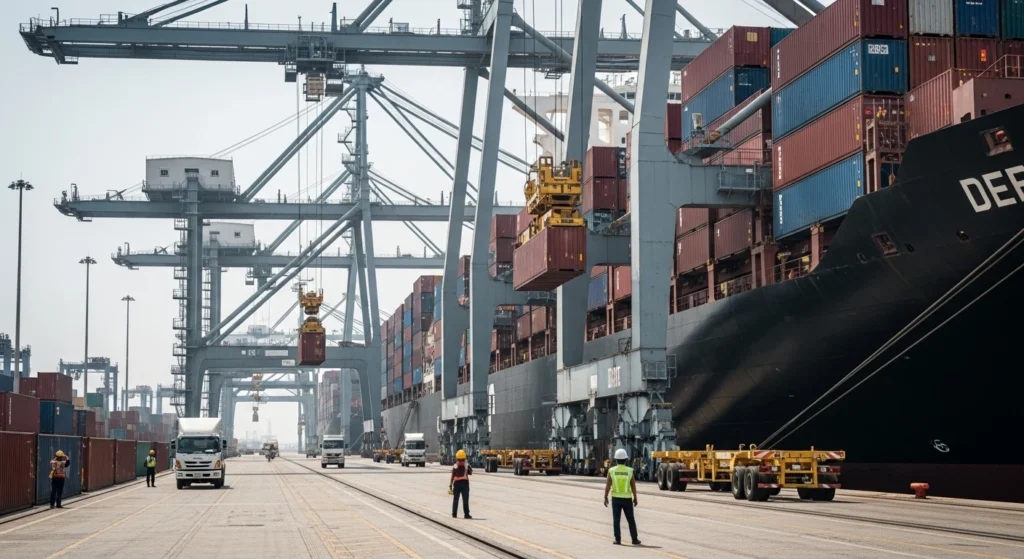
In many countries, the starting point of a boom is exports. Especially in countries with a strong industrial base, when overseas demand increases, the engine of the entire economy begins to run.
(Additional knowledge = there are countries where a boom can occur through domestic demand alone, and there are countries that rely heavily on exports for economic activity. This does not mean they live only on exports, but rather that their dependence on exports is relatively high.)
- Domestic demand (domestic shopping — meaning that Koreans eat meals in Korea, buy clothes in Korea, and purchase Korean-made machinery needed for Korean factories)
- Exports (overseas sales — literally selling goods produced within one’s own country to other countries)
Domestic-demand-based economies
(Because the land area is large and the population is in the hundreds of millions or even billions, a boom can occur through domestic consumption alone.)
- United States (about 349 million people)
- China (about 1.4 billion people)
- India (about 1.44–1.46 billion people)
Export-oriented economies
(On the other hand, countries with smaller land areas or populations — especially those strong in manufacturing — tend to be more influenced by exports.)
- South Korea (Samsung semiconductors) (~51 million people)
- Germany (Mercedes-Benz, Audi, BMW) (~83–84 million people)
- Netherlands (ASML) (~18 million people)
The Second Wave Created by Expanding Investment
When exports increase, companies naturally expand investment. They expand factories, introduce new equipment, and improve logistics systems.
In this process, companies that manufacture machinery, construction firms that build factories, and logistics companies all begin to move together. In other words, a change that begins in one industry spreads into many other industries.
(For example, suppose a company wants to start a glass manufacturing business. It must purchase land to build a factory, hire a construction company to build the facility, order machines and equipment to produce glass, purchase raw materials for glass production, sign contracts with logistics companies to deliver finished products, hire various workers for operations, and coordinate with power companies, network providers, maintenance services, and many other industries.)
In economics, this phenomenon is called the investment ripple effect.
Consumption Expansion Creates the Boom
When companies make money, the next change that appears is wage increases. Companies pay bonuses, raise salaries, and increase hiring.
At this point, workers’ wallets become thicker. People begin to eat out, travel, and purchase new goods.
As consumption increases, the domestic economy becomes more active.
The structure can be summarized as follows:
Exports increase → investment expands → consumption increases → domestic economy rises → economic boom
Domestic Economy — Another Pillar That Supports the Economy
Just because exports are important does not mean the role of the domestic economy is small. In reality, for an economy to grow stably, domestic/export cycles must move together.
The domestic economy literally refers to consumption and investment activities that occur within a country.
Consumption Demand and Investment Demand
There are two key pillars in the domestic economy: consumption demand and investment demand.
Consumption demand refers to ordinary citizens buying goods and using services. Eating at restaurants, buying clothes, or replacing a smartphone all fall into this category.
Investment demand refers to companies purchasing machinery or equipment for production. Building factories or introducing new equipment also belongs to investment demand.
(The investment mentioned here is not the same concept as stock investing or ETF investing that people commonly talk about. The investment discussed here is an economic term meaning companies purchasing machines or facilities for production.)
The core of economic fluctuations used to be investment alone!
Economists have long argued that the main cause of economic fluctuations lies in investment demand. Consumption tends to remain relatively stable, while investment changes greatly depending on economic expectations.
If companies expect good economic conditions, they invest aggressively. They build factories, increase production, and hire more workers.
However, if the economic outlook worsens, companies postpone investments and reduce production. This change has a significant impact on the entire economy.
But now, consumption has also become important in the modern economy. Why is that?
In the modern economy, a large portion of consumption is not essential consumption but optional consumption. Because of this, changes in asset prices have a greater influence on consumption behavior.
Let’s take a closer look.
In the past, consumption was relatively simple.
(The “past” here refers to times when services and goods such as OTT platforms, smartphones, cars, and travel were far more limited than they are today.)

- Food needed for three meals a day
- Clothes for commuting
- Toothpaste and toothbrush needed for brushing teeth
- Medicine needed when sick
These were necessities that were difficult to reduce even when the economy was bad.
However, in the modern economy the structure of consumption has changed dramatically.
Today there are many areas where consumption is optional.

- Travel
- Cars
- Smartphones
- OTT services (Netflix, Amazon, Disney, etc.)
- Music festivals like Ultra Music Festival
- Hobbies (fishing, music, car tuning, etc.)
These are not essential spending but discretionary spending.
Therefore when conditions worsen, people may reduce consumption such as:
- Cancelling OTT subscriptions
- Cancelling travel plans
- Delaying smartphone upgrades
- Postponing car purchases
When changes in asset prices are added to this, consumption becomes even more sensitive.
For example, suppose the price of your house or the stocks you own suddenly rises several times.
You might shout:
“Wow, I’m rich!”
Even if you have not yet converted the gains into cash, you might immediately purchase the Eminem concert ticket that was sitting in your online shopping cart.
But what if house prices and stock prices fall?
You might say:
“Hmm… maybe next time for the Eminem concert.”
and postpone the spending.
This phenomenon — where asset price changes affect consumer behavior — is called the Wealth Effect in economics.
And there is another reason why this effect has become stronger.
In the past, far fewer people participated in financial markets such as stocks and real estate. Today, participation has become widespread, to the point that almost everyone around you may be involved.
As a result, changes in asset prices have a much larger impact on consumer psychology.
To summarize in one sentence:
In the past, most consumption consisted of essential spending, so it did not fluctuate greatly with economic conditions. But in the modern economy, discretionary consumption has increased and asset price changes influence consumer psychology, meaning consumption demand now has a much greater effect on economic fluctuations.
Because of this, when consumption decreases in modern economies, company revenues immediately fall, leading to reductions in investment and employment, which then rapidly affect the entire economy.
In the end, the key forces that move the domestic economy are corporate investment demand and people’s consumption demand.
Export Economy — The Growth Engine Connected to the Global Economy
In the modern world, many economies are deeply connected to global markets. Therefore the export economy has a significant influence on the entire national economy.
The Impact of Exports on the Economy
Products produced by companies move toward two markets. One is the domestic market, and the other is the overseas market.
The domestic market has certain limits determined by a country’s population size. For example, suppose a Spanish company sells products only within Spain. Since Spain’s population is around 50 million, the potential market size is naturally limited.
However, once companies turn their attention overseas, the situation changes completely. When entering the global market, they can sell products to roughly 8.2 billion consumers.
This is precisely why exports are so important.
When products begin selling well in overseas markets, companies increase production. As production grows, factories run more intensively and more workers are needed. Employment naturally increases.
As employment increases, wages and income rise, and companies invest more in new factories and equipment.
As a result, when exports improve, production, employment, and investment increase in a chain reaction. For this reason many countries say exports act as the engine of the economy.
(Of course, the domestic economy is also extremely important.)
The Balance Between Exports and Domestic Demand
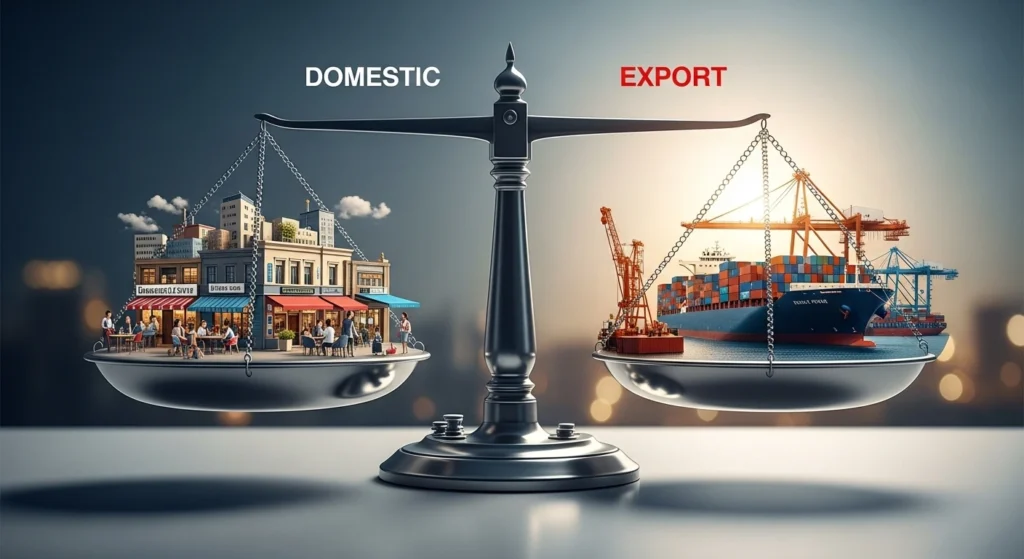
For an economy to grow stably, domestic/export cycles must remain balanced.
An economy that relies only on exports can become vulnerable to external shocks. On the other hand, an economy that tries to grow only through domestic demand may face limits due to the size of its internal market.
(For countries where domestic demand alone is insufficient, exports become extremely important. If countries that import goods suddenly reduce imports, or if events like wars or financial crises occur, people may find themselves unable to afford foods they once regularly enjoyed.)
The Connection Between Booms and Domestic/Export Cycles
Ultimately, a boom is not created by a single cause.
When global demand increases, exports increase. When exports increase, companies invest and expand employment.
As employment grows, people’s incomes rise. Those incomes then turn into consumption, activating the domestic economy.
When domestic/export cycles connect in this way and lift the entire economy, we call that moment an economic boom.
An economic boom is not merely an increase in numbers. It is a moment when factories, businesses, and people’s wallets all begin moving together, bringing vitality to the entire economy.
