

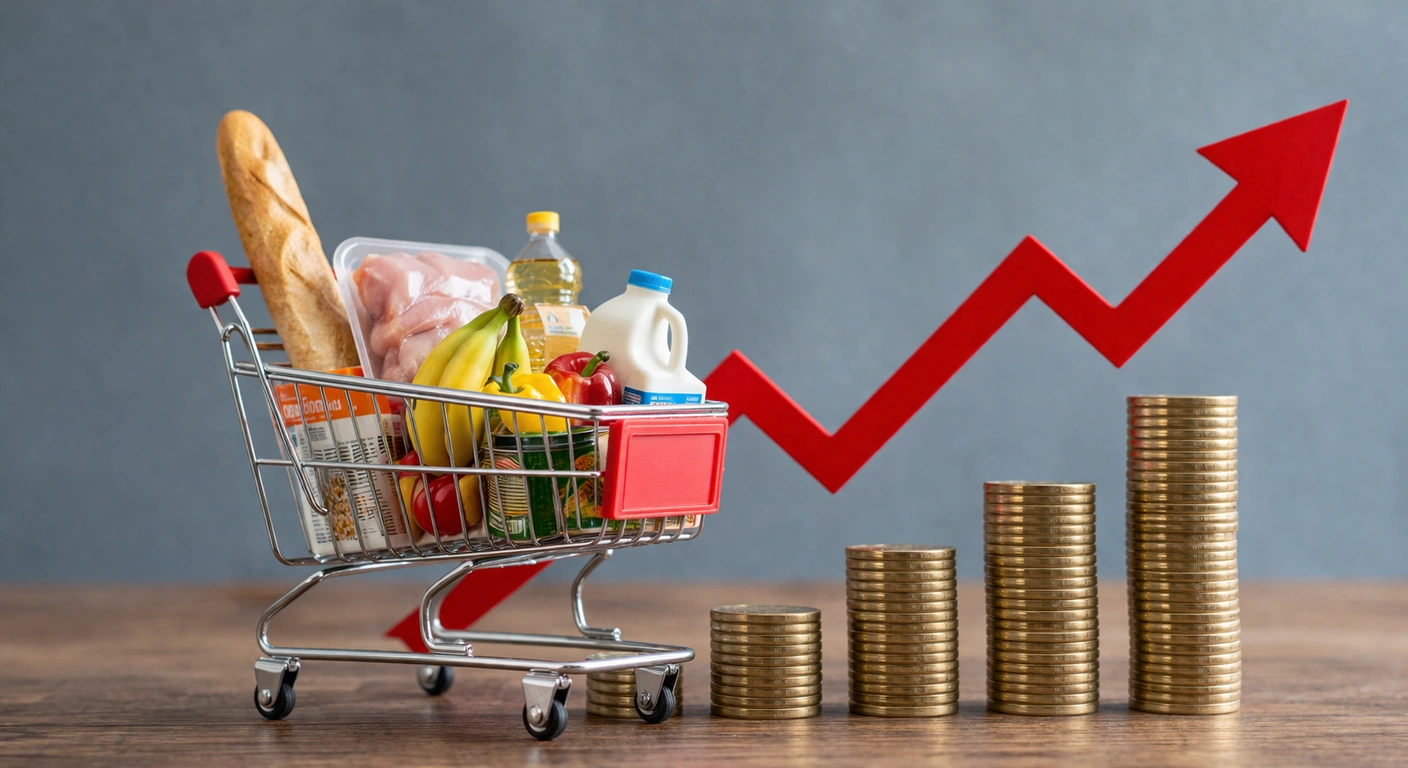

There is a phrase that often comes out of our mouths.
“Prices have gone up so much…”
“My salary is the same, so why are only prices going up? Why?”
“Huh? What? Since when did beer get this expensive? It went up by a whole 1,000 won?”
That is inflation.
But even though we go around saying, “Prices went up… it’s inflation…,” if someone were to stop you and ask,
“What exactly is inflation?”
“Why does inflation happen?”
“Why do prices rise?”
would you be able to answer right away?
I think most people probably could not.
I was like that too. In that kind of situation, I feel like I would shake them off and run away.
In reality, there is not much that we understand in depth.
Do we not just simply think, “Prices went up…” and leave it at that?
(If any readers feel that I am being rude, then you are probably already someone who knows about inflation.
I think you already have enough economic knowledge that you would not need to read this article)
I used to be like that too.
“So what if prices went up? Why is everyone making such a fuss?”
“Did anyone die? We are still alive, aren’t we?”
“What is the big deal? It only went up by a few hundred won or a few thousand won.”
That was how I thought.
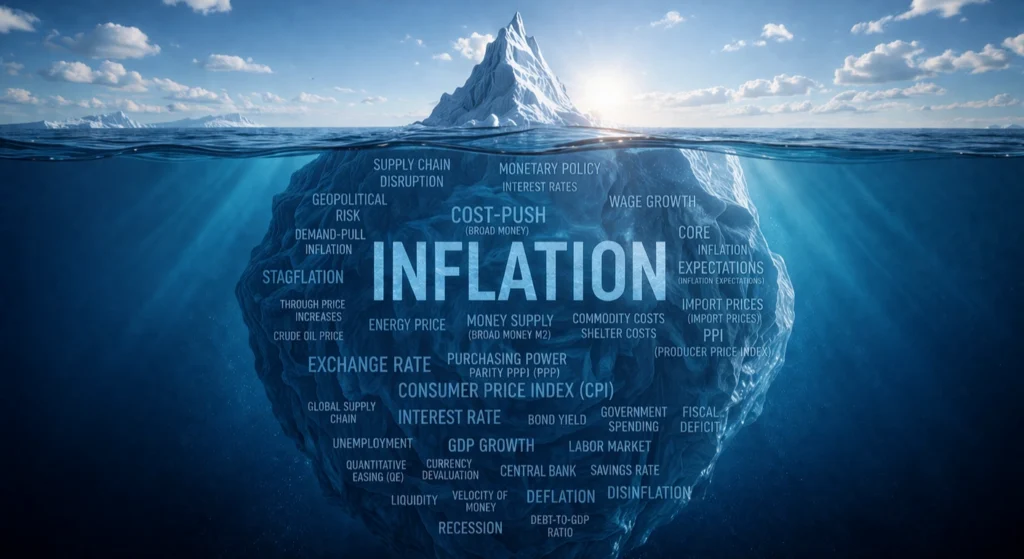
But when I looked into what was really inside rising prices, what I knew turned out to be only the tip of the iceberg.
The danger of inflation, and how much rising prices can affect us, gradually started to feel real to me.
I started seeing things I could not see before.
That is why we need to learn.
- Why prices rise,
- who the real culprits are that directly push prices up,
- what kind of direct effects rising prices have on us,
- how much the value of my money changes depending on the inflation rate,
- and what the state does when prices rise.
In this article, we will throw out these questions one by one and take a look together at the things that are closely related to inflation.
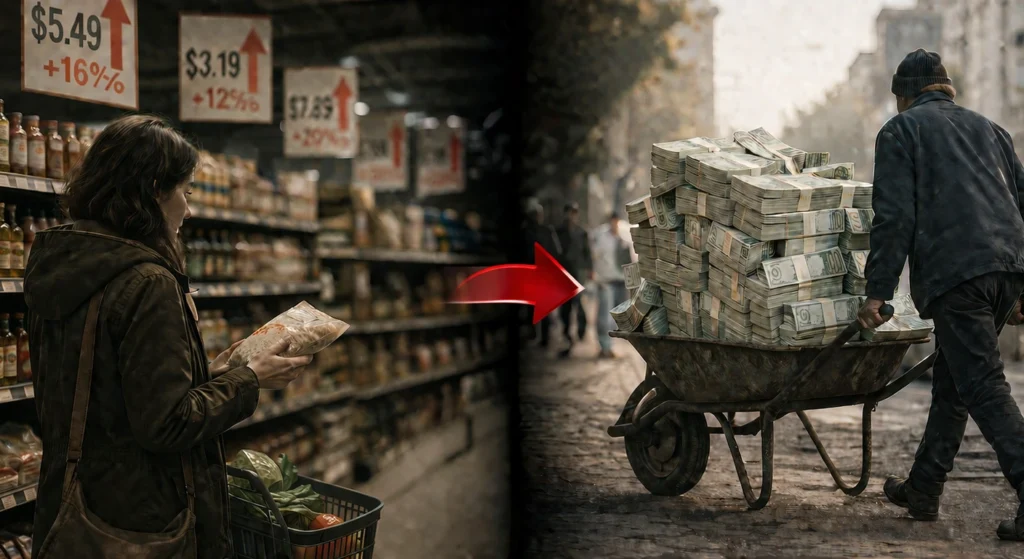
Changing the Perspective: Not Rising Prices, but Falling Currency Value
Before understanding what inflation is, there is one thing I would first like to recommend to readers.
That is to “change your perspective”.
Up to now, we have looked at inflation only as “rising prices.”
But from here on, instead of focusing on rising prices, try reading the text below with your focus on the falling value of money.
Then, even when looking at the same content, it may feel very different.
Even if it does not fully click right away, that is fine.
At the very least, just remember that inflation is not simply rising prices, but something that is also connected to the falling value of money.
Once the perspective changes, the way you see things will also change.
What Is Inflation and Why Does It Happen?
First of all, inflation means rising prices.
Put simply, prices are the prices of goods or services.
For example, let’s say that in the past you could buy one apple with 1 dollar, but after some time passes, you can no longer buy one apple with 1 dollar, and now you have to pay 2 dollars to buy one apple.
That is not simply that the price of apples went up.
It means that what you can do with 1 dollar has decreased,
in other words, the value of money has fallen.
That is inflation.
And prices do not refer only to things that we can see with our eyes or touch with our hands.
● Going to a hair salon and getting a haircut
● Paying a delivery fee
● Buying an airline ticket or accommodation
Things like these may not have a physical form, but because you pay money and consume them, they are all included in prices.
In other words, inflation is not just supermarket item prices going up, but
the prices of things across our whole daily lives going up.
Then why does inflation happen?
It is difficult to point to just one single cause of inflation.
Unless a president suddenly says,
“I will give free money to the entire nation! Just trust me!”
or countless workers say,
“We cannot work any longer unless you raise our wages! We are going on strike right now!”
and things become that extreme, inflation in reality occurs because of several factors.
The causes are really diverse.
The contents below are not in order of importance, but are a summary of representative causes.
👉 Economic boom
If you, me, our families, friends, neighbors, and coworkers are all making money well and start buying all sorts of things, supply will fail to keep up with demand. Then that affects rising prices.
👉 Rise in *raw material prices
Raw materials are the starting point for making goods and services.
Oil brought in from the Middle East is needed for transportation such as cars, ships, and airplanes, and even the vinyl, PET bottles, plastic, clothes, toys, and some medical equipment that we actually use are made through oil.
And when you consider metals used to make cars, as well as livestock needed for hamburgers or barbecue, you can see that there are truly many different kinds of raw materials.
If disruptions occur in so many kinds of raw materials, rising prices become only a matter of time.
(raw material : raw materials refer to the most basic materials before a product is made. Simply put, they are the starting point of materials needed before a factory makes something. For example, oil, iron ore, copper, wheat, and timber are raw materials)
👉 Increase in money supply
If a lot of money is released into the market, inflation can occur.
Examples include interest rate cuts or large-scale issuance of currency.
👉 Wage increases
From the employer’s point of view, if more money is going out as wages, they will try to make up for that cost somewhere else.
Then where will they make it up?
By raising product prices.
And that is not the end of it. Workers whose wages have risen may also increase their spending.
If that kind of flow overlaps, it can affect inflation.
👉 Imbalance between supply and demand
As the phrase itself says, if the balance between supply and demand breaks down, it affects inflation.
If there are more people who want to buy than the speed at which products are produced, prices naturally go up.
👉 Exchange rate
Imported items from overseas can become more expensive because of the exchange rate.
Let us say that in the past, 1,000 Korean won could be exchanged for 1 U.S. dollar, but because the value of the Korean currency fell, it now takes 1,476 won to buy 1 U.S. dollar (as of 2026-04-08).
In other words, compared with the past, more Korean won is needed to buy the same 1 dollar, and that means the burden of the price of raw materials or parts brought in from overseas also becomes greater.
Countries like Korea, which cannot solve everything on their own, have no choice but to import many raw materials and parts from overseas, so when the exchange rate rises, the prices of imported goods overall are bound to become more burdensome.
In the end, companies that use overseas parts see their production costs rise, and that burden can lead to higher product prices.
👉 Oil price increases / war
Oil is both a raw material for many products and the core of transportation.
So if oil prices rise or war shakes up supply chains, it has a huge effect on real life.
When that kind of situation happens, inflation can make life even harder for us.
👉 Other things
Natural disasters, supply chain problems, and inflation expectations can also affect inflation.
As you can see, there are too many causes of inflation.
So while we can talk about relative weight, it is difficult to explain it by looking at only one problem.
And prices do not move separately from one another. They are connected.
When one goes up, prices on the other side can shake as well.
Let’s go further down and see why.
What Kind of Effect Does Inflation Have on Us?
Put simply, it means that what you can buy with the same amount of money gradually decreases.
You probably do not need a long explanation for this, because readers are already feeling it themselves.
But there is probably at least one question like this that people have had.
“Prices went up… but why are the food and daily necessities we eat and use going up, and what does that have to do with it?”
The reason inflation feels like a direct hit to our lives is that price increases do not end in just one place.
Let’s look at a simple example.
If the price of imported raw materials or energy rises,
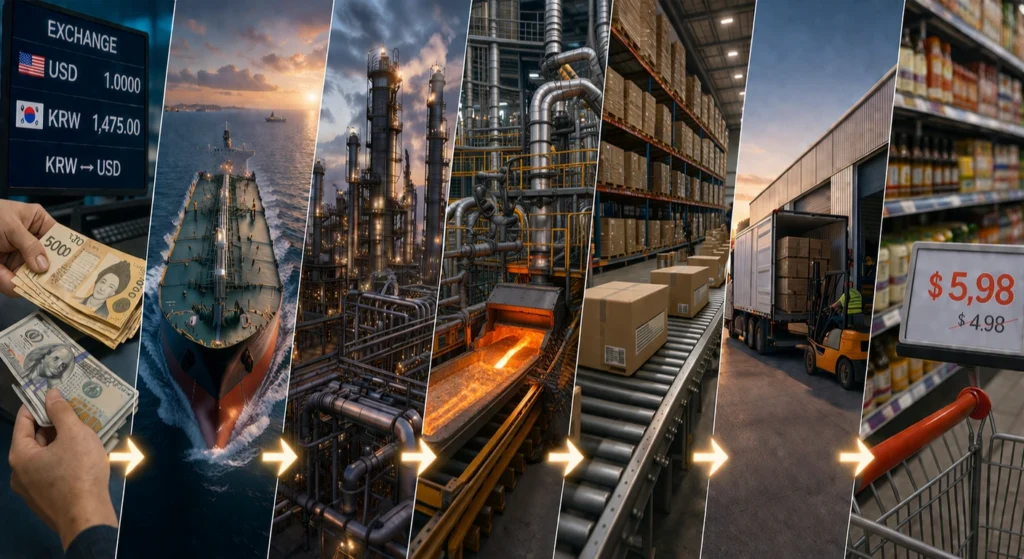
increase in import costs ▶ increase in ship and truck transport costs ▶ increase in refining and processing costs ▶ increase in factory production costs ▶ increase in packaging and storage costs ▶ increase in logistics costs to send goods to marts and stores ▶ increase in final selling price
(If the raw materials or energy are domestic, then currency exchange is not needed, and transportation costs from overseas are also removed, so they can be relatively cheaper than imported goods)
This kind of flow can follow.
If exchange rate increases, wage increases, and other factors are added on top of that, the costs companies have to bear become greater, and these increased costs are reflected in the prices of the beer, meat, pasta, pancakes, and all kinds of daily necessities that we buy.
On top of that, the burden of utility bills such as electricity and gas can also increase.
In the end, one price increase pushes up other prices in succession, affecting the whole of grocery shopping and living expenses.
If you have been continuously keeping a household account book,
try comparing 1 year ago, 5 years ago, 10 years ago, and 20 years ago with now.
You will be able to see at a glance how strongly inflation is felt.
The State’s Efforts to Control Inflation
If inflation is getting severe as the economy overheats, then this is where the central bank appears.
In order to protect the value of money,
and to help ordinary people like us maintain a somewhat more stable life,
the central bank brings out the card called “interest rates”.
If the economy seems overheated, it tries to slow the pace of rising prices and falling currency value through raising interest rates, increasing the burden of loans and cooling consumption and investment.
In a way, interest rates play the role of the brakes of the economy.
But interest rates are not all-powerful.
For example, there are problems such as natural disasters, war, oil price surges, and supply chain disruptions that are hard to solve with interest rates alone.
That is because these are not problems that end simply by adjusting the flow of money.
If a natural disaster occurs, the government has to focus on recovery so that farms and businesses can supply again,
and in situations like war or oil price surges,
it has to keep oil in reserve,
shift import sources to other countries,
or put more effort into international exchange and diplomacy.
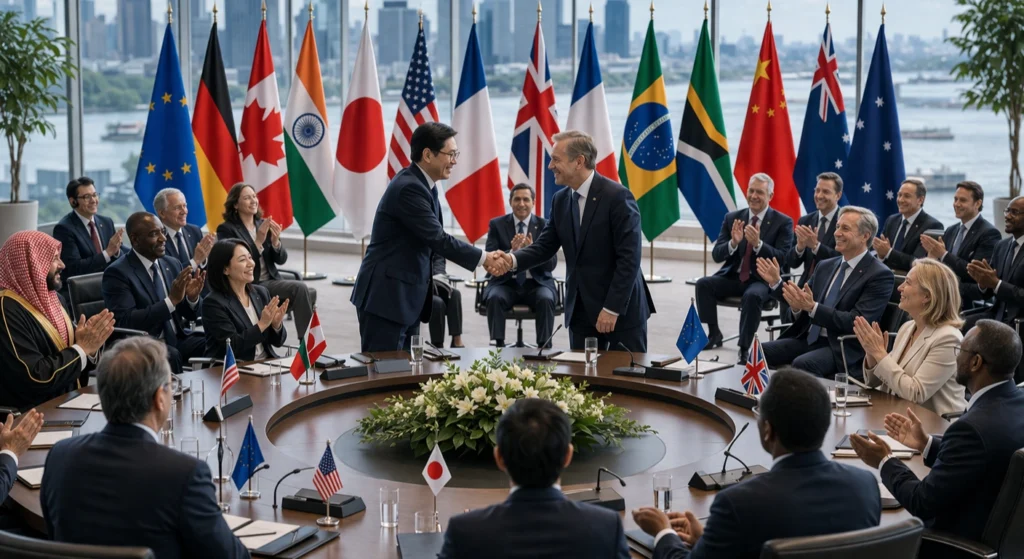
In this way, the government and the central bank continue responding in their own ways so that inflation does not overheat.
Misunderstandings and Reality Surrounding Inflation
Inflation cannot be seen simply as the phenomenon of goods becoming more expensive.
Only when you understand together why a moderate rise in prices is necessary, what relationship interest rates and stock prices have, why prices that go up once do not easily come back down, and the difference between prices that last a long time and prices that shake quickly, does the reality of inflation begin to come into view properly.
It Is Not True That Rising Prices Are Only Bad
The decisive reason is that prices rising a little, slowly, means that the economy is not in a completely stopped state.
There has to be a flow where people work, earn money, companies make goods, and investment also happens, for prices to move little by little.
On the other hand, if prices keep not rising or only keep falling, people think,
“If I buy it later, it will be cheaper, right?”
and postpone consumption,
and companies also think,
“It won’t sell…”
and are more likely to reduce investment and hiring.
So central banks generally try to keep inflation around 2%.
That is because this is a level at which a relatively stable growth flow can be expected.
If we compare it to the human body, prices are like body temperature.
If body temperature is too high, that means you have a fever and it is dangerous,
and if it is too low, that also means the body is not in good condition.
Prices are the same.
If they rise too much, that is a problem,
but it is also not good if they cool down completely.
In other words, the problem is not the fact that prices rise itself,
but that they rise too fast and too severely.
Prices, Interest Rates, and Stock Prices
This is easy if you just look at the flow.
Prices rise a lot ▶ the central bank raises interest rates ▶ loans become burdensome ▶ consumption and investment decrease ▶ stock prices become more likely to feel pressure
That is because when interest rates rise, mortgage interest becomes burdensome, and it also becomes more expensive for companies to borrow money to build factories or expand their businesses.
Then it helps cool down an economy that is running too hot,
but from the company’s point of view, future earnings may decrease, so stock prices generally come under pressure.
Why Do Some Prices Shake Quickly, While Others Last a Long Time?
That is because the nature of the items is different.
🔴 Items that shake quickly
These are oil prices, some agricultural products, and raw materials heavily affected by international market prices.
Things like these can immediately fluctuate due to international prices, seasons, weather, war, and supply disruptions.
🔵 Items that rise slowly but last a long time
These are services like rent, dining-out costs, hospital bills, education costs, and hair salon costs.
These are affected more by wages, rent, and contract costs than by international market prices.
So they may not show sudden sharp jumps as often, but once they go up, they often stay up for a long time.
To summarize, you can look at it this way.
🔴 Things that shake easily: oil prices, raw materials, some agricultural products
🔵 Things that rise slowly but last a long time: rent, dining-out costs, hospital bills, education costs, various service charges
In other words,
oil prices and raw materials are closer to a price board,
while service prices are closer to a contract.
A price board changes often,
while once a contract changes, it lasts a long time.
Why Do Prices That Have Gone Up Once Not Come Back Down Easily?
You can see this as being because of the stickiness of prices, what is commonly called price rigidity.
In reality, once prices go up, there is a force that does not want to lower them again.
The reason is simple.
Think of a coffee shop in the United States.
Last year, because the prices of coffee beans, milk, and electricity went up, and employee hourly wages also increased,
let’s say the shop raised the price of a single espresso from $3.50 to $4.00.
Then, a few months later, just because the price of coffee beans fell a little,
would it be able to immediately lower it back to $3.50?
In reality, that is usually difficult.
Because,
Wages: It is very difficult to lower baristas’ hourly pay or employees’ salaries once they have been raised. Employees may resist, or they may quit altogether. From the owner’s point of view, saying “Bean prices went down a bit, so we are reducing your pay again” is practically impossible.
Rent: Commercial rent is often tied up in contracts. Even if bean prices go down, the chance that the landlord will say, “Then I’ll lower your rent starting this month,” is not very high.
Contracted operating costs: Costs such as delivery platform fees, card payment fees, cleaning service expenses, and internet bills are usually tied to contracts or fixed pricing systems, so they do not immediately go down just because one raw material became cheaper.
So from the owner’s point of view, it ultimately becomes this kind of situation.
“Bean prices went down a little, but employee wages, rent, and all kinds of fixed costs are still the same?”
In this situation, if the menu price is lowered too,
then from the owner’s point of view, it becomes a structure where only the profit margin is reduced.
That is why prices that have gone up once often do not come back down easily.
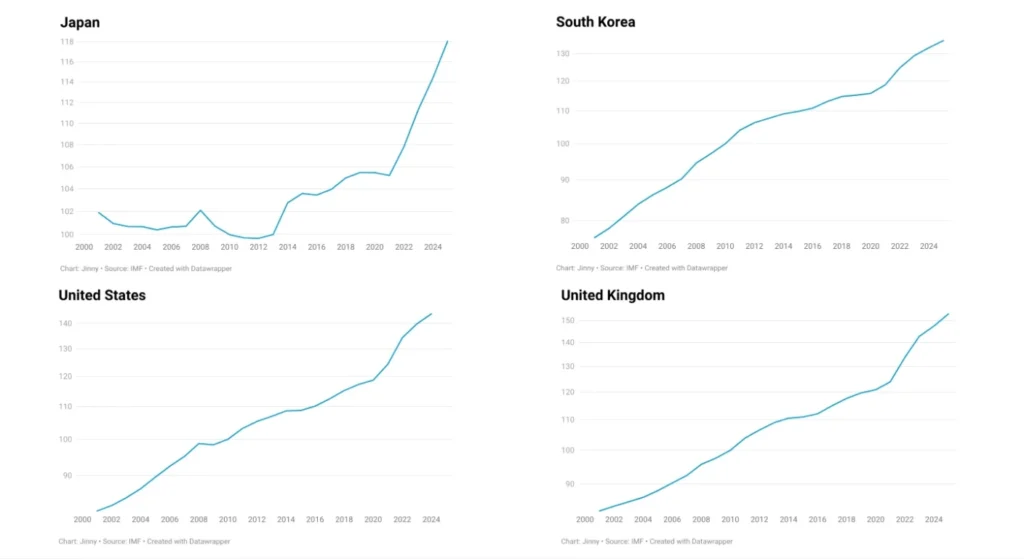
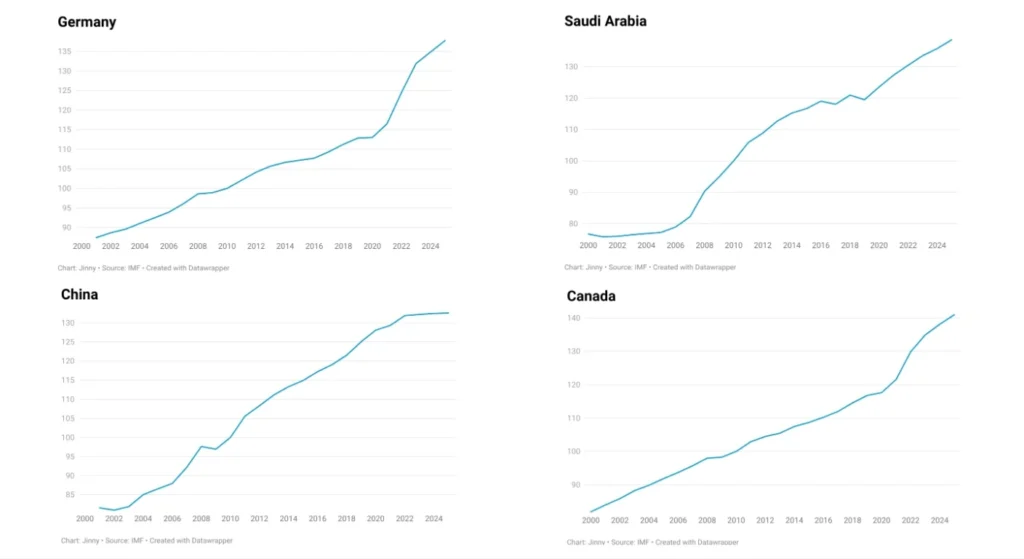
IMF official data was used to create this graph.
Looking at the graph, although there are differences in the speed of increase and occasional fluctuations among countries, the overall trend is upward in the long term. In other words, prices may temporarily slow down, but once they rise, they do not easily come back down and tend to gradually increase over time.
If you want to see data on how much consumer prices (CPI) have changed in other countries, you can check it by visiting the IMF data.
Other Friends of Inflation
Inflation is not the only thing.
The ways in which prices rise are all different,
and on the contrary, there are also cases where prices fall.
Some involve only certain items rising unusually sharply,
some involve only asset prices rising first,
and some involve economic stagnation and rising prices appearing at the same time.
So to properly understand the economy, it is necessary not to look only at inflation,
but also to know the concepts around it that move together with it.
Deflation, Agflation, Hyper, Asset, Stag, Debt
✅ Deflation
Deflation is easy to understand if you think of it as the opposite of inflation.
It is the phenomenon in which prices overall fall and the value of money relatively rises.
At first glance, it sounds like,
“If prices of goods get cheaper, isn’t that a good thing?”
but it is not necessarily so.
If prices seem likely to keep falling, people think,
“Oh? Prices are dropping? Then I should buy later when it gets even cheaper.”
and postpone consumption, while companies reduce production and employment because goods do not sell.
Then the economy freezes as well.
✅ Agflation
Agflation is a combination of Agriculture and Inflation, and it refers to the phenomenon in which the overall prices of agricultural products such as grains, vegetables, and fruit rise and pull up prices.
✅ Hyperinflation
Hyperinflation is not just prices going up; it is a state in which they surge so quickly that it becomes difficult to control.
You can think of it as a level where today’s price tag and tomorrow’s price tag are different, and even after you get paid, the value of that money quickly shrinks.
✅ Asset inflation
Asset inflation is an expression created by putting together asset price + inflation, and it refers to a phenomenon in which asset prices such as housing prices, stocks, and gold rise more than everyday living prices such as ramen or milk. Even if everyday prices do not seem to have risen much, if assets like houses or stocks rise first, people start to feel that “money makes money.”
✅ Stagflation
Stagflation is a combination of stagnation + inflation, and it is a situation in which economic stagnation and rising prices come at the same time. Normally, if the economy is bad, prices also seem like they should weaken together, but when shocks such as war or surging raw material prices come, a strange situation can happen where the economy is struggling but prices still rise.
✅ The relationship between debt and inflation
The relationship between debt and inflation is also important.
When inflation rises, the real value of money falls, so the actual burden of money that has already been borrowed can decrease.
On the other hand, if deflation comes, the value of money rises, so the burden of debt can feel heavier.
Of course, if interest rates rise together, then people who are taking on new debt have an even harder time.
Lastly,
inflation may look simple, but it is absolutely not a simple problem.
When one thing rises, another thing also shakes, and if you catch one side, another problem easily appears somewhere else.
So in the economy, there are always more problems of choice than perfect answers.
What matters is not judging by looking at only one thing,
but looking at the flow while viewing several factors together.
In the next post, we will look at how inflation is measured in numbers,
and how differences in prices can be seen depending on the inflation rate.
