

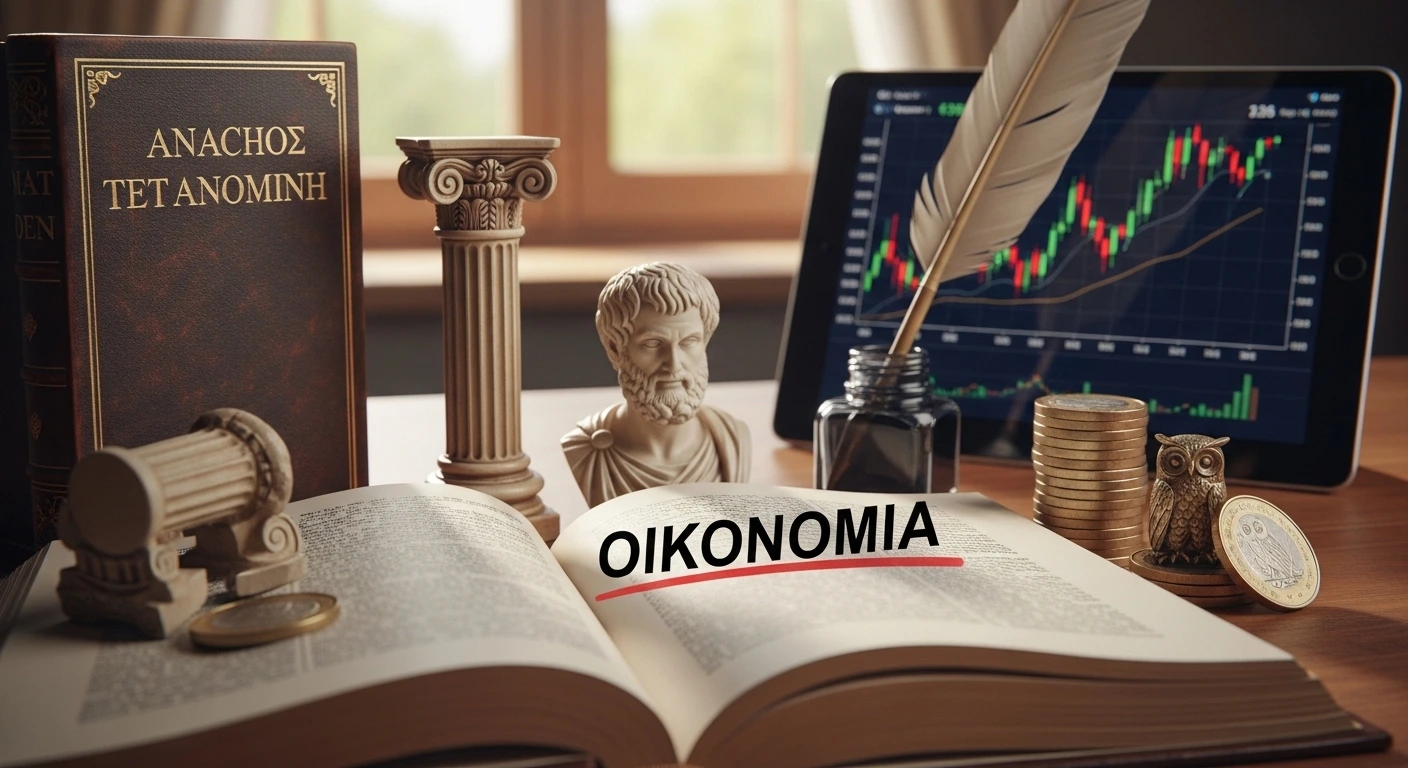

Economy originates from the ancient Greek word oikonomia. It is a combination of “oikos” (household) and “nemein” (to manage), meaning the art of efficiently managing a household. Today, economy deals with entire nations and markets, but its starting point was the rational management of resources.
The Etymology of Economy: Beginning from Oikonomia
The concept of economy did not originally begin with a vast national system, but with household management. In ancient Greece, economy concerned how to allocate and manage a household’s property, labor, and food.
Economy and Oikos: The House as the Starting Point of Economy
Oikos meant house, household, and property. It was not merely a building, but an entire living community that included family members, slaves, land, and means of production. Economy was the activity of sustaining this community.
Economy and Nemein: The Art of Distribution and Management
Nemein means to divide, allocate, and manage. Economy was the act of efficiently distributing limited resources. In other words, the essence of economy lay not in “how much was earned,” but in “how it was divided and managed.”
The Philosophical Background of Economy
The ancient Greek philosopher Aristotle distinguished between economy (oikonomia) and wealth accumulation (chrematistics). He argued that rational management for livelihood is different from the endless accumulation of wealth. This distinction became the starting point of discussions on economic ethics.
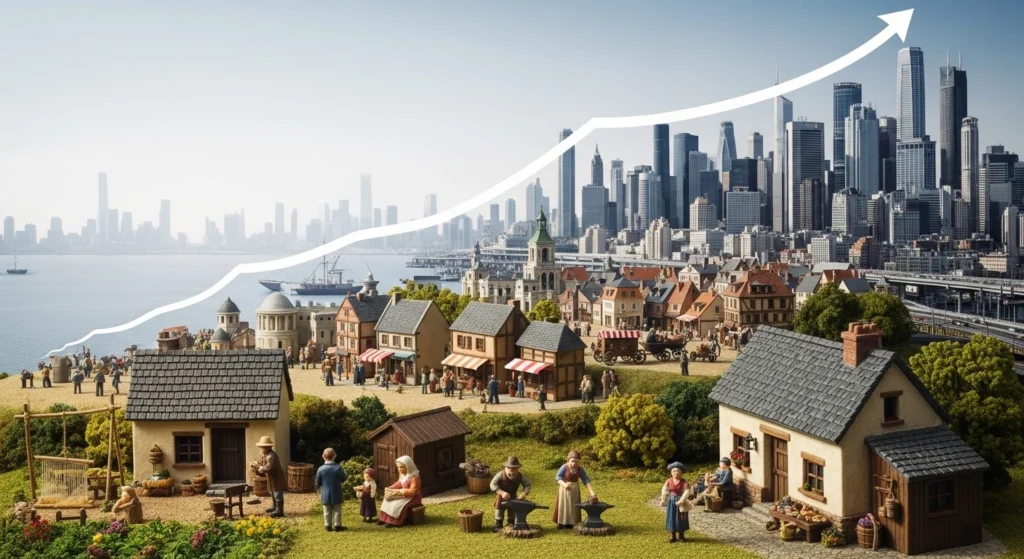
The Expansion of Economy: From Household to State
Over time, the scope of economy expanded beyond the household to the city-state, and eventually to the entire nation. The development of industrialization and capitalism transformed economy into a system centered on production, markets, and finance.
Economy and the Emergence of Markets
As exchange became more active, markets were formed, and economy was no longer merely a household matter. Concepts such as price, supply, and demand emerged, and economy became an object of systematic analysis.
The Birth of Economics
In the 18th century, Adam Smith explained the importance of market autonomy and division of labor in The Wealth of Nations. From this point on, economics established itself as an independent academic discipline.
The Structure of the Modern Economy
Today, the economy is a complex system in which households, firms, governments, and financial institutions interact. Indicators such as GDP, inflation, interest rates, and exchange rates serve as standards for analysis.

The Essence of Economy: Scarcity and the Problem of Choice
Although economy began with household management in ancient times and has expanded into a global system, its core principle remains unchanged. The essence of economy is the question: how should scarce resources be allocated?
Economy and Scarcity
Resources are limited, but human desires are unlimited. This imbalance creates economic problems. Choice and trade-offs are the fundamental premises of economic activity.
Economy and Efficiency
Economy pursues efficiency achieving maximum results with minimal resources. This principle applies not only to corporate production strategies but also to individual consumption decisions.
The Life Economy Ultimately Seeks
The ultimate purpose of economy is not merely the accumulation of wealth. Its fundamental goal is to achieve stable living conditions, sustainable growth, and the prosperity of the community. The ancient Greek concept of “household management” remains valid even today.
