


Apple stock is a rare name that is a technology stock while also carrying the character of a consumer stock. If you look only at iPhone sales volume, you have only seen half of it, and you need to look together at services, the ecosystem, and cash generation power to see this company’s stamina. More than short-term trends, you need to look together at repurchase habits, pricing power, and user lock-in effects to see the bigger investment appeal clearly.
Why Apple Stock Is Always Treated Separately
When many people look at Apple, they think only of the iPhone, but the reason the market values it highly lies more in the structure that creates repeat purchases than in the popularity of a single product. If you look at the service and accessory consumption that continues after device sales, you get a sense of why this company does not shake easily. You need to understand this part first to see the essence of the stock price as well.
It Is Not a Company That Sells Once and Ends There
In its fiscal 2026 first-quarter earnings release, Apple said its active installed base of devices exceeded 2.5 billion. In the same release, it also said both iPhone and Services revenue reached all-time highs. These figures mean that Apple is not a company that simply sells hardware, but a company that creates recurring revenue on top of a massive user base that is already in place.
From an investor’s point of view, what matters is the length of the relationship rather than the number of units sold. Once someone buys an iPhone, then uses iCloud, adds AirPods, moves payments to Apple Pay, and starts continuously piling up photos and notes, the cost of leaving grows. That is why Apple stock becomes clearer when you look at how deeply users are tied in, rather than at product launches.
A Rare Brand That Keeps Demand Even While Selling at High Prices
Apple recorded $143.8 billion in revenue and EPS of $2.84 in fiscal 2026 first quarter, and Tim Cook said iPhone set an all-time record in every geographic segment. The fact that a company selling products in the premium price range set records across all regions at the same time is closer to a signal of strong pricing power than simple popularity.
This strength stands out even more in downturns. Low-priced products immediately face more comparisons when the economy slows, but with Apple, the standard of purchase itself changes because of the brand and user experience. Even if someone delays replacing a phone, a considerable number of those who decide to replace it eventually try to choose within the iPhone lineup.
When translated into the stock, this characteristic is read as downside defense. There are many companies whose revenue grows, but few can keep desire alive while selling expensively. That is why Apple ends up standing in a strange position where it is evaluated at the same time as a growth stock and something close to a defensive stock.
A Company Whose Cash Does Not Need to Speak Much
In fiscal 2026 first quarter, Apple’s cash flow from operations was nearly $54 billion, and the company said it returned nearly $32 billion to shareholders in the same quarter. It also declared a dividend of $0.26 per share. More important than the numbers themselves is the point that it can connect a good quarter not to a good story, but immediately to cash action.
This structure has quite a large effect on investor sentiment. When the market shakes, investors eventually return to the question, “How much real money does this company actually generate,” and Apple is often in an advantageous position on that question. Research and development, share buybacks, dividends, and supply chain investment all come out of cash.
Why Apple’s Earnings Release Is Read Like the Temperature of the Entire Market
Apple’s annual net sales for fiscal 2025 were $416.161 billion. Inside that were $209.586 billion from iPhone, $109.158 billion from Services, $33.708 billion from Mac, $28.023 billion from iPad, and $35.686 billion from Wearables, Home and Accessories. It is one company’s earnings, but in reality it is closer to a table that reflects premium consumption, digital services, and device replacement demand all at once.
So Apple’s earnings never end with simply “good” or “bad.” Depending on whether the iPhone was strong, services held up, or accessories supported results, the market reads the texture of consumer demand differently. It feels less like looking at one stock and more like reading a signal for the industry as a whole.
For this reason, Apple is always treated separately inside the stock market. It is not simply because its market capitalization is large, but because with one earnings release it answers several questions at the same time. In some quarters it is read with the face of a technology stock, and in other quarters with the face of a consumer stock.
Apple Earnings Must Be Read by Structure Rather Than Numbers
If you only skim the numbers every earnings season, you end up misunderstanding Apple quite often. With this company, you need to look together at where, in what way, and with what quality it earned money, more than at the gross amount of revenue. Even the same one dollar can mean something very different depending on profitability, regional mix, and product mix. You really need the eye to read that difference. That is why.
Before Total Revenue, What You Need to Look at First Is Revenue Mix
Looking at Apple’s annual net sales for fiscal 2025, the iPhone still takes the largest share, and Services has clearly established itself as the next pillar. The combination of $209.586 billion from iPhone and $109.158 billion from Services means that Apple is still a strong hardware company while at the same time having become a considerable services company.
This difference completely changes earnings interpretation. For example, even if the same growth rate appears, a quarter pushed up only by iPhone and a quarter in which Services rose together are received by the market with different weight. The former is read as product momentum, while the latter is more easily read as structural improvement in stamina.
So when you look at Apple’s earnings, it is better to look first at “where did it earn” rather than “how much did it earn.” Even if the numbers seem the same, if the quality of the revenue mix changes, the way the next quarter is anticipated also changes. The reason analysts split their evaluations of the same company’s earnings is mostly here.
Regional Figures Show Both the Company’s Balance and Its Weak Points
Apple’s regional net sales in fiscal 2026 first quarter were $58.529 billion in the Americas, $38.146 billion in Europe, $25.526 billion in Greater China, $9.413 billion in Japan, and $12.142 billion in Rest of Asia Pacific. The fact that the business is spread widely is a strength, but at the same time it also means that moves in certain regions are large enough to shake investor sentiment significantly.
Greater China in particular always carries meaning beyond the numbers. If revenue from that region is good, hopes for demand recovery attach to it, and if it is weak, worries about intensifying competition or slowing consumption rise quickly. That is why Apple stock can swing sharply based on just one regional table.
It Becomes a Company Where Installed Base Matters More Than Shipments
An investor seeing Apple for the first time will have their eyes drawn first to shipment articles. But if it is a company with an active installed base of more than 2.5 billion devices already, it is difficult to understand the company just by how many new units it sold. A large installed base means the floor on which service revenue can be attached is wide, and that floor does not disappear overnight.
This connects to the point that even if replacement cycles get longer, it does not mean the company immediately becomes weak. Even if a user buys a new iPhone one year later than expected, in the meantime storage, payments, subscriptions, and spending inside the app ecosystem can continue. When people say Apple’s earnings should be viewed by structure rather than by numbers, it means not missing exactly this kind of scene.
So if you view this company only like a traditional electronics company, you will often get it wrong. Even in moments that look slow if you only see the hardware cycle, when viewed through the whole ecosystem, density can actually be increasing. The reason the market keeps trying to value Apple richly is hidden here.
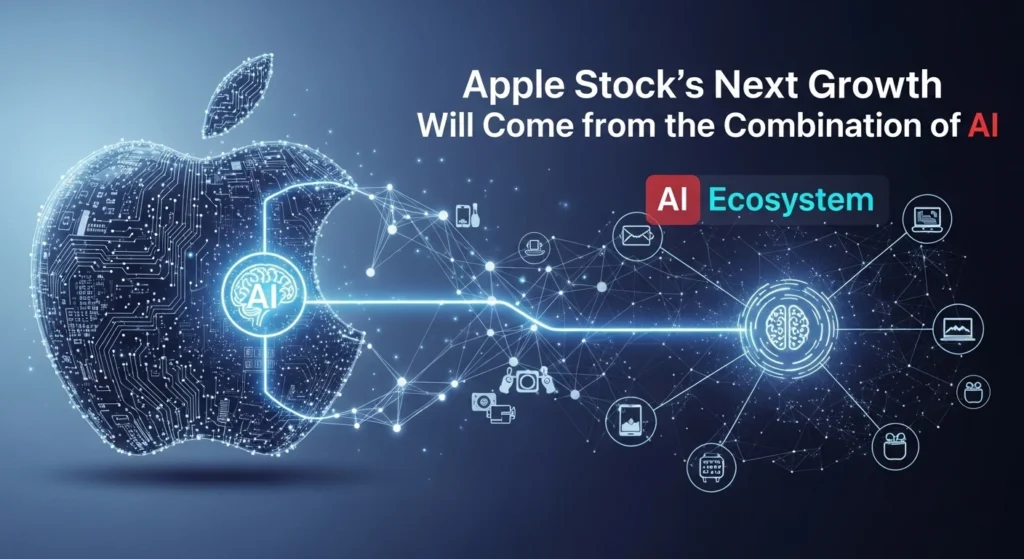
Apple’s Next Growth Will Come from the Combination of AI and the Ecosystem
Apple’s next scene does not end with a single product announcement. Only when devices, the operating system, developer tools, and services all mesh together does a new growth axis get created. So rather than surface-level feature additions, it is more important to see where the ecosystem as a whole is moving. The flow always grows bigger inside connection. More than expected.
Apple Intelligence Is Closer to Selling Trust Than Flashiness
Apple said on March 31, 2025 that Apple Intelligence features expanded to more languages and regions, including Japanese, Korean, and Simplified Chinese. In the same release, it emphasized an AI structure centered on privacy through on-device processing and Private Cloud Compute. This is why the way Apple puts forward AI is subtly different from other companies.
This approach may look less noisy, but in the long term it is quite smart. Consumers stay attached longer to features they can safely use every day than to features that amaze them once. Apple is closer to trying to make AI a tool that naturally seeps into the existing device experience rather than packaging it as a grand show.
Once Developers Begin to Attach, the Story Becomes Much Longer
In September 2025, Apple unveiled the Foundation Models framework and said developers could use the on-device large language model at the core of Apple Intelligence inside their apps. According to Apple’s explanation, this framework can work offline and AI inference is also free.
Looking at the apps introduced as official examples, the direction is clear. SmartGym creates workout routines and summaries, Stoic suggests personalized journaling prompts, and VLLO recommends background music and stickers to match video scenes. In other words, even if Apple does not directly create every killer feature itself, the platform itself has started to become the soil for new experiences.
From an investment perspective, this scene is important. Device sales are recorded as revenue at one time, but platform expansion changes habits for a long time. If Apple succeeds in planting AI deeply into the app ecosystem, the source of future growth can spread not from one or two specific products but into countless moments of daily life.
Services Is a Growth Axis Confirmed by Numbers
Apple said in January 2026 that 2025 was a record-breaking year for Apple Services. It also explained that various services such as Apple TV, Apple Music, Apple News, Apple Pay, and iCloud led global expansion and high usage. Services is now not a supporting role in earnings, but one axis of Apple’s narrative.
From the point of view of the stock, the more interesting part is density rather than speed. Selling a new device has quarterly fluctuations, but services attach a little more value to people who are already using Apple’s products. So as the installed base grows, services enlarge the size of revenue while also making the company’s rhythm more stable.
AI Can Create an Upgrade Reason Again
The Foundation Models framework was introduced as running on Apple Intelligence-compatible devices. That in turn can be read to mean that if new AI experiences become useful enough, some users may again gain a reason to replace hardware. However, this does not happen automatically, and it only works when features people actually use every day appear.
In the past, camera performance or battery life was the reason to upgrade, but going forward, real-use features such as document summaries, task automation, scene recognition, and personalized recommendations may take that place. That is probably what Apple wants in the end as well. Not to sell expensive new devices for their own sake, but to create moments where life becomes more convenient only by using a new device.
If this flow continues, Apple’s next rise can come not from the outward appearance of a new product but from a change in usage habits. It looks quiet on the surface, but from an investor’s point of view, this kind of change is rather more powerful. Once it takes hold, it becomes the kind of advantage that is difficult for competitors to catch up with.
Apple’s Strength May Be the Accumulation of Small Convenience Rather Than One Huge Hit
Apple explained that the Foundation Models framework is tightly integrated with Swift and can create responses in a consistent format through guided generation. That means it becomes easy for developers to attach AI features inside an environment they were already using. Rather than a grand declaration of innovation, this kind of developer convenience often acts more directly on actual ecosystem expansion.
So Apple’s next growth may be not one ultra-large service that appears one day all at once, but the accumulation of small conveniences felt at the same time across countless apps. Users may not remember the name, but the habit remains. And stock prices usually reflect the size of such habits late.
The Risks You Must Also Look at with Apple Stock
Apple is a strong company, but being strong does not automatically make it a safe stock. You need to look together at risks that appear late in the numbers, such as regulation, China-related variables, and slower replacement cycles. It is also worth remembering that a good company and a good buying point are not always the same. There are not a few variables to carry with optimism alone. That is always how it is.
After the Best Quarter, a Trap Called Expectations Appears
The fact that Apple created a record quarter with $143.8 billion in revenue and EPS of $2.84 in fiscal 2026 first quarter is clearly a strength. But for investors, the same fact can also become a burden. After setting a record, the market starts comparing that company not with actual earnings but with the even higher expectations that have been built.
The moment when a good company is not a good stock is usually born here. The business itself is fine, but if the speed of growth does not meet the market’s eye level, the stock price gets disappointed first. With a company as large as Apple, even without very bad news, it can face a correction simply because it was “less surprising than expected.”
This risk is closer to psychology than to numbers. So it is often felt better when looking at market mood before an earnings release than when looking at the chart. The longer you hold Apple stock, the more often you are reminded that the quality of the company and the purchase price are separate matters.
Even Though iPhone’s Weight Has Fallen, It Is Still Not at a Negligible Level
Out of Apple’s annual net sales of $416.161 billion in fiscal 2025, iPhone revenue was $209.586 billion. That is roughly half. Even though Services has grown greatly, the fact that the iPhone still sits at the center of the Apple story has not changed.
This in turn means that slower replacement cycles are still a stock variable. Even if services support the company, if the core product cannot support expectations for a long time, the whole narrative slows down. Even if you find the reason Apple is strong in the ecosystem, the possibility of weakness can still begin first in the flagship device.
AI Expectations Do Not Translate Directly into Earnings
Apple Intelligence has been broadening its languages and regions, and developer expansion has also started through the Foundation Models framework. The direction clearly looks good. But a good direction and a direction that immediately becomes big money are not the same. It takes time for AI features to lead to actual upgrade demand, increased app usage time, and greater service consumption.
The market often buys the narrative first and asks for the numbers later. While Apple gathers AI expectations, the stock can react ahead of time, but eventually it reaches a point where it cannot avoid the question, “So what actually changed?” If the answer is weak then, the expectations can easily turn into disappointment instead.
So AI is both an opportunity and a test for Apple stock. More important than the fact that there are many announcements is how deeply it enters the user’s day. More than a stylish demonstration, a change in habit has to appear. That is the real thing.
China and the Supply Chain Shake Investor Sentiment Before the Numbers Do
On its supply chain page, Apple explains that its products are designed in California and made by people all around the world. It also says that thousands of businesses and millions of people in more than 50 countries and regions participate in the supply chain. This is a strength of efficiency and scale, but at the same time it is also a structure that is always exposed to geopolitical and logistics variables.
In addition, China is not only part of the supply chain but also an important market. Greater China revenue alone was $25.526 billion in fiscal 2026 first quarter. So China-related news brings interpretations tied simultaneously to both production and sales, and for that reason it often touches investor sentiment before the earnings table does.
