



As March got underway, one question kept popping up: Are dollars really flowing back into spot Bitcoin ETFs? On the surface, yes. But it’s easy to misread both the strength and the direction of the move if you only chase headlines that mix calendar-month tallies, trailing four-week sums, and weekly or daily streaks. March clearly flipped to net inflows through the middle of the month, only to face late-week reversals that compressed the final monthly figure.
This piece breaks March down by date and by fund to show what actually happened. From the five-session net inflow streak in mid-month and a single-day high, to the -$296M weekly net outflow in the final week—and the distinct roles played by IBIT, FBTC, and GBTC—we put the numbers in context and strip away avoidable noise.

The outline of March 2026’s ‘inflows are back’: the split between calendar month and trailing four weeks
Up to mid-March, the inflow picture was unambiguous. By the end of the second week, month-to-date (MTD) net inflows into Bitcoin-linked products stood near +$1.33B, beginning to offset the choppiness seen earlier in the year. The weekly prints over the same span were also strong. But the last week of March saw -$296M in net outflows, handing back part of that mid-month momentum. Even so, the shift back to net inflows held in aggregate.
The main source of confusion was the “last four weeks” lens. Late-March reporting showed roughly +$2.5B of net inflows on a trailing four-week basis, which looked at odds with the calendar-month numbers. That discrepancy is mechanical: calendar month fixes the window from the first to the last day of the month, while a trailing four-week total rolls forward each day. Ask the same question of different time slices and you will naturally get different answers.
Calendar-month lens: a mid-month rebound, then a late-week fade
Mid-March delivered 2026’s first five-session run of consecutive net inflows, adding about +$767M. The single-day high in that stretch reached roughly +$250.9M—evidence that the “inflows are back” headline wasn’t a mirage. Coupled with aggressive creations early in the month, the tape looked like it was building sustained traction.
Then, during the March 23–27 week, -$296M flowed out, knocking the trend off balance. The mid-month streak was partly offset by a late-week risk-off turn. March still finished positive on a net basis, but the acceleration glimpsed in the middle of the month didn’t fully persist into the close.
Why the trailing four-week tally looks bigger
A trailing four-week sum wraps roughly the prior 20 trading days depending on the end point. If strong mid-March weeks are included while late-week headwinds fall partly outside the window, the number will naturally look larger. That’s why the calendar month can look like “modest net inflows” at the same time a trailing four-week lens reads as “substantial net inflows.”
Blend those two frames and you risk overstating or downplaying the true trend. Calendar-month figures help reveal changes in pacing, while trailing four-week totals capture the mass of momentum. Neither is inherently superior; they work best as complements.

What the daily tape says: streaks and whipsaws living side by side
March can be reduced to two words: streaks and whipsaws. Direction flipped more than once within the same month, and daily extremes laid market psychology bare. There were stretches where high-frequency basis and hedging flows distorted the signal in reported inflows.
In other words, the daily tape surfaces micro-changes that monthly or trailing four-week averages smooth away. On good inflow days, you can see which dynamics did the heavy lifting. On bad ones, you can spot where the cracks emerged by fund. Those details help assess how durable the direction really is.
Early-to-mid March: constructive signals
On March 2 alone, roughly +$458.2M came in, led by IBIT with about +$263.2M. Big early prints like that were the trailer for the mid-month streak. Then, across five consecutive sessions in mid-March, net inflows added about +$767M. The daily high for that week was logged near +$250.9M.
March 16 also printed a strong daily net inflow of around +$202M, with BlackRock’s IBIT responsible for roughly +$139M. It was one of those days that answered the question, “Who’s driving this?” quite clearly. The footprints suggested a blend of systematic buying by hedge funds and family offices with a steady uptick in retail participation.
Late-week volatility expands: from +$167M to -$225M
On March 23, flows were still positive at about +$167.2M. Under the hood, IBIT added +$160.8M and FBTC +$41.7M, underscoring a strong tilt toward large, low-fee funds. But three days later, March 26 saw -$171.3M, followed by -$225.5M on the 27th—heavy hits in quick succession. Month-end on March 31 brought a partial rebound with +$117.5M, but the back-and-forth was enough to muddy the monthly narrative.
That tonal shift reflected a mix of macro catalysts and derivatives positioning. Slight re-pricing of the policy-rate path, give-and-take across risk assets broadly, and the placement of futures rolls and options gamma amplified the day-to-day movement of money. The takeaway was familiar: a week is more than enough time for sentiment to flip.
Who led the inflows: the bright spots of IBIT and FBTC, and GBTC’s drag
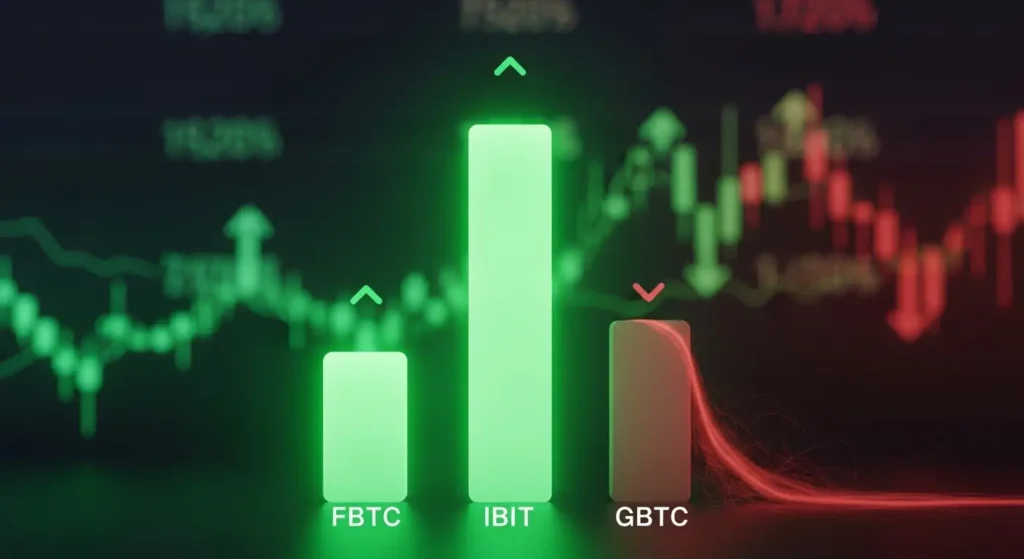
IBIT and FBTC sat at the center of the inflow phase. With fee advantages and superior operating and trading infrastructure, the two funds took the lion’s share during the streak days. GBTC, by contrast, continued to bleed modestly, weighed by its relatively higher all-in cost.
This bias toward “low fee, large scale” is about more than price sensitivity. It links to institutional execution standards. In large creations and redemptions, capital that wants to minimize slippage and secondary spreads naturally gravitates to the biggest vehicles.
IBIT’s heft: what AUM and held BTC tell us
By mid-March, IBIT’s assets under management (AUM) were estimated near $55B. Over the same period, IBIT’s Bitcoin holdings were often cited in the 0.75–0.80M BTC range. The concentration of daily inflows into IBIT during the streak all but explained itself through sheer scale.
On heavy inflow days, secondary market turnover and primary creations quickly moved in sync. Efficient creation baskets helped keep spreads stable. The result was a classic network effect: the big fund got bigger—an effect March’s data reaffirmed convincingly.
FBTC and others in support, while GBTC trends to gentle outflows
FBTC consistently played second chair to IBIT. On neutral-to-positive days it often posted plus contributions, such as +$41.7M on March 23. Newer and mid-sized funds filled niches at the margin, but they didn’t displace the top two in terms of scale.
For GBTC, unless the fee differential is materially narrowed, the relative pressure to see outflows remains intact. While some managers have launched lower-fee mini-trusts to patch the gap, March’s pattern made the end preference clear: capital favored the combination of lower fees and larger scale.

Total assets and market share: how much Bitcoin sits in ETFs
As of March 27, U.S. spot Bitcoin ETFs held a combined net asset value of about $84.77B. Measured against Bitcoin’s market capitalization at that time, ETF NAV represented roughly 6.42% of the market. That is not a trivial footprint for products that have only been listed a short while.
This ratio ultimately reflects the access and trading convenience of the spot, physically backed ETF wrapper. Without foreign brokerage accounts or bespoke custody, institutions can now secure systematic Bitcoin exposure. That lowered the adoption threshold for pensions, RIAs, and advisory-directed assets.
ETF NAV and Bitcoin market cap: a two-way interaction
ETF NAV is a function of price times holdings, so it swells naturally in price uptrends. Even when price wobbles, if primary creations continue, NAV doesn’t fall as much. In March, the interplay of price swings with ongoing creations and redemptions produced a relatively steady NAV share.
Understanding this clears up the puzzle of “Why is NAV share stable if the price is down?” The simple answer: net inflows can partly offset a price decline, and larger holdings can absorb a dip in market cap.
The trap in saying ‘inflows = long-term demand’
Not every dollar into a spot ETF is long-term capital. Basis trades, hedges, and prompt rebalances can all inflate the inflow data with tactical flows. Around options and futures expiries in particular, creations and redemptions often serve as tools to fine-tune broader positioning.
Rather than declaring a week or two of inflows a definitive return of long-term demand, it’s better to cross-check with fund-level holdings, secondary turnover, and options open interest. The late-March whipsaw was a timely reminder of how quickly tactical capital can pivot.

What steered the flows: macro variables and market microstructure
March’s data suggests a dual engine: big-picture macro shocks alongside small-gear microstructure moves. When rate-path expectations or geopolitical headlines nudged risk appetite, the ETF creation/redemption machinery translated that psychology into day-by-day money movement.
On quieter days, microstructure explained more of the variance. Spreads, creation-basket efficiency, the carry books of authorized participants (APs), and the delta-gamma profile of the derivatives complex all pushed and pulled on both direction and intensity.
Rates, liquidity, geopolitics: near-term drivers
The -$296M in the final week of March aligns with a risk-off tone stirred by macro catalysts. The market re-priced the policy-rate path versus the prior month, major indices corrected, and select geopolitical developments boosted demand for safety—each feeding directly into Bitcoin’s risk premium.
ETF flows are often the quickest listed channel to reflect those tone changes. With a low threshold to transact—and a mechanism that begins in the secondary market and can roll into primary creations/redemptions—shifts show up in measurable, day-to-day prints.
The coupling of primary and secondary
When sentiment leans toward inflows, buys pile up in the secondary market and spreads tighten. APs then step in to scale creations, hedging with spot purchases and compressing premiums or discounts. That virtuous loop sat beneath the five-day mid-March streak.
On outflow days, redemptions accelerate and the primary mechanism runs in reverse. The -$171.3M and -$225.5M daily prints on March 26–27 showed how secondary-market offer pressure can propagate into chunky primary redemptions.
How to read the data: align baselines, decompose by fund, and add context
Conflicting conclusions—“inflows are back” versus “flows are slowing”—came from looking through different lenses. Build the habit of separating calendar-month, weekly, and trailing four-week frames, and pair that with fund-level decomposition and attention to daily extremes.
Layer in total assets, market share, and derivatives positioning, and you can filter out both overstatement and understatement in the headlines. March offered a clean case study for exactly that kind of practice.
Start by aligning aggregation standards and time zones
Calendar month means a fixed first-to-last-day window. Trailing four weeks is a rolling window. Weekly figures are typically Monday–Friday on U.S. Eastern Time. Because March housed both a strong mid-month and a weak final week, your interpretation depends heavily on which pane of glass you look through. Set the standard first, then compare numbers.
Also note: providers can have different cutoffs. Even the same day’s flow number can diverge by tens or hundreds of thousands of dollars based on timestamp conventions. That won’t flip the direction, but it can matter when you’re gauging extremes.
Decompose by fund and flag outliers
Days when IBIT and FBTC dominate are textbook “low-fee, large-scale” preference regimes. When GBTC’s outflows swell, relative sensitivity to fees and trading costs is in the foreground. Dates like March 23 (IBIT +$160.8M, FBTC +$41.7M) and March 27 (-$225.5M) are useful pattern primers.
Sharp daily swings often coincide with derivatives expiries, macro events, or large block trades. When asking “why,” put options open interest, futures basis, and secondary turnover alongside the flow tape. It’s almost always more useful to read the forces moving the numbers than to stare at the numbers in isolation.

Wrap-up: ‘inflows are back’—but the speedometer keeps flickering
The verdict for March 2026 is straightforward: on a calendar-month basis, inflows returned. The five-session mid-month streak and the roughly +$1.33B MTD at that point signaled a directional turn. At the same time, the -$296M weekly outflow in the final week—and the -$171M/-$225M daily reversals—showed the speedometer still swings.
The trailing four-week sum swelling to about +$2.5B was simply a function of looking at the same month through a different frame. Separate your baselines and the confusion fades. IBIT and FBTC held the baton during the inflow phase, while GBTC couldn’t shake the outflow pressure. As of March 27, ETF NAV around $84.77B—about 6.42% of Bitcoin’s market cap—speaks to a structural foundation of demand.
Still, dollars into spot ETFs mix strategic and tactical motives. Macro shifts can bend the airflow in a day or a week. Rather than racing to conclusions on a single metric, align your aggregation frame and read fund-level and daily data in context. That is the most practical user manual March’s tape leaves behind.
What to watch next
The first checkpoint is whether calendar-month inflows continue into April or whether late-March’s tone extends. Watch for a repeat of mid-month streak dynamics and any change in the frequency of daily extremes.
Also track shifts in IBIT/FBTC share, the pace of GBTC outflows, and what secondary turnover relative to total assets says about the “character of money.” If derivatives positioning becomes a bigger factor, expect more volatility in creations and redemptions too.
