

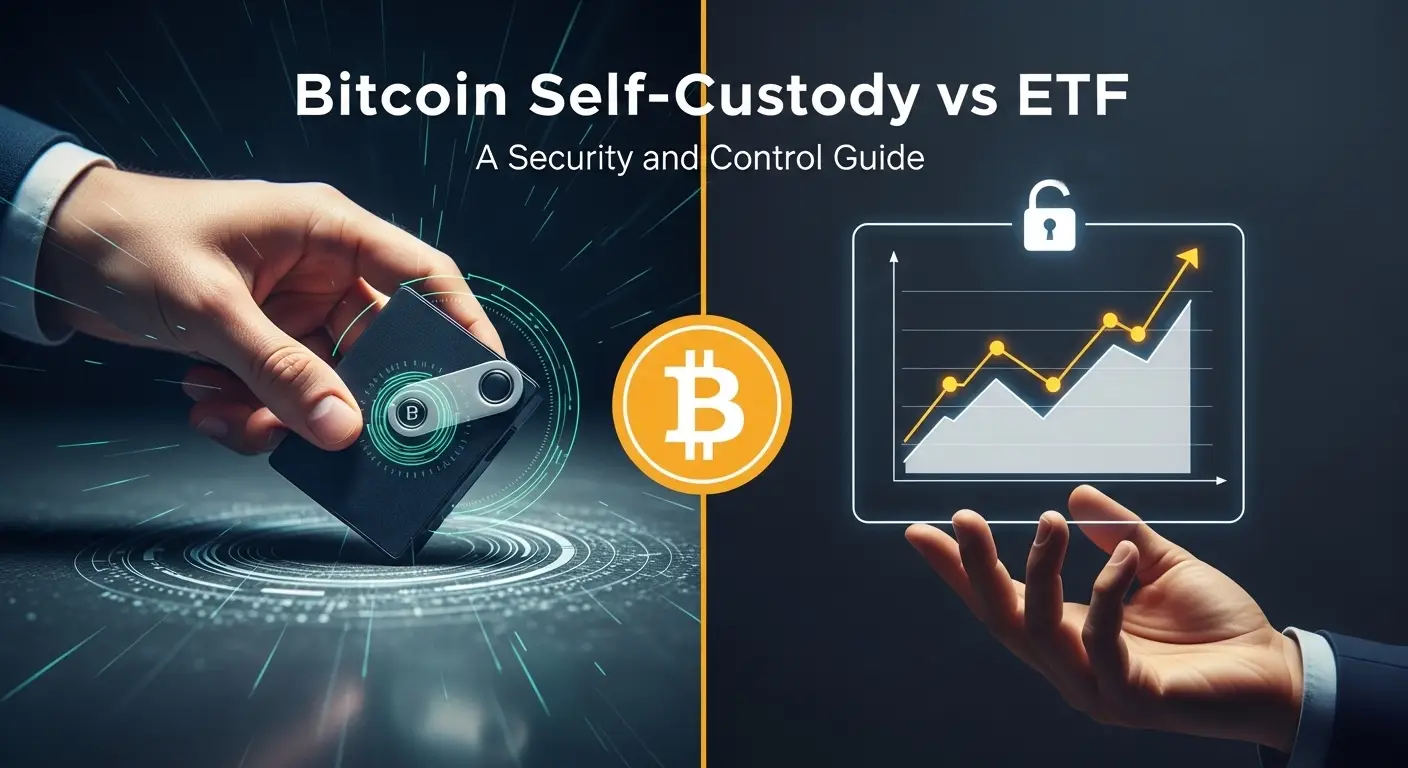

The same bitcoin carries very different risk profiles depending on how it is held. Self-custody, where you control the private keys and move funds on-chain, places full authority and accountability on the user. By contrast, a spot bitcoin ETF relies on a trust structure and third-party custody, giving investors indirect exposure. Beyond price outlooks or tax angles, the two paths diverge in security architecture, control rights, and how failures propagate when things go wrong.
This article serves readers seeking a guide to bitcoin self-custody versus ETF security trade-offs by placing the mechanics of approved spot bitcoin ETFs alongside the core principles of key management. It clarifies how far institutional safeguards actually reach, who bears responsibility under different failure modes, and which practical checkpoints to consider given your habits, organization, and objectives.

Start by defining the baselines of security and control
On January 10, 2024, the U.S. Securities and Exchange Commission approved rule changes for the listing of 11 spot bitcoin ETPs (including ETFs). With trust structures that directly hold bitcoin now recognized, both individuals and institutions can obtain bitcoin exposure as a “security” within brokerage accounts. Accessibility widened, but security and control were redistributed across multiple actors within the ETF ecosystem.
Self-custody, in contrast, boils down to managing private keys. Guard the keys and you can transact on-chain 24/7 without permission; lose or leak them and there is no undo button. The contrast ultimately centers on the direction of control and whether a safety net exists when failure occurs. ETFs provide procedural safeguards and standardized operations, yet introduce interdependent third-party risks. Self-custody simplifies procedures but expands the user’s responsibility gap.
How the investment and custody landscape changed after 2024 approval
With spot bitcoin ETF approval, investors can trade bitcoin exposure within brokerage accounts during exchange hours. The trust segregates bitcoin with a third-party custodian, and the investor owns shares of the trust (ETF shares). The appeal lies in a familiar regulatory perimeter, reporting standards, and market-surveillance mechanisms reinforced by surveillance-sharing arrangements.
It is important to distinguish that ETF shares, treated as securities, may benefit from procedural protections in the SIPC framework, whereas the bitcoin held by the trust is not insured by FDIC or SIPC. ETF prices can temporarily diverge from net asset value (NAV), and when creation/redemption is cash-based, execution frictions can influence tracking and overall performance.
Three core questions of security and control
First, who holds what authority? In self-custody, signing power is fixed entirely with the user. In ETFs, the custodian, administrator, authorized participants (APs), and brokers share responsibilities for safekeeping, settlement, and liquidity.
Second, what can fail? Self-custody is most vulnerable to key loss, key leakage, and social engineering. ETFs can face concentration at the custodian, congestion in creation/redemption channels, outages among brokers or APs, and exchange closures.
Third, who covers what when incidents occur? Self-custody requires you to design both prevention and recovery. ETFs rely on insurance, contracts, and regulations, each bounded by limits and exclusions—and none of these backstop market losses.

Under the hood of spot bitcoin ETFs: trust, custody, creation/redemption
A spot bitcoin ETF holds actual bitcoin through a trust and distributes ownership via shares of that trust. Bitcoin is predominantly kept in segregated cold storage using institutional custody standards for access controls and multi-approval workflows. Some custodians maintain crime insurance under specified conditions, but policies have limits and exclusions; they are not synonymous with “full reimbursement.”
At launch, most products adopted cash-based creation/redemption. APs deliver cash for ETF shares and receive cash upon redemption. While in-kind (direct bitcoin transfer) may be considered in the future, a cash model requires the trust to execute bitcoin buys and sells, where cost and timing can introduce tracking error.
Trusts, third-party custody, and the boundaries of responsibility
ETF investors own shares in the trust. The trust’s bitcoin resides in segregated accounts under the custodian’s name, with private keys managed offline. Custodians are often regulated trust companies with client-asset segregation, capital requirements, and audit controls. However, they are not FDIC/SIPC members, and assets under custody do not fall under deposit insurance or securities-protection programs.
If a broker fails, customers’ “securities” may be recoverable through SIPC procedures, but SIPC does not restore investment losses per se. Nor does any public insurance automatically and fully cover loss of the trust’s bitcoin. In practice, ETF protections rest on legal segregation, contractual obligations, and private insurance, with actual coverage determined by the fine print and limits.
How cash creation/redemption introduces tracking error and execution risk
Under cash creation/redemption, APs contribute cash and the trust acquires bitcoin in the market. Execution costs, spreads, liquidity swings, and rebalancing across venues can accumulate, creating a small wedge between ETF market performance and spot bitcoin. In-kind models tend to reduce such frictions, but most products launched with cash-based flows.
Managers mitigate tracking error with multi-venue execution, fill-quality controls, and inventory management. Still, during high volatility or one-sided flows, costs and timing become more material, acting as an invisible cost on top of the stated expense ratio over time.
Trading hours, NAV gaps, and the 24/7 on-chain contrast
ETFs trade during exchange hours. After-hours sessions may exist but can be thinly liquid, and ETF market prices can diverge from real-time NAV. Large gaps tend to be arbitraged by APs, but premiums/discounts can persist in the short term.
Bitcoin itself moves on-chain 24/7. Self-custody users can transact at any time, subject primarily to network congestion, and transfer the underlying asset without price slippage between a proxy and spot. This time-axis difference can dramatically shape perceived control during liquidity stress or macro events.

Self-custody in practice: keys, backups, hardware, multisig
Self-custody is entirely about private keys. The key is the ownership, and you must design your own backups, offline storage, access controls, and recovery steps. Small operational-security habits prevent catastrophic outcomes.
Hardware wallets strike a balance by keeping signing keys isolated while maintaining day-to-day usability. Layering multisig further removes single points of failure and extends into inheritance and emergency-recovery scenarios.
Backups, cold storage, and recovery drills as core workflows
Store seed phrases in at least two physically separate locations, ideally using fire- and water-resistant media. Design storage so that sites do not reveal each other, and avoid leaving digital traces—maps, photos, address books—tied to the locations.
Cold storage means complete disconnection from the internet. Build a habit of creating signatures offline and transmitting only signed transactions to online devices, reducing exposure to malware, keyloggers, and remote intrusion. You can rehearse recovery with testnets or watch-only wallets, periodically validating that you can truly restore from your backups.
Eliminating single points of failure with hardware wallets and multisig
Hardware wallets isolate signing keys inside secure elements. Always verify receive addresses on the device screen, and apply firmware updates only after authenticating official signatures. With multisig (e.g., 2-of-3, 3-of-5), attackers must compromise multiple keys simultaneously, raising the difficulty exponentially.
When building multisig, mix vendors, firmware stacks, and supply chains to diversify vendor risk. Document descriptors or policy backups so you can recreate the exact policy if a device fails. For inheritance, leave clear execution instructions—locations, order of operations, third-party attestations—to prevent bottlenecks in an emergency.
Common beginner mistakes and an operational security checklist
The most frequent disasters involve photographing seed phrases, syncing them to the cloud, or sharing via messaging apps. One upload can create permanent exposure. Another trap is phishing sites and malicious wallet extensions—be wary of address tampering and spoofed approval prompts.
Operational security need not be complicated. Confirm amounts and addresses on the hardware screen before sending; for large transfers, do a small test transaction first. When adding a new device, practice recovery before storing funds. Separate a long-term vault from a spending hot wallet, and add a watch-only wallet to monitor balances and flows without exposing signing keys.
Safeguards and insurance: how SIPC/FDIC and crime insurance actually work
Institutional protections do not erase all risks. ETF shares, as securities, may enter SIPC processes if a broker fails, but SIPC does not cover market losses. Moreover, the bitcoin held by the trust is not protected by FDIC or SIPC.
Custodian crime insurance is an important defense line but does not promise full reimbursement. Coverage limits, exclusions, exposure windows for hot/warm wallets, and whether insider incidents or social-engineering scenarios are covered all determine the real contours of protection.
What is and isn’t protected if a broker fails
SIPC aims to recover customer securities and cash in a broker liquidation. ETF shares generally fit within this framework, but recoveries depend on asset location, record integrity, and adherence to segregation rules. SIPC does not cover investment losses, and both limits and timelines apply.
Separately, the trust’s underlying bitcoin does not fall under deposit insurance or securities-protection umbrellas. Custody contracts and private insurance form the shield, but actual coverage for specific losses depends on product documents and policy terms.
The scope and limits of ETF custody insurance
Major custodians emphasize cold storage to minimize external attack surfaces, combining internal controls with physical security. Crime policies may address theft, loss, and certain insider misconduct, but real-world conditions—deductibles, event definitions, and cooperation requirements—govern payouts.
Avoid the shortcut of “there’s insurance, therefore it’s safe.” Insurance is a last-resort monetary buffer. Compensation depends heavily on the legal character of the incident and contractual compliance. Investors should read risk and insurance sections in offering and custody disclosures to understand true boundaries.
The self-custody equivalent of insurance is disciplined procedure
Self-custody comes with no automatic public insurance. Instead, operational controls—physical dispersion, multi-party authorization, documented recovery steps, and identity verification for key-holders—function as de facto insurance. Multisig, geographic separation, mutually unknown storage sites, and routine audits mechanically reduce risk.
Personal insurance options exist, but coverage definitions, premiums, and qualifying events are narrow. For most users, elevating operational maturity delivers better cost-to-benefit than paying for limited and uncertain private policies.

Interdependence risk vs. self-responsibility risk: compare by failure modes
ETFs operate through layered structures—trusts, custodians, APs, brokers, and exchanges. In normal times this ecosystem offers convenience and discipline, yet in specific scenarios interdependence can amplify risk. Self-custody minimizes external reliance, but user error can be fatal and immediate.
Asking which is “safer” misses the point. What matters is recognizing your likely failure modes, whether buffers activate when they occur, and how much complexity and responsibility you can realistically maintain.
Custody concentration and chain reactions from third-party reliance
When assets concentrate at a single large custodian, the blast radius of operational outages, regulatory actions, or supply-chain issues grows. The AP–prime broker–broker chain means friction at one link can spill into liquidity strains, wider discounts/premiums, and redemption queues. In stress, systems may be “functioning but slower,” which investors will feel as creeping friction.
Interdependence can also create resilience. Multi-approval workflows, audits, and emergency playbooks are designed so that one actor’s error does not collapse the whole. Investors should review product documents for creation/redemption policies, AP diversification, and custody redundancy to gauge structural chokepoints.
Lost keys, phishing, and social engineering: the shadow of self-responsibility
Self-custody failures tend to be simple: you lose the key, an attacker learns it, or you’re tricked into signing. There is no password reset or customer support fix. Survival depends on routines that prevent loss, block leakage, and enforce verification before signing.
Social engineering sidesteps technical defenses. Impersonation calls, forged documents, and contrived emergencies break composure and elicit signatures. Building in deliberate delays helps: pause and re-verify large transfers, and require second-party confirmation so human error is filtered out by design.
Blended strategies and governance tailored to your environment
Organizations subject to compliance may use ETFs for baseline exposure where accounting, audit, and approval trails are clean, while allocating strategic reserves to multisig vaults. Individuals might separate roles: small hot wallets for spending, hardware-plus-multisig for long-term holdings, and ETFs when price exposure without on-chain handling is sufficient.
Whatever you choose, governance documents matter. Define access rights, emergency contacts, device life cycles, and procedures for inheritance, departures, or loss. Run quarterly simulations to find gaps. Technology evolves, but documentation remains the rudder that directs risk.

A decision checklist: choosing security and control that fit you
Realistic choices are rarely binary. Use the checkpoints below to project your environment and goals. Do you prioritize maximum control, prefer regulatory structure and reporting, or want to combine strengths from both worlds?
In the end, feasibility beats neat comparison tables. Complexity you cannot maintain becomes risk; systems that are too simple invite single points of failure. The point of this checklist is to find a difficulty level you can sustain.
If you prioritize control
Start by sizing what you truly need to move 24/7 and whether you have the will and skill to be responsible for it. Have you split your seed backups across at least two secure locations? Have you performed a recovery test within the last month? Do you habitually verify addresses on your hardware wallet?
If you are ready for multisig, sketch a plan mixing vendors, storage sites, and approvers. Are policy backups and emergency contact documents written? Do you need inheritance or transfer procedures? If so, streamline them to be “simple yet safe” so they remain executable under stress.
If you prioritize convenience and regulatory frameworks
From broker, custodian, and manager disclosures, have you reviewed the custodian identity, insurance limits, cash creation/redemption policy, AP roster, and trading cost transparency? Are you comfortable with how the product handles off-hours events, premiums/discounts, and liquidity?
Do you understand what SIPC does and doesn’t do if your broker fails? Have you compared ETF expense ratios and historical tracking error? From accounting, audit, and reporting perspectives, do internal approvals and asset classifications fit? The more “yes” answers here, the stronger the case for an ETF.
Transition planning and emergency procedures
Before shifting exposure—ETF to self-custody or vice versa—map out trading, tax, and operational costs. Asset transfers are consequential events. Rehearse with small amounts and identify where failure could occur.
In emergencies, simplicity saves. Consolidate contact trees, role assignments, storage site lists, device serials, policy-backup file hashes, and step-by-step recovery into one document. Ensure at least two people can access it under seal. Each quarter, walk the document, update changed devices, addresses, and permissions, and verify it still works end-to-end.
