


Panic, the Great Depression, and bubbles are stories of economic collapse that have repeatedly appeared throughout the history of capitalism. Economies do not always grow. Sometimes they overheat, bubbles form, and eventually they burst, leading to panic. In this article, we will examine how panic occurs, what the most famous Great Depression in history was, and how bubbles become the seeds of panic.
How Panic Begins
Panic is not simply an economic slowdown. It refers to a situation in which the circulation of the economy stops and both companies and the financial system begin to shake at the same time. When panic occurs, production sharply decreases, unemployment rises, and consumption freezes. In other words, Demand is gone.. On the surface it may look sudden, but panic usually appears when problems that have been building inside the economic structure explode all at once.

The Basic Structure of Panic
Panic usually begins when the balance between production and consumption collapses. Companies try to increase production efficiency and reduce costs in order to gain more profit.
In that process, workers’ wage increases become limited, and in the worst case they receive a notice of dismissal the next morning. Naturally, workers close their wallets.
This is where the problem begins. Factories continue producing goods, but the wallets of the people who are supposed to buy those goods become thinner and thinner. If someone has just received a notice of dismissal from work, would they really go out to a pub with friends to watch soccer and drink beer? Most people would start thinking about loan payments and living expenses first.
At first this change may seem small. But over time the situation becomes visible. Inventory begins piling up in warehouses, and companies begin to worry about reducing production. This is the point where panic can begin.
Unemployment and the Collapse of Consumption
When inventory begins to pile up, companies reduce production. When production decreases, workers are laid off. Workers who are laid off naturally have no choice but to reduce their consumption.
When consumption falls, company sales decline even further. Companies then reduce production again and lay off more workers. If this process repeats, a downward spiral begins across the entire economy.
This is when panic appears. Goods pile up in warehouses, but people cannot consume them because they have no money. A strange situation emerges.
To help understanding, let’s look at a simple and slightly extreme example.
One day, a pizza shop begins to see its sales decline. As fewer customers walk through the door, unsold ingredients start to pile up. Eventually, the owner is forced to cut costs and lays off one employee.
The laid off worker can no longer afford to stop by the pub after work for the beer he used to enjoy.
But the problem does not stop with just one person.
For similar reasons, not only pizza shops but also mobile phone stores, clothing stores, and used car dealerships begin to experience falling sales. As customers disappear, goods start to sit unsold on store shelves, and businesses begin laying off employees to reduce costs.
As workers across many industries lose their jobs, fewer people show up at the pub. Beer stops selling as it once did, and unsold kegs begin to pile up in storage. The pub eventually cuts back on the amount of beer it orders from the brewery.
The brewery faces the same problem. With orders declining, production is reduced and workers are laid off.
Those laid off workers can no longer buy pizza, drink beer, purchase clothes, or even think about buying a used car.
As consumption falls, business revenues drop even further. Companies reduce production again and lay off more workers. When this cycle repeats itself, the entire economy begins to spiral downward.
In the end, warehouses are filled with unsold goods, yet people cannot buy them because they no longer have the money. A strange and troubling situation emerges.
When this vicious cycle of declining consumption and increasing layoffs spreads across the entire economy, we call it panic.
The Repetition of Panic in Capitalism
An interesting point is that panic has appeared repeatedly throughout the history of capitalism. Since the Industrial Revolution of the 19th century, numerous financial panics and economic collapses have occurred.
Economists often explain this as the “business cycle” of capitalism. When the economy overheats and investment and production increase, at some point the balance collapses and panic appears.
Economists sometimes explain this as the business cycle of capitalism. As the economy overheats and investment and production increase, the balance eventually breaks down and a panic appears.
It is somewhat similar to our behavior when we enjoy drinking. When we first sit down at a drinking table, we keep emptying our glasses, carried away by the atmosphere without even realizing we are getting drunk. But as we continue drinking, at some point we no longer realize how drunk we actually are.
The next morning we wake up with a hangover and regret our actions from the previous night.
The economy is no different. It does not stop until it gets drunk.
In the economy, investment and production keep increasing (drinking), and the economy gradually overheats (getting drunk). Eventually, the moment the balance collapses, a panic appears (blackout). After that, people wait for the economy to stabilize and recover (hangover recovery).
However, historically not every crisis was of the same scale. Among them, the most shocking event was the Great Depression.
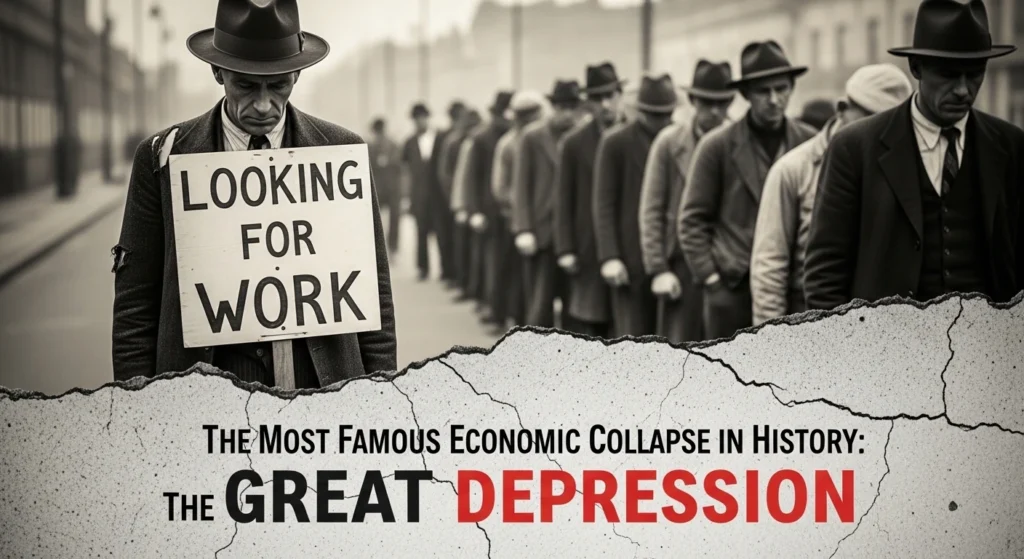
The Most Famous Economic Collapse in History: The Great Depression
The Great Depression was not simply an economic slowdown but an event that shook the entire global economy. The financial collapse that began in the United States in 1929 soon spread to Europe and the rest of the world. The Great Depression was not just a financial crisis but a historic event in which production, employment, and trade collapsed simultaneously.
The 1929 Wall Street Crash
The United States enjoyed economic prosperity during the 1920s. The automobile industry expanded, electricity spread, and *consumer goods industries grew. The stock market seemed to rise endlessly.
But there was a problem behind that rise. Many investors were buying stocks at prices far higher than the real value of companies. Excessive optimism and speculation had accumulated in the stock market.
In October 1929, stock prices collapsed on the New York Stock Exchange, and this enormous bubble burst. This event became the starting point of the Great Depression.
*Consumer goods: products that people buy in order to consume directly in their daily lives (clothing, food, home appliances, automobiles, furniture, radios).
The Shock of the Great Depression
The impact of the Great Depression was beyond imagination. The United States’ Gross National Product sharply declined(At that time, the concept of GDP had not yet been established.), and the unemployment rate rose to about 25%. Numerous companies went bankrupt, and thousands of banks collapsed.
(At that time, in 1930, the U.S. population was about 123 million. Among them, roughly 48 million people were physically able to work. About 25% of them roughly 13 million people were unemployed. That means one out of four friends you used to drink with was unemployed. Even if someone wanted to do dirty, difficult, or exhausting work, there were simply no jobs available. Can you feel how severe that situation was?)
When banks collapse, people cannot withdraw their deposits. Citizens who lose their deposits stop spending. When consumption stops, companies lay off more workers.
Through this process, the Great Depression expanded beyond a financial crisis into a crisis affecting the entire society.
Lessons Left by the Great Depression
After the Great Depression, the global economy experienced major changes. The idea spread that governments should intervene in the economy to some degree.
[Keynesian economics] also emerged during this period. It argued that governments should use fiscal spending to mitigate economic downturns.
The Great Depression was not merely an economic event but a historical turning point that changed the direction of modern economic policy.
(In the previous post, [Adam smith] I explained through Adam Smith’s The Wealth of Nations the idea that the economy should largely be left to the free market with minimal government intervention. However, events such as the Great Depression revealed a problem: during large scale economic crises, the market alone may not be able to restore the economy.
This is where Keynesian economics emerged. Keynes argued that in severe economic downturns, such as deep recessions, the government should actively intervene by increasing spending in order to stabilize the economy.
Therefore, in modern economies, Adam Smith’s principle of the free market is generally emphasized during normal times, while Keynesian style government intervention is considered necessary during major economic crises like the Great Depression.)

Bubble — The Seed of Panic
Panic often appears suddenly, but before it there is usually a bubble. A bubble refers to a situation in which prices rise far beyond their real value. The word comes from the image of a soap bubble something that inflates beyond its real form and eventually bursts. When bubbles form in real estate or stock markets, the entire economy begins to overheat.
How Bubbles Are Created
Bubbles usually begin when the economy is performing well. When companies make money and people’s incomes increase, investment and consumption also rise.
At first, investment is productive. Companies invest in technological development and workers’ wages increase.
But when money keeps increasing, the situation changes. Investors begin searching for higher returns, and in that process real estate and stock prices start rising rapidly.
Why People Fall Into Bubbles
When prices begin rising, people start believing that the rise is natural. If real estate prices go up, more people rush to buy property.
The same thing happens in the stock market. When stock prices rise, investors expect further gains and invest even more money.
Eventually a structure forms in which rising prices attract even more investors. That is what a bubble is.
The Moment a Bubble Bursts
A bubble does not last forever. At some point economic conditions change or investor sentiment weakens, and price increases stop.
At that moment investors begin selling their assets. When both real estate and stock prices start falling at the same time, the market collapses rapidly.
The financial system receives the biggest shock when a bubble bursts. For example banks lend money using houses as collateral, but when housing prices collapse the value of the collateral falls. Even if the house is sold, the debt cannot be fully repaid. Banks suffer losses, and borrowers are left with both a devalued asset and large debt at the same time.
When this process spreads further, a bubble can eventually lead to a financial crisis and then to panic.
The Question Left by Panic, the Great Depression, and Bubbles
Economic history has been a repetition of bubbles and panics. From the Dutch Tulip Bubble of the 17th century to the Great Depression of 1929 and modern financial crises, the same pattern has repeated.
A bubble forms, optimism expands, reality fails to keep up, and collapse occurs. That collapse often leads to panic.
The reason to understand panic, the Great Depression, and bubbles is not simply to study the past. By understanding how economies overheat and collapse, we can view future crises more calmly.
Economies always move between growth and collapse. And at the boundary between them appear the words panic, the Great Depression, and bubble
Lastly…
There is never a perfect answer in economics. In this world, when you gain one thing, you lose another.

1 thought on “Panic, Great Depression, and Bubble. How an Economy Collapses When Markets Break Down”
Comments are closed.