


Did you know that when you look at interest rates, there are many different kinds of interest rates?
When you look at interest rates, truly many different types of rates appear.
『Call rate』, 『federal funds rate』, 『repo rate』, 『market interest rate』, 『government bond yield』, 『corporate bond yield』, 『bank bond yield』, 『base rate』, 『policy rate』, and so on. There are all kinds of interest rates.
Just looking at the names already makes your head hurt, right?
“Wait, isn’t an interest rate just an interest rate? Why are there so many types?”
It is normal to think this.
But we do not need to dig into this like economics professors. We are not going to become central bank officials, and we are not going to become bond traders.
Of course, it is good to know. But if we start by defining every single term one by one, it becomes too boring. It feels like studying, and resistance already starts rising from the beginning.
So this time, let’s go differently.
Instead of memorizing each word like a dictionary, we will look at the flow of how the impact moves down to personal loans and corporate loans when the central bank raises or cuts interest rates.
And while doing that, we will naturally understand the interest rates that appear in the middle of the process.
For example, when a market where banks borrow money from each other for a short period appears,
“Ah, what appears here are money market rates like the repo rate, federal funds rate, and call rate.”
When the bond market appears,
“Ah, the interest rate attached to government bonds is the government bond yield, the interest rate attached to corporate bonds is the corporate bond yield, and the interest rate attached to bank bonds is the bank bond yield.”
Like this.
Instead of memorizing it in a difficult way, it is a method of following the path where money flows and attaching the names of interest rates along the way.
If you understand just this much, when words like base rate, market interest rate, government bond yield, bank bond yield, and loan interest rate appear in the news, you will no longer just blankly pass over them like before. You may even hear someone say, “You know the structure of interest rates a bit, huh?”
Then now, let’s follow how the interest rate change that started from the central bank moves through the money market and bond market, gathers into banks’ funding costs, and eventually affects our loan rates and corporate loan rates.
Let’s get it. ※ If you would like to learn more about what interest rates are, click here.
1. Everything Starts with the Central Bank’s Interest Rate Announcement
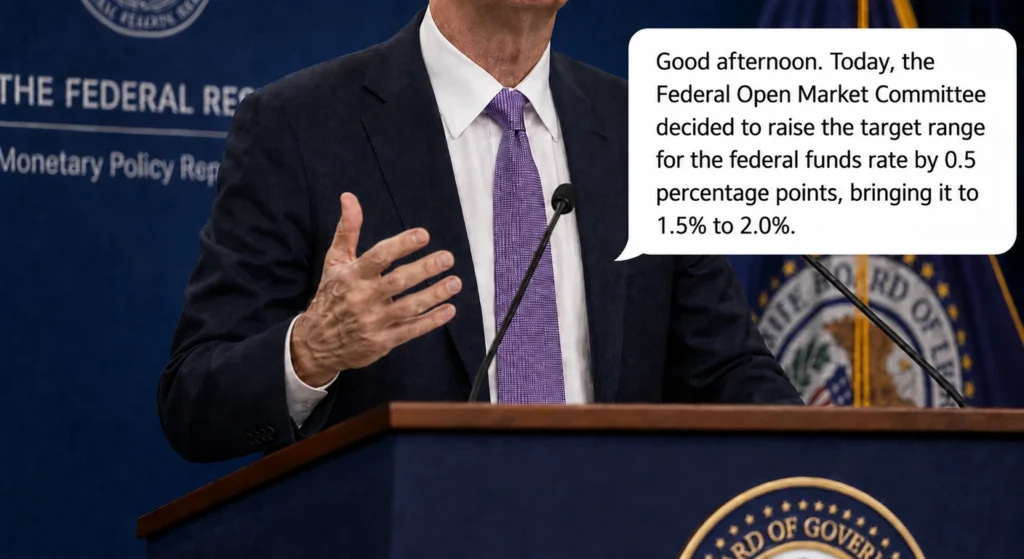
Let’s assume that one day, the central bank governor sits at a press conference and announces this.
“Good afternoon. Today, the Federal Open Market Committee decided to raise the target range for the federal funds rate by 0.5 percentage points, bringing it to 1.5% to 2.0%“
The base rate, which was previously 1.5%, has become 2.0%. A 0.5 percentage point hike. If you just look at the number, it does not seem like much, right? But from the perspective of financial markets, this is quite a big deal.
Banks may face higher costs to bring in money, bond investors need to recalculate government bond yields, corporate bond yields, and bank bond yields, and companies may find it more expensive to borrow money going forward. And individuals may feel it a little later through auto loans, credit card loans, and mortgage interest burdens.
The starting point here is the 📌 「central bank base rate」 The central bank base rate is the key interest rate used by the central bank to set the direction of interest rates across the entire market.
When the central bank raises interest rates, it sends this signal to the market.
✅ “We will make the cost of borrowing money more expensive going forward.”
On the other hand, when it lowers interest rates, it sends this signal.
✅ “We will make the cost of borrowing money cheaper going forward.”
The central bank moves the starting point of the interest rate environment, and that shock passes through the money market, bond market, and banks’ funding costs, eventually coming down to us and to companies.
In the United States, you can think of it as the Fed’s policy rate; in the Eurozone, the ECB policy rate; in the United Kingdom, the Bank Rate; and in Japan, the Bank of Japan’s policy rate.
💬 TMI: You can understand base rate and policy rate as almost similar terms. The exact name differs slightly by country and central bank, but the broad meaning is the same. It is the core interest rate used by the central bank to set the direction of interest rates across the whole market.
2. After the Interest Rate Announcement, the First Places to React Are Broadly Two Paths
So, if the central bank raises the base rate from 1.5% to 2.0%, does the loan rate we already have go up immediately that evening? No, it does not.
There are places that react first. Broadly, there are two paths. The first is the 「money market」, and the second is the 「bond market」
The money market is a market where banks and financial institutions borrow and lend money for short periods, and the bond market is a market where bonds like government bonds, corporate bonds, and bank bonds are traded.
💬TMI: The representative ways banks bring in money include deposits entrusted by customers, bank bonds issued directly by banks, the money market where they borrow short-term money, and the central bank window used in special situations.
These two, the money market and the bond market, are different markets, but eventually they gather into one place. That is the bank’s funding cost.

3. First Flow: Money Market
The first is the 📌 money market.
What is the money market? As mentioned once above, it is a market where banks and financial institutions borrow and lend money for short periods.
Banks also do not have exactly the right amount of money left every day. When you receive your salary and spend less in a certain month, you think, “Oh? I have a little money left this month.” But in another month, after drinking, ordering delivery, and spending on this and that, you may think, “Huh? Where did my money go? Did my salary really come in?” Banks are similar.
Some banks may have extra money today, and some banks may be short of money today.
What does a bank that is short of money do? It has to borrow. Why? Because the next day, customers may come to withdraw money, or there may be payments to settle. Does the branch manager take out a personal loan to fill the bank’s shortage? Of course not. Banks bring in money like banks.
One of those places is the money market.
And in this money market, there are various transactions such as 『repo transactions』, 『federal funds transactions』, and 『call transactions』 The interest rate attached to those transactions is the rate, and those are called the 📌「repo rate」, 📌「federal funds rate」, and 📌「call rate」
Banks usually use these transactions to raise the short-term funds they need right away. Simply put, the Money Market is where banks borrow short-term money when they urgently need it.
In the United States, the federal funds rate and repo rate are especially important, and in Japan, the term call rate is also used. The names are different, but the core is the same. You can think of them as the interest rates attached when financial institutions borrow and lend money for a very short period.
To explain the repo rate a little more easily:
📝 The repo rate is the interest rate attached when money is borrowed for a short period using bonds as collateral. Simply put, it is the interest rate attached to a transaction like, “I will temporarily leave my government bond with you, so lend me some cash.”
3-1. Why Does the Money Market Rate Rise When the Base Rate Rises?
This part can be confusing.
“If the central bank raised the base rate, why does the interest rate for money borrowed between banks also rise?”
To understand this, we need to look at reserves. Reserves are money that banks hold in accounts at the central bank.
Simply put, it is like “the bank account balance of banks.”
Banks hold a certain amount of money at the central bank, and many major central banks pay interest on this money. When the central bank raises the base rate, the interest banks can receive just by leaving these reserves at the central bank also rises.
💡For example, let’s say the base rate rose from 1.5% to 2.0%.
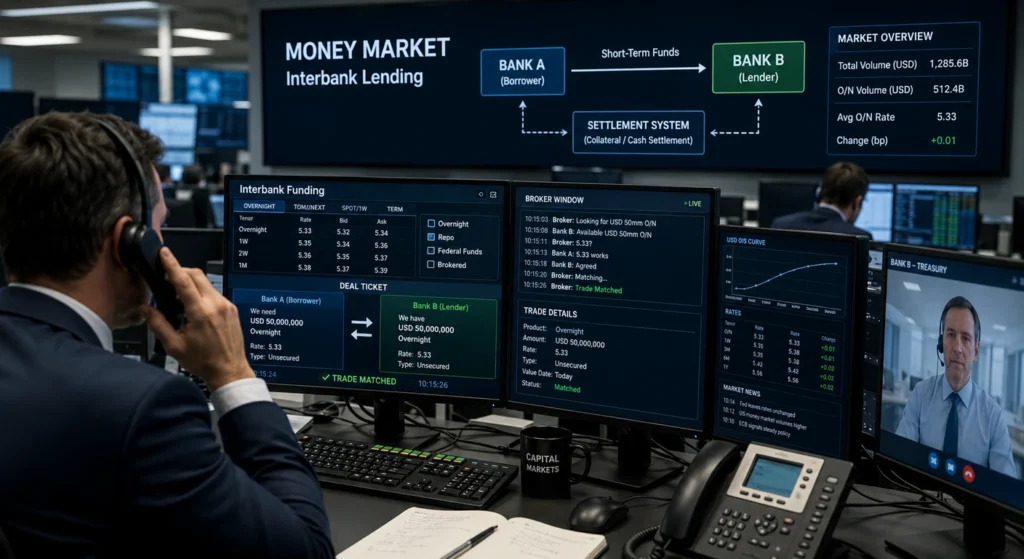
Bank A says to Bank B:
Bank A: “Bank B, lend me some money. How about 1.0% interest?”
Bank B calculates immediately.
Bank B: “Are you crazy? If I leave money at the central bank, I can get around 2.0% interest. Why would I lend it to you at 1.0%? 1.0% crosses the line.”
Bank A changes the condition.
Bank A: “Ah… okay. Then I’ll pay 3.0% interest. Then you can lend it, right?”
Only then does Bank B respond.
Bank B: “Okay. At that level, I can lend it.”
Of course, in the real market, instead of moving wildly like 1%, 2%, and 3%, it often moves tightly in decimal-point units. But the principle is this.
When the central bank raises the base rate, banks no longer want to lend money at low rates. Since they can receive interest by leaving money at the central bank, there is no reason to lend to another bank at a much lower rate.
So money market rates like the federal funds rate, repo rate, and call rate also face upward pressure.
The first thing we looked at was the money market. Then now, let’s go to the second flow, the bond market. Why? What did I say above? The big flows where central bank interest rate changes first spread are the money market and……………… That’s right. The bond market. Banks also fund themselves by issuing bank bonds. Before that, let’s briefly look at what the bond market is.

4. Second Flow: Bond Market
Central bank interest rate changes do not affect only the money market. At the same time, the bond market also reacts quickly.
What is a bond? Simply put, it is a certificate that money was lent.
When the government borrows money, it issues government bonds. When a company borrows money, it issues corporate bonds. When a bank borrows money, it issues bank bonds.
📌
👉Government borrows money → government bond
👉Company borrows money → corporate bond
👉Bank borrows money → bank bond
Here too, the structure is the same. A bond is a certificate that money was borrowed, and the interest rate is the rate attached to that bond.
The interest rate attached to government bonds is the 📌「government bond yield」, the interest rate attached to corporate bonds is the 📌「corporate bond yield」, and the interest rate attached to bank bonds is the 📌「bank bond yield」
Ordinary people like us usually go to banks when we borrow money. But companies and banks do not always use bank loans when they need money. They also issue bonds and directly raise money from the market.
When the central bank raises the base rate from 1.5% to 2.0%, investors immediately calculate.
“Market interest rates may rise going forward.”
“Newly issued bonds will need to offer higher yields to be sold.”
So bond market interest rates also move.
📌 What appears here are government bond yields, corporate bond yields, and bank bond yields. These rates are the core of what we commonly call 「market interest rates」
4-1. What Is a Market Interest Rate?
A market interest rate is not an interest rate directly set by the central bank. It is an interest rate created as money is traded in the market.
Money market rates are also formed in the market, but short-term rates move within the influence zone of the central bank base rate. So they react much more directly to the central bank base rate than the bond market does.
💡For example, a bank short of money says, “I’ll pay this much interest, so lend me some money,” and a financial institution with extra money thinks, “The base rate is already around this level, so that rate feels a little awkward,” and decides whether or not to lend.
Eventually, here too, if there are many sides wanting to borrow money, interest rates rise, and if there are many sides wanting to lend money, interest rates fall.
The bond market is similar. The rate at which the government borrows money, the rate at which a company like Apple or Amazon borrows money, the rate at which a company like Samsung or TSMC borrows money, and the rate at which a bank borrows money are compared with each other.
Investors keep calculating.
“Safe government bonds are giving this much interest.”
“Then Apple bonds should give at least this much to be worth buying.”
“Bank bonds need to offer this much to be attractive.”
📌 This is how the side trying to borrow money and the side trying to lend money continuously match the price, and the interest rate formed in that process is the market interest rate.
5. Corporate Bond Yields and Bank Bond Yields Are Set Based on Government Bond Yields
Inside the bond market, the most important reference point is the government bond yield. The government bond yield is the interest rate the government bears when it borrows money.
It is usually treated as the yield of the safest bond in that country. In particular, U.S. Treasury yields play a very important benchmark role in global financial markets.
💡For example, let’s say the U.S. Treasury yield is 3%. This means a bond issued by the U.S. government pays 3%. But let’s say Apple issues corporate bonds and offers the same 3%.
Then where would investors want to put their money?
The U.S. government? Or Apple?
No matter how great Apple is as a company, the U.S. government is usually seen as safer. Then from Apple’s perspective, it cannot raise money.
Why?
Because investors think this.
“Safe government bonds give 3%, so why would I buy corporate bonds? If you want to receive money, add enough interest to compensate for the risk.”
📌 So corporate bonds and bank bonds usually have to offer more interest than government bonds. The additional rate added to the government bond yield is called a 「credit spread」
📌
👉Corporate bond yield = government bond yield + company credit spread
👉Bank bond yield = government bond yield + bank credit spread
A credit spread is, simply put, the cost of bearing risk. It means that because it is riskier than government bonds, it has to give this much more for investors to buy it.
Now, various bonds line up based on the government bond yield. You can buy corporate bonds from large companies like Apple, Amazon, Nvidia, Samsung, and TSMC; you can buy bank bonds; or you can buy bonds from unknown companies with low credibility.
There are many choices. The only difference is the risk.
Safe bonds sell even if they give only a little interest, while risky bonds have to add more interest to sell.
For example, let’s say there are choices like this in the market.
👉Government bond yield: 3.0%
👉Apple corporate bond yield: 3.6%
👉Amazon corporate bond yield: 3.8%
👉Bank bond yield: 4.0%
👉Low-credibility corporate bond yield: 6.0%
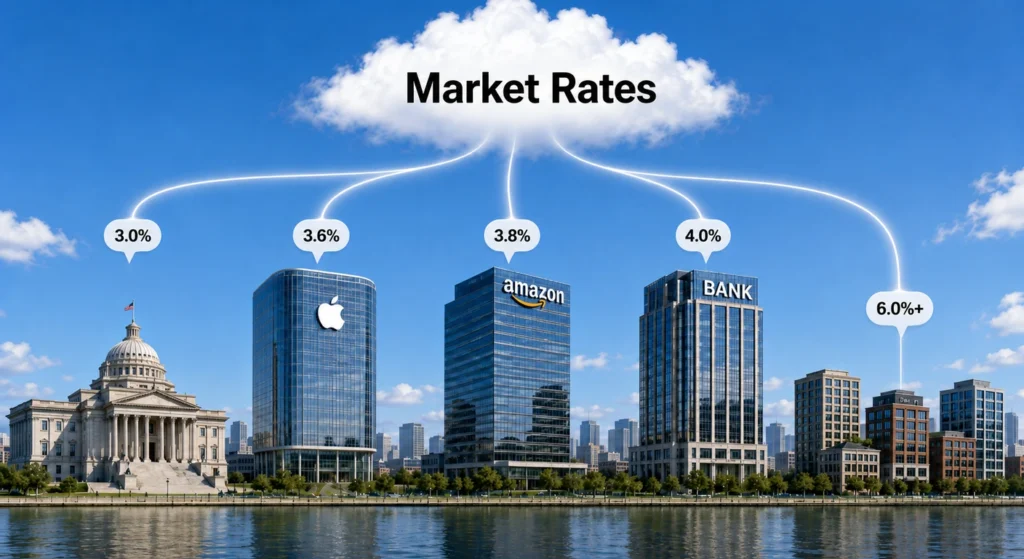
Investors compare like this.
👉“Government bonds are 3.0%, so is Apple’s 3.6% okay?”
👉“If bank bonds are 4.0%, is that worth buying for the risk?”
👉“An unknown company says it will give 6.0%, but can that company really pay the money back?”
Like this, inside the bond market, government bonds, corporate bonds, and bank bonds are compared with each other. Government bonds are the reference point, and corporate bonds and bank bonds have credit risk added on top of that, so their yields are determined.
Therefore, corporate bond yield is the interest rate applied when a company borrows money from the market, and bank bond yield is the interest rate applied when a bank borrows money from the market.
6. Banks Look at Market Interest Rates and Issue Bank Bonds to Raise Money
Now, let’s return to banks.
Earlier, we said one way banks fund themselves is bank bonds, right? A bank bond is a bond issued by a bank to borrow money.
The bank says this to the market.
“Our bank will borrow money. We will repay the principal after a few years, and we will pay interest in the meantime.”
When an investor buys that bank bond, the bank brings in money.
But can the bank attach any interest rate it wants to the bank bond? Absolutely not. It has to look at market interest rates.
As mentioned above, interest rates also form as market rates with a competitive nature. The bank has to look at the government bond yield, the yield on large corporate bonds like Apple’s, the yield on other bank bonds, and how much investors currently dislike risk.
Let’s say that in the past, the bank could issue bank bonds at a 4.0% rate. But after the central bank raised rates, and government bond yields and corporate bond yields also rose, now the bank bonds need to offer at least 5.2% to be sold.
Then the bank’s funding cost rises.
The flow is like this.
Market interest rates rise
👉 Bank bond yields rise
👉 The cost for banks to bring in money through bonds rises
👉 Bank funding costs rise

7. The Two Flows Eventually Gather into Bank Funding Costs
Now, we are almost there.
At first, it was the central bank base rate. Then we went to the money market and looked at money market rates like the repo rate, federal funds rate, and call rate. On the other path, we went to the bond market and looked at government bond yields, corporate bond yields, bank bond yields, and credit spreads.
It looks complicated, but eventually it gathers into one place.
📍 Bank funding costs.
From the bank’s perspective, what matters is simple.
“So how much did it cost us in total to bring in money?”
In the money market, there is a cost when banks borrow short-term money,
and in the bond market, there is a cost when banks issue bank bonds and bring in money.
In addition, with deposits, the interest paid to customers becomes a cost,
and in special situations, using the central bank window can also involve costs.
In the end, the bank’s overall funding cost can be seen simply like this.
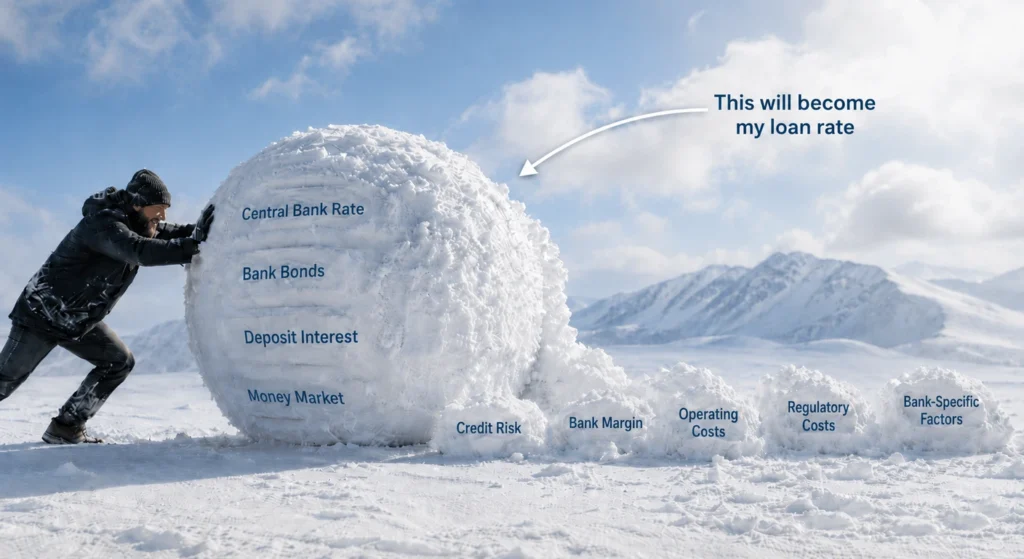
Bank overall funding cost
= deposit rate + bank bond yield + money market funding cost + other funding costs
8. Bank Funding Costs Eventually Lead to Loan Interest Rates
Once we get here, we are now right in front of our actual loan rates.
The change that started from the central bank base rate has passed through two big paths, the money market and bond market, and gathered into bank funding costs.
Then, from the bank’s perspective, the calculation begins.
📌“It cost us this much to bring in money, so how much should we lend it out for so that we do not lose money?”
📌If a bank brought in money at a 4% cost and lends it to individuals or companies at 3%, that is a loss. Then is the bank doing charity? Of course not. Banks are businesses too.
💬TMI: Bank lending is not only a structure where banks simply take money out of a vault and hand it over. There is also a structure called credit creation, where deposits are created together when loans are made. But if we go down into that deep basement here, our heads will hurt. In this article, we will focus on why loan rates move, in other words, the bank’s funding costs.
So the bank takes one more look here.
📌Based on the cost of bringing in money, the bank adds bank-specific conditions such as the risk that the borrower may not repay, the profit the bank needs to leave, operating costs, and regulatory costs, and finally adjusts the rate we receive on loans.
To express everything we have said so far in one sentence:
📍If the bank brings in money cheaply, there is room to lower loan rates,
📍and if the bank brings in money expensively, loan rates face upward pressure.
The interest rate applied when an individual borrows money from a bank is the 📌「personal loan rate」 Mortgage loans, credit loans, auto loans, and credit card loans are included here.
The interest rate applied when a company borrows operating funds or investment funds is the 「corporate loan rate」 From a company’s perspective, if this rate rises, decisions like building factories, expanding equipment, or hiring more people can become burdensome.
Of course, depending on whether it is a 📌「fixed-rate loan」 or 📌「a variable-rate loan」, the speed of reflection can differ. A variable rate can be adjusted according to the cycle set in the contract, and a fixed rate is maintained during the existing contract period, but when the maturity ends or the loan is refinanced, it can be affected by the changed interest rate.
📝The speed at which these rates are reflected also differs by market. In the case of the money market and bond market, they can be reflected within seconds, minutes, or hours, and sometimes the market even moves before the interest rate announcement press conference. That is how sensitive these areas are.
📝On the other hand, existing loans that we actually feel in real life can take several months to reflect, depending on whether they are fixed-rate or variable-rate and what the rate adjustment cycle is. New loans tend to reflect relatively quickly, so the changed interest rate environment can be reflected as quickly as within a day, or over several days.
Like this, if you memorize interest rates one by one, they become complicated. But if you look at the flow from the central bank down to personal and corporate loan rates, the concept of interest rates becomes relatively easier to understand.
The central bank sets the base rate, and based on that base rate, it affects the money market and bond market. That effect influences the funding costs of the banks we use, and at the end, it affects the interest that we or companies have to pay.
⚠️Of course, if you open up this structural framework directly, there will be more various information, and there will be things I could not cover. But when viewed in the big picture, interest rates flow in this way, and I hope this helped at least with what you were curious about.
