

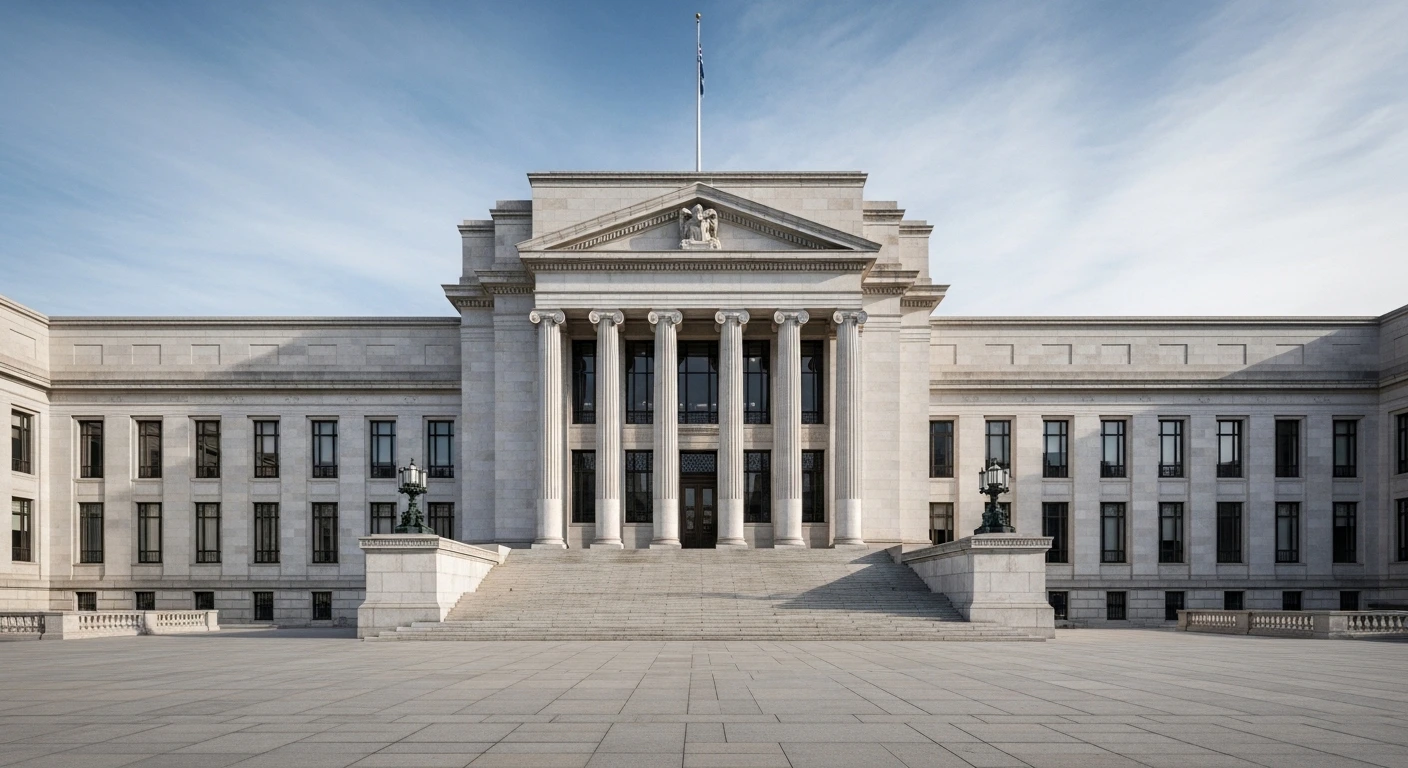

In this post, we will slowly look into what a central bank is and why it was created. Starting from the question of whether it is simply an institution that prints money (money supply), a place that only announces interest rates, or a core institution that moves the entire financial system, I will try to unpack the background behind the birth of the central bank and the various stories contained within it. Through this, let us become a little more familiar with the money and financial system that we use in everyday life.
The First Clue of Curiosity, What Is a Central Bank?
When people usually think of a central bank, they tend to think, “Isn’t it the place that prints money?”, “Isn’t it the place that announces interest rates?”, or “Doesn’t it mean something like the Federal Reserve?” In fact, all of those are correct. However, those expressions only show one part of what a central bank is, and if we organize the idea a little more, we can understand much more clearly what kind of institution a central bank is. This time, let us take a slightly deeper look into the central bank, which many of us have only known through surface-level knowledge.
If we were to describe a central bank in one sentence, it can be seen as an institution that manages the flow of money in a country.
It is the place that sometimes manages the flow of money, sometimes stabilizes the financial system, and sometimes holds up a shaking market.
But what does it mean to manage the flow of money?
First, let us start with the expression we commonly use: “the place that prints money.”
That is correct to some extent. A central bank is responsible for deciding the amount of money that will newly enter the market and for managing the issuance of currency. In other words, it means that it is the key institution that determines how much new money that is not yet in circulation will be supplied. The reason it adjusts the money supply in this way is to manage the flow of the market according to economic conditions. When the economy is in recession, it increases the supply of money to support consumption and investment, and on the other hand, when too much money has been released and the risk of prices rising grows, it also plays the role of controlling the money supply to prevent or ease inflation.
Here is one thing worth knowing. The banknotes we use when paying at restaurants or shopping malls are usually not made directly by the central bank, but by a specialized institution such as a “mint“. When the central bank decides how much to issue, the mint produces the actual currency according to that decision. In the end, even if the actual production is handled by another institution, the starting point of issuance is the central bank, so the expression “the central bank prints money” is not entirely wrong either.

(TMI: There is a Spanish drama related to the mint on Netflix, “Money Heist.” It was so fun that I binge-watched it three times. And only then did I realize what kind of place a mint actually is.)
However, this structure is not exactly the same in every country. Depending on the country, the central bank may handle issuance while private printing companies produce the currency, in a monetary union several central banks may share the production, or there may even be exceptional cases where the country does not have its own banknotes at all.
Then what about the expressions “the place that announces interest rates” or “a place like the Federal Reserve”? These are also correct.
A central bank manages the speed of the market by adjusting interest rates when the economy becomes too overheated or, on the contrary, too frozen. If the economy gets too hot, it raises interest rates to cool the overheating, and if the economy gets too cold, it lowers interest rates to encourage consumption and investment to come back to life. Put simply, it acts as a device for adjusting the economy. And the place that officially announces the direction of these interest-rate policies is also the central bank.
When the subject of interest rates comes up, it is hard to leave out the Federal Reserve (Fed), the central bank of the United States. Because the dollar is the most influential currency in the international financial market, a U.S. interest-rate decision does not end within the United States alone but has a major impact on financial markets all over the world. That is why the whole world often becomes tense over a single announcement from the Federal Reserve. This part will be covered in more detail in a future post.
In the end, a central bank is not simply a place that prints money.
It can be seen as an institution that manages and adjusts a country’s money so that the economy does not shake too greatly, while protecting the value of money and the balance of finance.
And if we look at why the central bank was created, where it began, and when and for what reasons it emerged, the image of the central bank that we only knew on the surface will appear far more three-dimensional. That is because more historical events and necessities than one might expect were hidden behind the birth of the central bank.

When, where, and how was the central bank created, and why was it created?
The first central bank began in 1668 with Sweden’s Riksbank.
However, when it comes to the starting point of the “modern central bank” that we think of today, the Bank of England, established in England in 1694, is usually mentioned more often.
So when talking about the “first,” Sweden is often used as the reference point, and when talking about the “modern central bank,” England is often used as the reference point.
But the early central bank was not an institution created to control prices and adjust interest rates like it does now.
Its first beginning was much simpler.
At the time, the government needed a large amount of money to wage war, and it needed a way to raise that money more stably.
Put simply, the first central bank was close to being the government’s wallet and a window for raising war funds.
But did the role of the central bank end just because the war ended? That is not the case.
Even after the war ended, the government still had to manage taxes, repay debts, and issue government bonds.
As a result, the central bank naturally remained as an institution that continued managing the government’s money.
But the private financial system at the time also had far more than just one or two places that needed fixing.
Shall we take a look at history?
In the 17th century, there was almost no system like today in which “a nation’s currency is issued only by the central bank.”
At that time, because metallic currency such as gold and silver was at the center, it was not only the government that made things similar to money. In England, even goldsmiths began issuing receipts to people. As time passed, private banks and local banks also began putting out paper-like things under their own names.
These *goldsmiths’ receipts were originally a kind of certificate saying, “The gold you deposited is here.”
But as time passed, this paper began to be used like money among people.
*Goldsmith (Goldsmith): People in 17th-century England and elsewhere who used strong vaults to store people’s gold and issued receipts. These receipts later circulated like currency and became one of the early forms of modern banking.
On the surface, this system seemed to be working well.
But as time passed, problems began to appear one by one.
- The kinds of money became excessively numerous
(Government-issued currency, goldsmiths’ receipts, and hundreds or thousands of private and local bank currencies) - It became difficult to know which paper was truly trustworthy
- If a bank failed, the paper issued by that bank also fell greatly in value
- When a crisis came, people rushed all at once to withdraw the money or gold they had entrusted *(bank run)
*Bank Run
A phenomenon in which people become anxious, thinking, “Isn’t that bank going to fail?” and rush all at once to withdraw their money, and that anxiety actually brings the bank down.

In the end, if we summarize the problem of that time in one sentence, it is this.
Trust in money was too unstable.
So although the central bank was first created to solve the government’s money problems, as time passed its role gradually grew larger.
At first it was “the government’s wallet,” but later it developed into “an institution that holds up trust in money,” “an institution that stabilizes the banking system,” and “an institution that supports the market in times of crisis.”
In other words, the central bank did not appear from the beginning as a completed form,
but became what it is today as roles were added one by one as the problem of war funds and the confusion of the financial market overlapped.
So if we look at why the central bank is needed and what core roles it came to take on, the flow becomes much clearer.
Let us dig into it right away.
The “Representative Reasons” Why a Central Bank Was Needed and Its “Core Roles”
The first is to unify currency and preserve its value by “controlling the money supply”
If, as in the past, each bank issued its own money, the credibility and value of each currency could differ, creating major confusion. So the central bank took charge of managing currency issuance in an integrated way and adjusting the amount of money circulating in the market in order to stabilize prices and the value of money.
The second is to stabilize the financial system by serving as the “lender of last resort”
Just as ordinary citizens go to a bank to receive loans, banks also borrow money from other banks when they lack funds. However, in a crisis where the entire financial market is shaking, there may be no one left to borrow from. At that point, the very last place they can rely on is the central bank. The central bank supplies the necessary funds and acts as the final safeguard that blocks the chain collapse of banks. In a word, it plays the role of “the bank of banks,” that is, the lender of last resort.
The third is to regulate the economy by “setting interest rates”
When the economy is booming and our family, friends, and neighbors are all buying houses and cars, and the burning desire to buy anything that seems profitable begins to spread, consumer enthusiasm can easily overheat. At times like that, the central bank cools down the overheated market by throwing cold water on it through interest rate hikes. On the other hand, when the economy is in recession and consumption is so weak that even the price of a meal or transportation feels burdensome, the central bank cuts interest rates to reignite extinguished consumer desire and bring warmth into a market filled with cold air, thereby moving the economy again. In this way, the central bank plays the role of keeping the economy from becoming too hot or too cold.
The fourth is because it had to allow the government to borrow large sums of money in a stable way.
Both now and in the past, wars have happened endlessly, and each time, the amount of money governments must spend goes beyond imagination. Roads have to be built, industrial facilities and public infrastructure have to be maintained and reinforced, and there are many places where money must be spent, but the taxes we pay alone are nowhere near enough. In wartime, this is even more true.
At such times, governments looked for places to borrow money because the tax revenue people paid was still far from enough. In the past, this meant borrowing directly from the central bank, but today most governments issue government bonds and borrow money from the market. This method pulls in funds already circulating in the market rather than creating money directly through the central bank, so it produces relatively less inflationary pressure.
However, in situations such as a national disaster like the COVID-19 pandemic or a severe economic crisis, the power of the central bank becomes necessary. In such times, governments may not borrow directly from the central bank, but may instead raise funds in a way where the central bank purchases government bonds.
Interesting Stories Entangled with the Central Bank
Let me bring up some stories that are directly connected to the central bank and at the same time interesting.
In the world, there are people who try to perfectly duplicate something, like “Catch me if you can,” and there have also been people who ended up performing the role of a central bank for the sake of a country.

“Counterfeit Money”
During the American Revolutionary War (1775–1783), the United States printed paper money called “Continental Currency” in order to finance the war.
But Britain, then the world’s strongest power, targeted this currency and waged economic warfare.
It circulated counterfeit notes and tried to destroy the American economy by shaking trust in the currency.
What happens when too much money is released? And what if counterfeit currency is mixed into it?
- Naturally, the value of the existing money collapses
- Prices skyrocket
In the end, people stopped trusting that money, and even a saying appeared:
“Not worth a Continental”
This was not just a problem of counterfeit money.
It was a representative case showing that
“if trust in money collapses, it is nothing more than scraps of paper.”
“The 1907 American Financial Panic — The J.P. Morgan Incident”
This story is real.
Even people who do not know much about investing have probably heard the name J.P. Morgan at least once.
In 1907, a financial crisis broke out in the United States.
Banks were driven to the brink of collapse, and people began rushing to withdraw their money.
This was a bank run.
The problem was that at that time, there was no central bank in the United States.
(It was a chaotic period in which a central bank had been created and then abolished.)
Then who was supposed to stop this situation?
Today, the government would respond in cooperation with the central bank, but at that time it could not.
The person who appeared then was J.P. Morgan.
Is this the kind of moment when people say that a hero appears in chaotic times?
At the time, J.P. Morgan was not just a rich man. He was someone with a level of influence capable of moving the entire financial system.
He gathered major bankers in one place and said,
“If we don’t release money now, we all go under.”
There is even a story that he locked the doors so they could not leave.
In the end, he gathered
- his own funds
- the funds of other banks
and injected them into the market, calming the bank run and preventing the collapse of the financial system.
Literally,
J.P. Morgan, as an individual, ended up playing the role of a central bank.
After this incident, the United States realized:
“We need an institution that can control finance from the center.”
And eventually,
“the Federal Reserve (FED)” was established.
The Federal Reserve System
Unlike other countries, the United States uses the name Federal Reserve System instead of the term “central bank.”
There is quite an interesting background behind this structure and this name,
and I will deal with that part in more detail separately after finishing the explanation of the central bank.
Finally, the Debate Between the Independence Camp and the Anti-Independence Camp of the Central Bank
In the past, there was an endless debate between those who argued that the central bank should keep its distance from the government and those who argued that it should be under government control. The independence camp believed that if politicians handled money and interest rates recklessly, the economy would be easily shaken, while the anti-independence camp argued that the central bank, too, should move within the broad framework of the government chosen by the people.
Today, however, the debate has shifted to “how far does independence reach?”
For example:
- How much government influence should be allowed in interest-rate decisions?
- How far should the central bank intervene during a crisis?
- Up to what point is political pressure acceptable?
Let us dig much more deeply into this old debate — along with specific history and real-world cases of conflict — in the U.S. Federal Reserve (FED) post.

1 thought on “What Is a central Bank (and the Federal Reserve)”
Comments are closed.