


※ In the previous post, we looked at what the exchange rate is, why it came into being, what factors move it, and what effects it has on our daily lives.
But the exchange rate is not some tame thing that is just a few numbers printed on a screen. On the surface, it may look quiet, but behind it, a huge battleground is unfolding where money clashes with money and the calculations of one country get tangled up with those of another.
In this post, I want to step a little deeper into the middle of that battlefield. I plan to go through, one by one, how visible numbers and actually felt value can differ so much, as in nominal exchange rates and real exchange rates; how some countries try to hold the exchange rate down tightly while others throw it to the market, as in fixed exchange rate systems and floating exchange rate systems; and how money flows around and shakes inside the foreign exchange market.
And the story does not end here. Along with interesting stories about why the dollar shows up so often in international trade, and why countries pile up dollars as if sweeping them in whenever things get unstable, this post will take a deeper look at the real face of the exchange rate that was hiding behind the numbers.
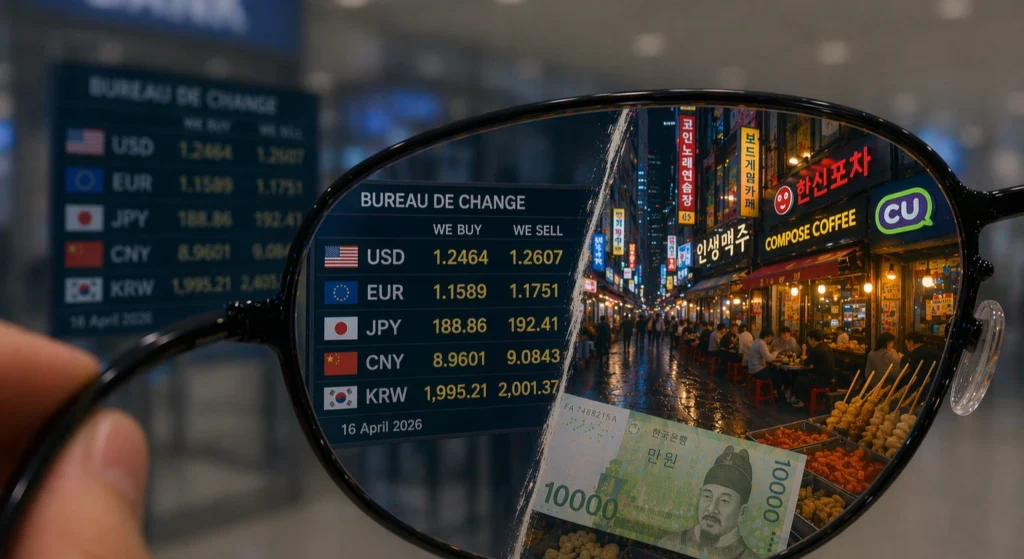
Nominal Exchange Rate and Real Exchange Rate
Let us assume that a British person is going on a two-week trip to Korea.
Before leaving, he might roughly think like this.
“If I am going to stay in Korea for two weeks, around 4,000 dollars should be enough to be safe, right? Let me check the exchange rate first….”
But when he actually looks up the exchange rate, it is not as bad as he thought.
“Huh? The exchange rate is really low? Then around 3,000 dollars should be enough!!”
So he happily exchanges about 3,000 dollars.
At this point, the exchange rate he searched on the internet, or the one he saw on a bank display board,
that is the nominal exchange rate.
It is, literally, just a number that comes from comparing one currency with another, the ordinary exchange rate we most commonly see in the news or at the bank.
But the real problem begins when he arrives in Korea.
After actually arriving in Korea and staying a few days, something feels strange. Meals are more expensive than expected, transportation is not cheap either, and accommodation feels burdensome. At first, he was happy because the exchange rate looked favorable, but once he actually started living there, it did not feel cheap at all.
So a thought like this pops into his head.
“What is this! I thought it would be great because the won exchange rate looked favorable from the pound’s point of view, but this is nothing to be happy about. Why is Korea so expensive!!! 3,000 dollars is not going to be enough, is it? I would probably need around the 4,000 dollars I originally set aside to get through the remaining two weeks without worrying….”
This is exactly the important point.
If you only look at the exchange rate on the surface,
you can say,
“Oh, the exchange rate looks good this time?”
and be happy.
But once you actually go there and start buying meals, taking the subway, going to cafes, booking accommodation, and spending money on various things, what you feel can become completely different. In other words, the exchange rate number looked good, but the actual cost of living may not be good at all.
📌That is why the concept of the real exchange rate is needed.
There is no need to think about this too difficultly.
You can simply understand the real exchange rate, from the perspective of a traveler who is about to go on a trip, as a concept that looks at the local prices of that country together with the exchange rate.
As for theory, and how economics explains it, let’s leave those difficult stories aside.
When going on a trip, it means that looking only at the nominal exchange rate is enough, and there is no need to go as far as calculating prices in a complicated way.
📝So before going on a trip, it helps to also look at what prices are like in that country. The nominal exchange rate can be checked right away on the internet or at a bank, and for local prices, it is much more realistic to first look through things like YouTube reviews, blog reviews, or travel communities.
However, since I think there may be some people who are even a little curious, to explain it very simply,
📌the real exchange rate in economics is a concept that reflects the nominal exchange rate plus the relative price levels of the two countries.
In other words, it is not just about looking at how much my money and that country’s money are exchanged on the surface, but also about looking together at how expensive or cheap the prices of goods and services in that country are compared to my own country.
At this point, a thought like this may come to mind.
“Then shouldn’t they just show the real exchange rate from the beginning when comparing exchange rates? Why do they always show only the nominal exchange rate?!!”
This is also a perfectly valid question.
But the real exchange rate is not that simple like the nominal exchange rate. When calculating the real exchange rate, the value can change depending on the price levels between the two countries, such as CPI or the GDP deflator. In addition, these statistics do not change instantly in real time like the nominal exchange rate, and are usually updated slowly, such as on a monthly or yearly basis.
So it is difficult to show it clearly right at this very moment, like the news or a bank exchange-rate board does.
📍So there is no need to hold on to the term real exchange rate as if it is something very difficult and grand. You can just think of it like this.
✅The nominal exchange rate is the exchange-rate number you can see,
✅and the real exchange rate is the exchange rate that comes out after reflecting the price levels of both countries in the nominal exchange rate.
✅(From a traveler’s point of view, it is enough to look only at the exchange-rate board at the exchange booth and the prices in the country you are going to travel to.)
Fixed Exchange Rate System and Floating Exchange Rate System
One day, a fellow called the exchange rate was released into the middle of the market.
Originally, the value of money is quite sensitive. It shakes with just a little anxiety, and it goes wild with just a little expectation. One war headline, one interest rate announcement, one piece of U.S. economic news, and it can suddenly leap like crazy, or slump helplessly.
And then some countries look at this chaos and think:
“Let’s just tie this thing down.”
That is the fixed exchange rate system.
On the other hand, some countries say:
“Leave it. Let it move on its own in the market.”
That is the floating exchange rate system.

Let us first look at the fixed exchange rate system
A fixed exchange rate system literally means a system that tries to keep the exchange rate fixed at a certain level as much as possible.
For example,
it is like deciding,
“1 dollar will be kept around 1.35 Canadian dollars.”
Simply put, it is like the country putting a leash on the exchange rate.
📌If the exchange rate tries to jump upward, the government or central bank sells or buys dollars and pulls it back down again. If it tries to sink downward, they intervene again and prop it up by force.
In other words, instead of leaving it to the market,
the country itself steps in and says,
“Hey, do not move from there,”
and holds it in place. That is the system.
The advantages of this system are quite attractive.
👉 The exchange rate does not fluctuate wildly
👉 It is easier for companies to calculate when doing trade
👉 Importers and exporters can both make predictions to some extent
In a word, it has a sense of stability.
But the problem is that this stability is not free. To hold down the exchange rate by force, the country has to hold an enormous amount of dollars. That is because every time the exchange rate shakes, it has to jump directly into the market and stop it.
When this gets serious, what happens?
The market starts asking more and more questions.
👉 Can they really keep stopping it?
👉 Do they have enough dollars?
👉 Do they have the stamina to endure?
Once people begin to doubt, from that point on they swarm in like sharks that smell blood. Everyone rushes to buy dollars all at once, and a moment comes when the country cannot handle it no matter how much it tries to stop it.
Then what happens in the end?
The exchange rate that had been forcibly held down all that time suddenly snaps loose one day. The fellow that used to be quiet starts running wild like a fierce dog whose leash has been cut.
In other words, a fixed exchange rate system may look peaceful on the outside, but inside, it can be an enormous battle of endurance.

Now it is the floating exchange rate system
A floating exchange rate system is much more straightforward.
“The exchange rate? Let the market decide.”
That is the mindset.
It is a system where the exchange rate moves according to supply and demand.
The government may not completely let go, but the basic principle is this.
➡️ Do not tie it down by force
➡️ Let it go according to the flow of the market
This is similar to not blocking the flow of a river and just letting it flow. If it rains, the water level rises; if there is a drought, the water level falls. It may look unstable, but it is considered better than blocking the waterway by force and causing it to burst.
The advantages of a floating exchange rate system are clear.
👉 It reflects reality quickly
👉 The market’s evaluation shows up in the price right away
👉 Compared with a fixed exchange rate system, there is relatively less need to keep pouring in dollars endlessly
For example, one day 1 dollar may equal 1.35 Canadian dollars, then a few days later it may become 1.38 Canadian dollars, or on the contrary, it may fall to 1.32 Canadian dollars. This is the market repricing the exchange rate according to the situation at each moment.
But the downside is also very clear.
The exchange rate can fluctuate a lot.
Today, 1 dollar = 1.35 Canadian dollars; next month, 1.42 Canadian dollars; and on some other day, 1.30 Canadian dollars.
When it swings like this,
👉 importing companies get headaches
👉 people going overseas have more complicated calculations
👉 people with dollar debt feel their hearts drop
In other words, the floating exchange rate system gives freedom, but gives instability along with it.
To sum up, the feeling is like this.
The fixed exchange rate system is a way of putting shackles on the exchange rate and having the country hold it down. It is stable, but to maintain it, a lot of money and stamina are needed.
The floating exchange rate system is a way of releasing the exchange rate into the market. It is more natural and reflects reality faster, but instead, it shakes often.
✅ Fixed exchange rate system = a system that ties the exchange rate down
✅ Floating exchange rate system = a system that leaves the exchange rate to the market
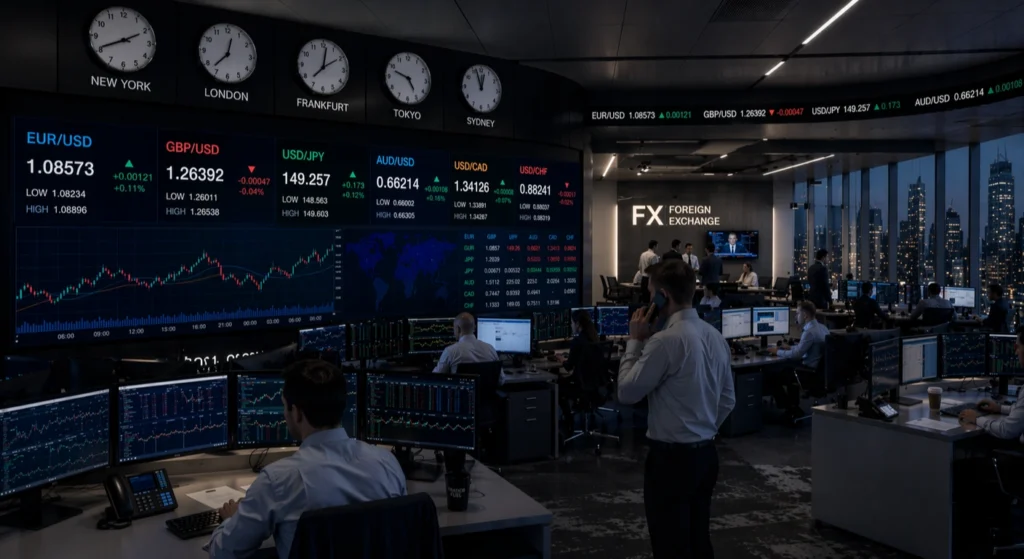
Foreign Exchange Market
When many people hear the word “trader,” the first thing they imagine is a stock screen. Names like Apple, Tesla, and Nasdaq come up, charts move up and down, and someone presses buy and sell buttons.
But in this world, there is a bigger arena where not companies but money itself is traded. That is the foreign exchange market.
What you look at in the stock market is a company. You trade by looking at whether that company will do better or shake more.
But in the foreign exchange market, the perspective changes completely. Here, you do not look at companies; you look at exchange rates. Currency pairs like euro/dollar, dollar/yen, and Australian dollar/U.S. dollar move, and people buy and sell while looking at the changes in those numbers.
There are charts, and there are buys and sells, just the same. But the difference is that stocks trade company prices, while foreign exchange trades the exchange ratio between money and money.
So the foreign exchange market is fully a “world of trading” too. There are traders who enter based on whether exchange rates will rise or fall, and there are people who make it their profession.
Companies cannot live apart from this market either. If they buy and sell goods overseas, they end up needing another country’s money, and the moment that happens, they are connected to the foreign exchange market. On the outside, it looks like investment, but inside, it is a place where payment and trade are all tangled together. That is the foreign exchange market.
And the truly scary thing about this market is its size.
According to the Bank for International Settlements (BIS), as of April 2025, the average daily trading volume of the global OTC foreign exchange market was 9.6 trillion dollars.
📍 Per day.
Not per year, but 9.6 trillion dollars moved in a single day.
(As of the end of 2024, the New York market’s daily trading volume is approximately 250 billion dollars, and the foreign exchange market is roughly close to 40 times larger than this.)
BIS describes the foreign exchange market as the largest financial market in the world, and sees its trading volume as much larger than activity in global stock markets.
Why is it this huge?
Because this market is not a place visited only by a few traders. People going on trips exchange money, companies paying for foreign goods exchange money, companies receiving export payments exchange money, banks continuously adjust their positions, funds trade, and if necessary, even central banks move.
In a word, the foreign exchange market is not a “market with only investors,” but a market where real money in the real world actually flows. That is why its trading volume can only be overwhelmingly large.
There is also a reason why this market almost never rests.
Stock markets have clearly defined trading hours. For example, the regular session of the New York Stock Exchange is from 9:30 a.m. to 4:00 p.m. on weekdays.
The foreign exchange market, by contrast, operates in a way where one region hands off to another when it finishes. People usually explain this flow as Sydney → Tokyo → London → New York → Sydney again.
BIS also explains that foreign exchange trading begins on Monday morning in the Asia-Pacific region and continues around the clock until Friday afternoon in New York, as if the clock never stops.
So when you look at the foreign exchange market, it feels a bit different.
It is not a place where you ask, like in the stock market, “Which company will go up?” It is a place where “How much does this money become if I exchange it for that money right now?” is swinging in real time. The shape of the chart is similar, but the thing fighting inside is different.
In the stock market, companies are the listed items, but in the foreign exchange market, currency pairs are the listed items. Just by catching this one difference, the foreign exchange market becomes much clearer.
To sum it up very simply, it is this.
The foreign exchange market is a huge real-world arena where the world’s money collides with one another. What is traded here is not companies, but currencies. There are charts, buys and sells, and traders. The difference is that stocks are bought and sold by looking at companies, while foreign exchange is bought and sold by looking at exchange rates. And its scale is overwhelming, reaching an average of 9.6 trillion dollars a day as of 2025.
The Dollar Is an Asset
Because the dollar has long been sitting at the center of world trade, its presence becomes even bigger not only in visible places but also in invisible ones. Usually it does not show itself very clearly, but once the world begins to shake, what one had in hand in the end is what separates expressions. Even if it does not show in quiet times, once a strong wind begins to blow, hidden preparation starts revealing itself one by one.
Shall we look into it more closely?
Why is the dollar used so much in international trade?
There are many countries in the world, and each has its own money. Korea has the won, Britain has the pound, Europe has the euro, and Japan has the yen.
On the surface, it feels like, “Why not just each use their own money?” But international trade does not work that innocently.
The problem starts the moment one country tries to buy goods from another country.
“We want to be paid in our own money.”
“No, it is easier for us to pay in our own money.”
The moment each side pushes forward its own currency like this, the trade suddenly becomes tiring. You have to calculate the exchange rate, worry about whether the value will swing in the middle, and even consider whether the other side can easily exchange that money. You are buying and selling goods, but before you know it, the money itself has become the more troublesome problem.
At this moment, the dollar appears.
📌 Simply put, the dollar is the common language of the international trade arena. Just like people who are not good at English still try English first when they go abroad, countries too often take out the dollar first when trading with one another.
Why?
📌 Because it is the money that is used the most, circulates the most, and can be exchanged the most easily.
Let us take an example. A Korean company trades with a Brazilian company, the Brazilian company buys raw materials from Saudi Arabia, and Saudi Arabia signs contracts with yet another country. If every time they had to say, “Shall we do it in won, in real, in riyal?” their heads would explode.
So everyone uses the dollar, which they are already familiar with, which banks readily accept, and which overflows in the market. If you use dollars, calculation is easier, price comparison is easier, and later it is easier to exchange it into another country’s money. In a word, it is something like a lubricant that forcibly keeps complicated international trade running.
And that is not the end of it. The prices of key raw materials such as oil, gas, grains, and metals are also mostly quoted in dollars. In other words, the price tags of important goods in the world economy are often already written in dollars.
So using dollars in international trade became, at some point, not so much a choice as a habit. Since the majority already use it, it is more convenient for me to use it too, and once I begin to use it too, the dollar becomes even stronger.
This is similar to how the messaging app that many people use ultimately becomes bigger. People may have started using it because they liked it, but later they use it because it is inconvenient not to use it.
And decisively, the dollar is not just a money that is used a lot; there is also a perception underlying it that it is a relatively trustworthy money.
International trade does not involve a few pennies; large sums move around. So if you traded in an unstable currency and the exchange rate swung violently while payment was being made? From a company’s point of view, that is enough to turn the stomach upside down.
In the end, the reason the dollar is used so much is not something grand. It is not because the dollar is the most superior money, but because it is the most convenient, the most widely accepted, and the easiest to trust.
International trade is not romance; it is reality. In reality, the money that is safe, fast, and accepted by everyone beats the money that is merely fancy. And the one that sat on the throne in that fight for a long time was the dollar.
Foreign exchange reserves, why do countries pile up dollars?
Usually, everyone uses their own country’s money. They receive wages in their own currency, pay taxes in their own currency, and buy food in their own currency.
So at first glance, a thought comes up like this.
“If they use their own country’s money, why bother piling up dollars?”
On the surface, that seems like a fair point.
But the problem is that this is only true when the world is peaceful. The moment the economy begins to shake, that question changes in an instant.
👉 “Do we have money that works in the international market right now?”
👉 “Can we pay import bills immediately?”
👉 “Can we endure even if foreign funds flow out?”
From this point, the mood changes sharply.
A country also needs emergency funds. An individual too normally uses cards and bank transfers, but when a truly urgent situation comes, they look for cash they can hold in their hand. A country is similar. Even if things normally run in its own currency, once a crisis breaks out, it needs money that immediately works in the international market. The thing that plays that role is the dollar.
Let us take an example.
One day, the exchange rate suddenly leaps like crazy. Foreign investors begin pulling their money out, saying they are anxious. Things like oil, gas, and grains still have to be imported, and payment is urgent. On top of that, there is overseas debt that has to be repaid.
What if, in that situation, the only thing the country has in hand is its own currency?
That is like a house facing a typhoon with no umbrella, unlocked windows, and no batteries in the flashlight. Normally it may look fine, but once one big blow comes, it shakes in confusion.
That is why countries pile up dollars in ordinary times. If they put them aside when times are good, they become less miserable when times are bad.
Why dollars in particular?
📌 The answer is simple. Because when things are urgent, it is the money that works best.
Whether paying import bills in the international market, repaying foreign debt, or calming financial markets, the dollar has power. In a crisis, “Please look at our money too” does not work very well. The market is cold. At such times, everyone looks for money that is familiar, trusted, and can be used immediately. That is the dollar.
So foreign exchange reserves are not just a warehouse piled with numbers. They are closer to an oxygen tank that a country has secretly prepared. They are a device that lets it endure when a suffocating moment arrives.
For example, if foreign money rushes out all at once and the exchange rate surges, the central bank can release the dollars it has piled up into the market. Then the market starts to look at how much strength that country has to endure.
“Ah, this country is not one that has absolutely no dollars.”
“So it is not a country that will collapse because it cannot make payments right away.”
“At the very least, it has water to put out the fire.”
This signal is exactly what matters.
The economy seems to run only on numbers, but in reality, fear and trust work on it tremendously. If people feel, “That country is okay,” panic is lessened. On the other hand, if the words “They do not even have dollars” start going around, fear spreads in an instant.
That is because once the market becomes uneasy, it starts by doubting whether that country can properly handle import bills or foreign debt. The larger that doubt grows, the faster money flows out, the more the exchange rate shakes, and the more fear grows its own body.
In the end, foreign exchange reserves are closer to a weapon of trust than to mere money. They are money that is actually used in times of crisis, but the very fact that the money exists also has the effect of calming the market. It is literally proof that says, “We are not barehanded.”
Simply put, the reason countries pile up dollars is not to look impressive. It is to survive when crisis comes.
Usually, it does not show. But when things truly shake, the expressions of countries with many dollars and countries without them become completely different. One side grits its teeth and endures, while the other side can stagger as exchange rates, imports, foreign debt, and market anxiety all crash down at once.
So piling up dollars is not greed; it is preparation. It is not because they are timid, but because they know too well that the world can turn upside down at any time.
When you study exchange rates, you realize in the end that the story does not really flow well without the dollar. I think the readers reading this post must also have felt once again how large the dollar’s presence is.
But the world now is different from the past. Competition for hegemony is becoming more and more intense, and some say that dollar hegemony will someday shake, while others believe that the dollar will not collapse easily.
Opinions may differ, but at least up to this very moment, it is hard to deny the fact that the power of the United States and the dollar is still extremely strong. That is why the story of the dollar will not end easily in the future either.
I hope that all of you reading this post, whichever perspective you choose, live healthily and happily. Thank you.
