

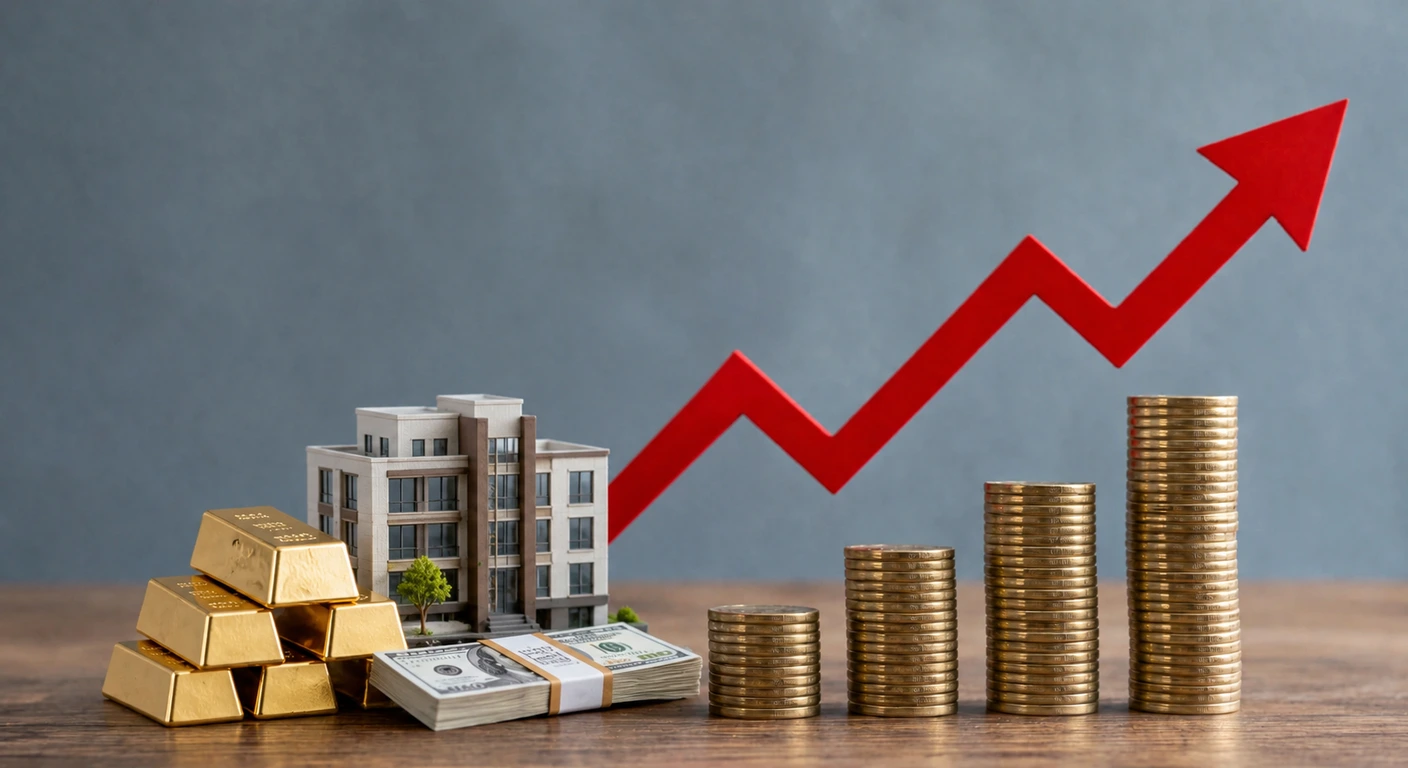

We tend to think of inflation simply as “prices of goods have gone up.”
But the truly important thing is somewhere else.
The money we need to eat, wear, sleep, and live.
It is about whether that money’s value is really doing its role properly.
What if the money I am holding no longer has the same value as before?
Furthermore, what if we can no longer trust the country and economic system of the money we are using?
How should we respond then?
And when you study economics deeply, there is one concept that never disappears no matter where you go.
It comes out when you look at interest rates,
it comes out when you look at exchange rates,
and it eventually comes out again when you look at stocks and real estate.
🔍 Shall we look together at what that is?
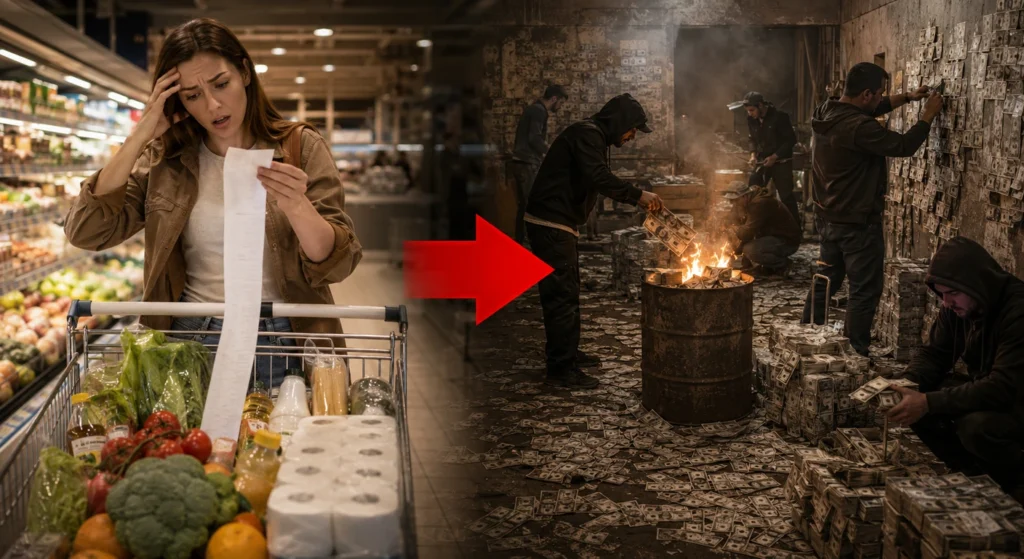
📌 Once Again, Prices Have Not Gone Up, the Value of Money Has Fallen
I mentioned this in the previous post as well, but because this part is important, I will quickly and strongly point it out one more time.
※ If you want to see the previous post, click here.(What Is Inflation? (1/2))
Prices did not go up, my money!
In other words, the value of our country’s money has become trash.
This one expression is enough.
Then usually this kind of thought will come up, right?
“If I just hold it as cash, isn’t my money melting?”
And from exactly this moment, people’s eyes start heading outside of cash.
Assets such as real estate, gold, and dollars start coming back into view.
Then naturally, the next question comes out here.
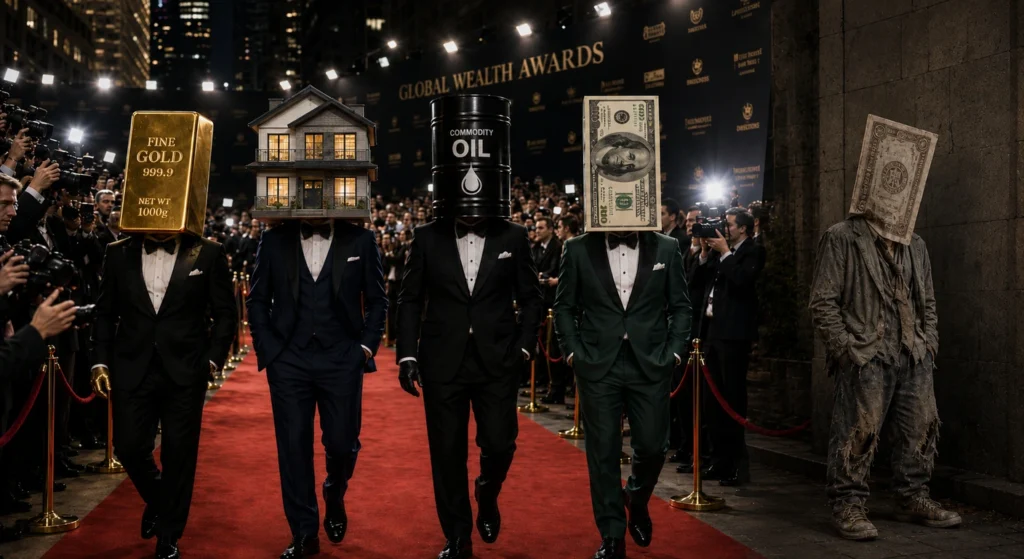
If the Value of Money Falls, Do Real Assets and Safe Assets Get Attention?
To emphasize again, inflation is not simply a phenomenon where prices of goods rise.
On the contrary, 📍 it is a phenomenon where the value of money falls.
So the more serious inflation becomes, the less comfortably people can look at cash like before.
“Is it okay to just hold this money?”
“If its value weakens as time passes, shouldn’t I rather move it into assets like gold, dollars, or real estate?”
These kinds of thoughts naturally arise.
Why Do People Look for Assets When the Value of Money Shakes?
The reason people look for assets during times of inflation is not simply only to make more money.
Rather, to say it more accurately, 📌 it is to avoid having the value of the money they already have taken away.
When the value of money shakes, people start looking for assets that seem more solid than cash.
At this time, what is often mentioned is exactly real assets and safe assets.
📌 Real assets are assets that actually exist.
Representative examples include gold, real estate, land, and commodities.
📌 Safe assets are assets that people consider relatively safe when the economy is unstable.
Representative examples include dollars, gold, and U.S. Treasury bonds.
Of course, just because the name is safe asset does not mean it is truly absolutely safe.
Where in the world is there such an asset?
Even assets called safe can shake depending on market conditions.
However, when people are anxious, it is human psychology to look for a safer place.
Just like how we normally take out insurance.
👉 “Money can keep getting weaker, but won’t gold still remain?”
👉 “Even if my country’s money shakes, won’t the dollar still hold up?”
👉 “Even if prices rise, won’t the need for land and houses not easily disappear?”
Because of exactly this psychology, during inflation, assets receive more attention than cash.
The Reason Gold and Dollars, Real Estate and Land Receive Attention
Gold and dollars, honestly, if I explain them for a long time, only my fingers typing on the keyboard hurt.
But since I am a person who likes pain? it is okay.
Gold has long been considered a means of storing value.
Currency can be printed more if needed, but gold does not suddenly pour out just because someone presses a button at the mint.
It is not like gold just comes out endlessly because you dig the ground either.
That is why when the value of money shakes, people think of gold.
The dollar is the same.
The dollar is not a real asset, but it is the most widely used currency in global trade and financial markets.
When the economy becomes unstable, people try to find a strong currency rather than a weak currency, and the representative target is the dollar.
To put it simply, gold is an asset that has lasted for a long time, and the dollar is a key currency that many people trust and use.
And here, the more realistic assets are 📌 real estate and land.
📍Whether a person has a lot of money or little money, in the end, they must live somewhere.
Among the issues of humans eating, wearing, and sleeping, housing is a demand that does not easily disappear.
This is also why real estate and land are often connected with inflation.
When prices rise, construction costs, labor costs, material costs, and land costs can also rise together, and if the cost of building new buildings rises, the value of existing real estate and land can also be affected.
Also, land is even simpler.
Land cannot be printed out in a factory.
Just because it is needed, new land cannot suddenly be mass-produced tomorrow, and it is also not possible to take land through war.
📍 That is why when the value of money shakes, people look at assets such as gold, dollars, real estate, and land.
It is because they think that although the value of money can become weaker, assets that people continue to need do not easily disappear.
To summarize, it is like this.
👉 Gold has the characteristics of both a real asset and a safe asset,
👉 the dollar is not a real asset but is considered a safe currency,
👉 and real estate and land are representative real assets but are sensitive to interest rates.

But Real Assets and Safe Assets Are Not Invincible Either
Here, you must not misunderstand.
⚠️ Just because inflation has come, it does not mean gold, dollars, real estate, and land will always rise.
Just because it is called a safe asset does not mean it becomes an absolute shield, and just because it is a real asset does not mean its price always holds up.
Especially when inflation becomes severe, 🚨 the central bank can raise interest rates to control prices.
When interest rates rise, asset markets also receive pressure.
Real estate and land are greatly affected by loans and interest rates.
No matter how good the land or building is, if interest rates rise, the burden on people trying to buy it must inevitably become heavier.
🚨 Gold is also not an asset that always rises.
Because gold does not give interest or dividends, during periods when interest rates rise, its attractiveness can decrease.
So the key point is this.
⚠️ Real assets and safe assets can become tools to defend against the fall in money value, but they are never invincible assets.
Inflation pushes people outside of cash, but it is not magic that automatically raises every asset.

Inflation Is More Cruel to People Without Assets
📌 At this point, the real difference is revealed.
People who have assets have choices in front of inflation.
They can think about whether to move into gold, hold dollars, or carry real estate or land.
But what about people who have almost no assets and rely only on their salary?
They do not have many choices.
Prices rise immediately.
Food costs, housing costs, transportation costs, and energy costs rise quickly.
But salaries do not rise immediately.
Even if they rise, in many cases they cannot keep up with prices.
This is the cruelest part of inflation.
✅ For people who have assets, inflation may be a matter of defensive strategy.
✅ But for people who do not have assets, inflation flies in like a survival-cost bill.
Someone has this kind of worry.
“Where should I allocate my assets?”
But someone else has this kind of worry.
“How do I endure this month’s food costs and rent?”
It is the same inflation, but for someone, it is a problem of portfolio, and for someone else, it is a problem of living costs.
That is why inflation is announced as the same number to everyone, but it does not come as the same pain to everyone.
In the end, inflation is not simply a story of prices going up.
When the value of money weakens, it reveals who has the means to protect that value and who has to take the hit as it is.
To say it in one sentence, inflation can widen the gap between the rich and the poor.
📌 What is scarier than the difference between people with a lot of money and people with little money is the difference between people who have assets to protect that money and people who do not.
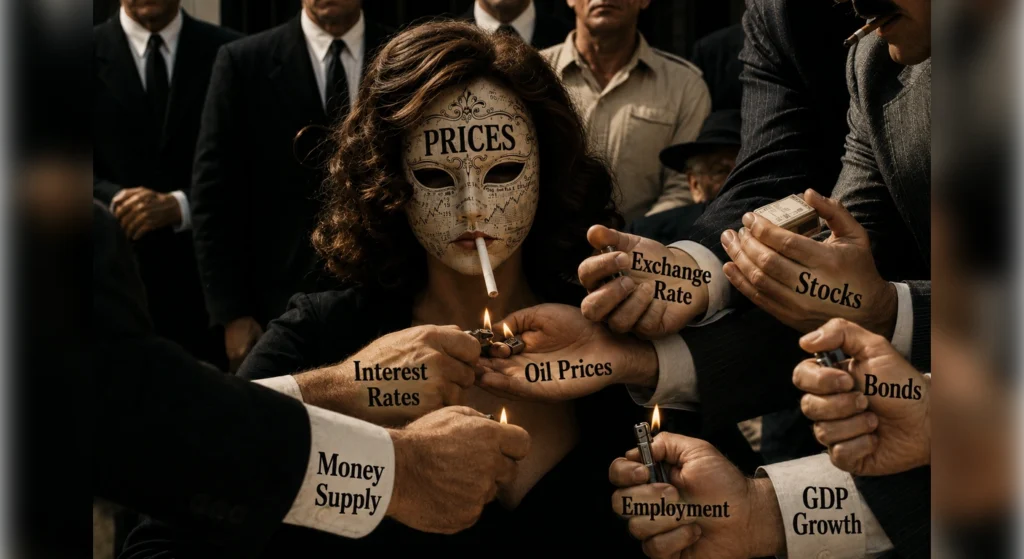
Why Is Inflation Always Part of the Economic Conversation?
When you are learning economics or studying stocks and investments, inflation can absolutely never be left out.
👉 When you study interest rates, inflation comes out,
👉 when you study exchange rates, inflation comes out,
👉 when you look at the stock market, inflation comes out,
👉 and when you talk about the central bank, inflation eventually comes out.
Even when you go a little deeper, it becomes more obvious.
👉 When moving from nominal exchange rates to real exchange rates,
👉 from nominal interest rates to real interest rates,
👉 and from nominal returns to real returns, there is always a direct relationship with inflation.
To put it simply, if you only look at the numbers that appear on the surface, that is nominal,
and if you reflect inflation and calculate the real power, that is real.
So no matter how advanced the economic knowledge you study is, inflation always stands at the center of the topic.
Then you really become curious.
“No, why does this guy keep coming out all the time?”
The reason is simple.
📌 Because inflation is an indicator that shows the power of money.
In the economy, in the end, people move with money.
👉 Salary is money,
👉 consumption is money,
👉 loans are money,
👉 investment is money,
👉 corporate sales are money,
👉 and national policy is, in the end, the work of controlling the flow of money.
But there is something important here.
What shows how much real power that money actually has is exactly inflation.
For example, let’s assume an office worker earns $5,000 per month.
The $5,000 when prices are low and
the $5,000 when prices are high are absolutely not the same money.
The number is the same.
The bank account shows the same $5,000.
But if you go to the mart, it is exposed immediately.
Before, you could fill the shopping basket quite a bit, but at some point, even though you have only put a few things in, your heart already starts hurting first at the checkout counter.
At that time, you realize.
📍 “Ah, the number of my salary is the same, but the power of money has weakened.”
So inflation is not simply a problem of “prices of goods have gone up.”
Inflation is a standard table that shows whether my money is truly strong, or whether it is just a bluff with only the number looking fine.
➡️ That is why interest rates also look at inflation.
When inflation rises too quickly, the central bank raises interest rates to cool down the flow of money.
➡️ Exchange rates are also connected to inflation.
When the value of money shakes, import prices, commodity prices, and living costs can shake together as well.
➡️ Stocks also look at inflation.
When prices rise, corporate costs rise, and interest rates can also rise.
Then corporate profits and stock valuations are affected as well.
➡️ Real estate also looks at inflation.
When inflation and interest rates move, loan burdens, construction costs, rents, and asset prices are all connected one after another.
In the end, inflation is not an indicator sitting quietly alone.
Inflation is both the result of the economy and the starting point that changes the next economic flow.
That is why inflation keeps coming out when you study economics.
It comes out so often that it is annoying, but the reason is clear.
When inflation shakes, the power of money shakes, and when the power of money shakes, the entire economy shakes.
To summarize it in one sentence, it is this.
✅ Inflation is not a story about goods prices.
It is the economic standard table that checks whether my money is still a usable guy.
That is why inflation never disappears wherever you go.
Whether it is interest rates, exchange rates, stocks, or real estate, in the end, the final question returns here.
“So does this make the power of my money stronger, or weaker?”
Lastly….
We receive salary in money,
we do savings in money,
we repay loans in money,
we calculate investment profits in money,
and even future plans are eventually made based on money.
But what happens if the value of that money is not temporary, 🚨 but keeps shaking?
From this point, people are no longer simply worrying about goods prices.
🚨 “Can I continue to trust this money I am holding?”
They start asking this question.

📌That is why, at the end of inflation, there is ultimately trust.
Trust in money,
trust in currency,
and trust in the economic system that manages that money.
📌 Inflation is the most realistic test paper that shows whether the money of that society is still trustworthy.
