



Interest rates are the price of pulling the future into the present. We endure the present in order to live into the future, yet ironically, this world also runs on a structure in which we have to pull the future forward and use it in advance.
When buying a house, when starting a business, when the money we need right now is not enough, people bring forward their future income and use it first.
But that price is never free.
That price is called interest rates, and they are cold, harsh, and realistic.
So in this article, as we carefully go through what interest rates are, the difference between interest rates and interest, why central banks move interest rates, and even %, %p, bp, nominal interest rates, and real interest rates, we will also try to make our relationship with interest rates, which have long felt distant and cold, a little warmer.
What Is an Interest Rate?
The term interest rate is easier to understand if we break down the meaning of each word. First, interest here does not mean “curiosity,” but means the interest added as the cost of borrowing money. And rate means a “percentage” or “a number that shows how many percent.”
In other words, interest rate refers to how many percent of a cost is added to the principal when borrowing or depositing money. Simply put, an interest rate expresses the cost added when borrowing or depositing money as a percentage.

💡 For example, let’s say you borrowed $1,000 from a bank. If the interest rate is 5% per year, then you have to pay an additional $50 as the cost of using that money for one year.
The calculation is simple.
$1,000 × 5% = $50
So after one year, you do not just return the original $1,000. You have to add $50 in interest and pay back a total of $1,050.
Simply put, it feels like this.
“Ah, thank you for letting me use $1,000 for one year. According to the agreed interest rate of 5%, I will add $50 in interest to the principal and pay back a total of $1,050.”
On the other hand, if I am the one depositing money in the bank, the story changes.
Let’s say I deposited $1,000 in the bank, and the deposit interest rate is 5% per year. Then after one year, I will receive $50 as the reward for leaving my money there.
In other words, as a reward for not spending the money I wanted to use right away and leaving it deposited for one year, $50 in interest is added to the original $1,000, making the total $1,050.
This situation can be seen like this.
“Ah… I will hold back from buying what I want and eating what I want for one year. In return, I will later receive my original $1,000, plus $50 as the cost of not satisfying my desires for one year.”
For one person, it is the cost of using future money early. For another person, it is the reward for holding back from spending money now.
✅ In short, an interest rate is the price of money. It is not just a number decided by feeling when borrowing or depositing money, but a percentage that shows how much cost is added to the principal.
Interest Rate and Interest Are Strictly Different
You can think of the interest rate as the ratio of interest, and interest as the actual amount of money you pay or receive according to that ratio. If you look at an example, you can understand it right away.
💡 Let’s say you borrowed 1,000 dollars from a bank, and the annual interest rate is 5%.
Here,
5% = interest rate
50 dollars = interest
That is how it works.
To say it more realistically, it is like this.
“Our bank’s loan interest rate is 5% per year.”
→ This is the interest rate.
“One year later, I paid back the 1,000-dollar principal plus 50 dollars in interest.”
→ This is interest.
The Reason Interest Rates Exist Is Price Stability, but Central Banks Do Not Look Only at Prices
The biggest reason interest rates exist is ultimately price stability. However, (there are central banks like the Fed that have to take care of both prices and employment at the same time.)
The reason smart central bank employees stay up all night working is also all for price stability.
“Prices went up? Let’s raise interest rates.”
“People are struggling? Let’s lower interest rates.”
If it were this simple, how comfortable would central bank employees be?
But what if…
“You thought everything would be over if prices were controlled? Touch one thing wrong, and the entire national economy could get blown away!!”
📌 They raised interest rates to control prices, but loan burdens exploded and job postings decreased. They lowered interest rates to revive the economy, but exchange rates and prices could go crazy again.
So the central bank aims at the main target called prices, but behind that, it also has to put employment, the economy, exchange rates, and even the market’s convulsions that could explode in a chain reaction into the calculator and run everything together.
Let’s take a look at what things make central bank employees lose all their hair.
⚠️ The importance of indicators may differ depending on the country, but it is usually similar. Especially because U.S. economic indicators have a huge impact on global markets, I will explain based on the indicators that the Fed reflects.
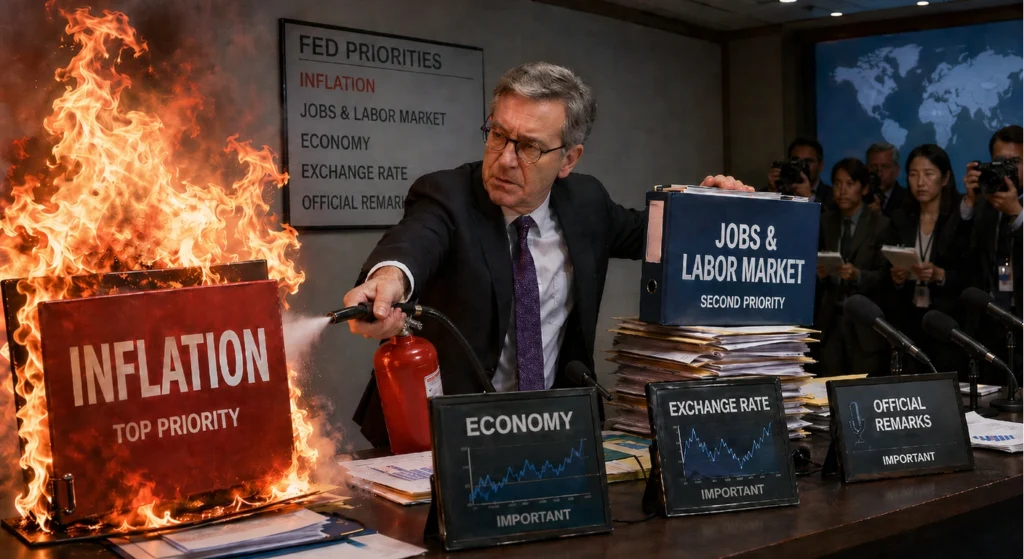
No. 1 Priority: Prices
When prices start going crazy, money just becomes pieces of paper. If the price of chicken is different today and tomorrow, who would want to make plans and earn money? Since there is no standard, the economy itself becomes shaken. That is why the central bank runs to put out the fire called prices first, no matter what kind of criticism it receives.
“If we cannot control prices now, the money all of us have will become trash. There is no time to think about anything else. We have to put out this fire first!”
This is why central banks around the world all shout for price stability. Just like there is no time to save furniture in a burning house, the first principle of interest rates is to first control prices so the economy does not burn to death.
Then what kinds of indicators are there for prices?
📌 CPI (Consumer Price Index)
= Literally, it is an indicator that shows how much the prices of things we consume in daily life have risen.📌 PCE (Personal Consumption Expenditures)
= “Why did beef get so expensive this time? I should just buy chicken.”The indicator that looks at prices while also reflecting the flow of people avoiding expensive items and moving to other consumption is PCE. You can understand it as an indicator that looks at prices, but reflects changes in consumption patterns better than CPI.
📌 PPI (Producer Price Index)
= This is not prices from the consumer’s point of view, but prices from the company owner’s point of view.PPI is not the price that consumers feel at the supermarket, but an indicator that looks at how much the prices companies receive when selling goods and services have changed.
If the word Core is attached in front of each of these words, the meaning changes. I plan to cover this in detail later in a post about prices.
The Next Important No. 2 Priority: Employment
Just when they think prices have cooled a little and they might lower interest rates, this time they hear that the job market is too active.
There are few unemployed people and many employed people, so consumption is likely to increase. Then from the central bank’s point of view, it may think, “Wait, the market might heat up again?” and reconsider lowering interest rates. Depending on the situation, the possibility of raising interest rates may even appear in order to prevent inflation.
That is why employment and labor market indicators are also referenced together. They need to see how hot or cold the labor market is right now in order to take the proper action, whether that is lowering interest rates, holding them steady, or raising them.
Then what kinds of indicators are there for employment?
📌 Unemployment Rate
= If the unemployment rate is low, you can see it as “among people who are willing to work, there are few people who cannot find a job.” If the unemployment rate rises, you can see it as an indicator that means “finding a job is getting more and more difficult.”📌 Non-farm Payrolls
= It is an indicator that shows how much non-farm employment increased during one month, excluding some categories such as agriculture, self-employed workers, unpaid family workers, domestic workers, and soldiers.In other words, it is a number that shows, “How many more employees were added this month?”
📌 JOLTS
= It shows how much companies are trying to hire people, how many people they actually hired, how many people quit, and how many people were laid off.
In addition, there are initial jobless claims, Wage Growth, average hourly earnings, and so on.
No. 3 Priority: Others: The Economy, Exchange Rates, and the Central Bank’s “Words”
For the economy, they look at indicators such as GDP growth rate or PMI and judge whether the economy is holding up right now or losing strength.
For exchange rates, they look at flows such as whether foreign money is coming in or going out and estimate the level of market anxiety.
Also, press conferences or remarks from central bank governors like the Fed chair are not just simple comments. They can also become hints that show what they are currently more worried about. For example, in phrases like “prices are concerning” or “we must be cautious about economic overheating,” you can indirectly read the governor’s inner thoughts.
📍 Besides these, they make decisions by comprehensively reflecting various factors such as financial conditions and international variables.
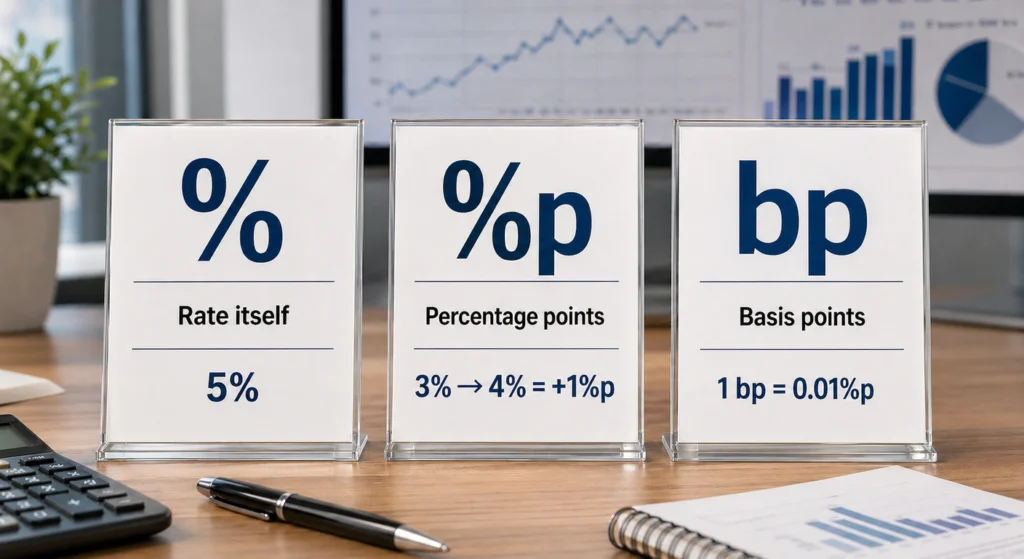
How to Express Interest Rate Units: What Is the Difference Between %, %p, and BP?
When you look at interest rate news, the numbers look similar, but the expressions are all different. Sometimes they say 5%, sometimes they say a 0.25%p hike, and sometimes they say a 25bp hike.
At first, it looks like a financial code made to confuse people.
“Can’t they just say interest rates went up? Why do they twist the words like this?”
But if you cannot distinguish these, the numbers keep getting tangled when you read interest rate news. Especially when looking at central bank announcements, bond markets, exchange rate markets, and stock market stories, %, %p, and bp come out almost like a basic language.
Simply put, the structure is like this.
% = the current level of the interest rate
%p = how much the interest rate moved
bp = a unit used by people in the financial market industry
「 % 」 : A Unit That Shows the Current Height of the Interest Rate
💡 For example, let’s say a foreign investor is looking at U.S. Treasury bonds.
U.S. 10-year Treasury yield: 4.50%
This can be understood as, “The current interest rate level of the U.S. 10-year Treasury is 4.50%.”
There is no need to think of it as difficult.
「 %p 」 : A Unit That Shows the Amount of Change in the Interest Rate
💡 Let’s say the interest rate changed like this.
5.00% → 5.25%
How much did it rise?
Ordinary people would want to just say, “It rose by 0.25%.” But the accurate expression is this.
It rose by 0.25%p.
Here, %p means percentage point.
There is one thing we need to point out here. It is because there can be room for confusion.
If you simply say “a 0.25% increase” here, it becomes ambiguous. That is because a 0.25% increase can also be interpreted as an increase of 0.25% from the existing interest rate.
If an interest rate of 5.00% increases by 0.25%:
5.00% × 1.0025 = 5.0125%
That is what it becomes.
It is easier to understand with money.
💡 Let’s say a foreign investor borrowed 1,000 dollars. At this time, the interest rate is 5.00%.
The interest paid in one year is 50 dollars.
If the interest rate rises by 0.25%p this time, the rate becomes 5.25%, so they have to pay 2.5 dollars more.
But if it rose by 0.25%, the rate becomes 5.0125%, so they have to pay 0.125 dollars more.
Can you clearly feel the difference?
That is exactly why the expression method is made clear.
To organize it again, what we were trying to say was:
5.00% → 5.25%
In other words, it means the interest rate number moved by 0.25 spaces, so the amount of change in the interest rate should accurately be expressed as a 0.25%p increase.
「 BP 」: A Unit of Interest Rate Change Used in Financial Markets
BP means basis point.
This unit was made so that people working in the financial market industry could say it more conveniently. And in reality, bp is used more often than %p.
There is nothing difficult about it. It is simple.
The formula is simple.
1bp = 0.01%p
So it can be organized like this.
25bp = 0.25%p
50bp = 0.50%p
100bp = 1.00%p
For example, let’s say the central bank raised interest rates.
5.00% → 5.25%
You express it as the interest rate rising by 0.25%p, and in financial markets, it is expressed as a 25bp hike.
What if it is 5.00% → 6.00%?
It is a 1%p increase in the interest rate, a 100bp hike.
To organize it in one sentence:
If it says 5.25%, it means the current level of the interest rate.
If it says a 0.25%p hike, it means the amount the interest rate moved.
If it says a 25bp hike, it is the financial market expression meaning it was raised by 0.25%p.
The writer, myself, and all the readers reading this post should also stop simply saying % when talking about interest rates somewhere, and go around sounding smart by saying how many bp or how many %p.
What You See Is Not Everything: Nominal Interest Rates and Real Interest Rates
In the post I previously wrote, “What Is an Exchange Rate?”, the keywords nominal and real also appeared.
Part 1
Part 2
The exchange rate that appears in a Google search box or on a bank’s electronic display board is usually the nominal exchange rate. Just as there is a separate concept called the real exchange rate that reflects the prices of both countries, interest rates have a similar concept.
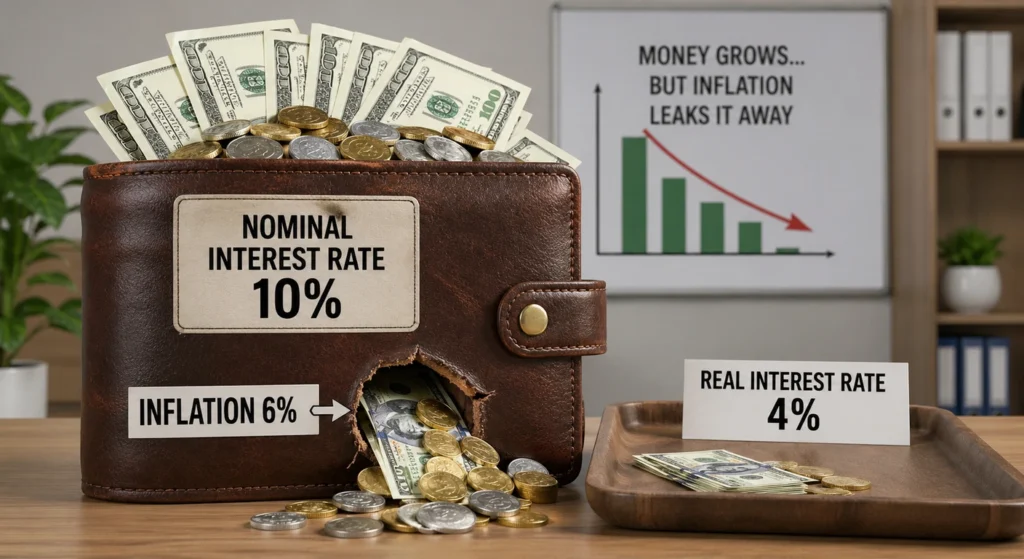
The number written in a deposit product description, the number stamped on a loan contract, and the interest rate mentioned in the news are nominal interest rates. The real interest rate is the nominal interest rate minus the inflation rate, which is the true felt interest rate.
💬 (TMI: The real exchange rate reflects the nominal exchange rate + the price levels of both countries, while the real interest rate reflects the nominal interest rate + the inflation rate. So even though prices and inflation may sound similar, they are actually completely different concepts)
“The real interest rate is the nominal interest rate minus the inflation rate?”
There is no need to feel that it is difficult at all.
This is not a difficult formula. It is closer to a story that distinguishes between the number that appears on the outside and the value that actually remains.
💡 Let’s look at an example.
You have some spare money and go to the bank to try saving it. Then the bank employee says with sparkling eyes:
“The deposit interest rate is a whopping 10%. This is a good time to save!!”
If the interest rate is 10%, you would probably scrape together all the money you have and do not have and deposit it. You put in 100,000 dollars, and the annual rate is 10%. Just looking at the number makes your heart race.
“Wait… If 100,000 dollars has a 10% rate, that means 10,000 dollars of interest in one year, right? I can get 10,000 dollars of interest without losing the principal? Isn’t this basically making money while sitting still?”
On the outside, it really looks good. No, it does not just look good; it almost feels like a sweet temptation.
But after one year passes, the situation feels strange. Prices in the world rose by 5% during that time. Food prices rose, dining-out costs rose, living expenses rose, and here and there, they quietly started eating away at the money in your wallet.
At that moment, you might think like this again.
“So what if prices went up a little? I deposited 100,000 dollars and earned 10,000 dollars in interest over one year. Isn’t that still a gain?”
This is exactly where the real interest rate appears.
📍 As said earlier, very simply, you can think of it as subtracting the inflation rate from the nominal interest rate.
Let’s assume the nominal interest rate is 10%, and prices rose by 5% during the same period.
Then the real interest rate becomes 5%.
📌 Nominal interest rate 10% – inflation rate 5% = real interest rate 5%
If you deposit 100,000 dollars, the nominal interest after one year is 10,000 dollars. But when reflecting the 5% inflation rate, the gain that remains based on actual purchasing power decreases to roughly around 5,000 dollars.
📌 In other words, the number printed in the bank account clearly increased a lot, but because prices also rose together, the actual purchasing power of your money did not increase as strongly as you might think. In this way, even if it is positive nominally, once prices are reflected, the actual power that remains can become much smaller.
📌 This is the real interest rate.
💬(TMI = Inflation rate and Consumer Price Index are different concepts)
Example:
Consumer Price Index CPI in October last year = 100
Consumer Price Index CPI in October this year = 103
Since it rose by 3% this year compared to last year, the inflation rate rose by 3%. Do you understand?
Admittedly, I brought an extreme example so that readers could get a feel for it all at once.
📌 But reality does not flow according to our tastes. Bank deposit rates are not high, and inflation is also difficult to suppress. So the point is that you should not only look at the number printed in your bank account; you also have to look at prices together.
💬 (TMI: Unless we are large corporations engaged in major trade, the real exchange rate is often not something we need to dig into deeply for things like overseas travel. On the other hand, the real interest rate is relatively useful to know because it shows how much of the actual strength of our money remains in savings, loans, and investments)
✅ To organize it in one sentence:
The nominal interest rate is the number that appears to the eye, and the real interest rate is the true value that remains in your money after reflecting the inflation rate.
So when looking at interest rates, rather than simply looking at what percent the rate is, you also have to look at whether that interest rate is beating inflation.

1 thought on “What is Interest Rate? The Price of Money in the Economy”
Comments are closed.