Subprime mortgages are not someone else’s story. Anywhere in the world, there are many people who have taken out a loan to buy a house, or who are thinking about a mortgage in the future. That is because, in order to build a family and create a place to live, there comes a moment when you have to get a house even if it means borrowing a large amount of money.
But what would happen if a bank easily lent me money even though I did not have the ability to repay it? And what would happen if institutions that make money by selling loans and people who try to borrow recklessly, believing more in rising housing prices than in their own ability to repay, all gathered together at once?
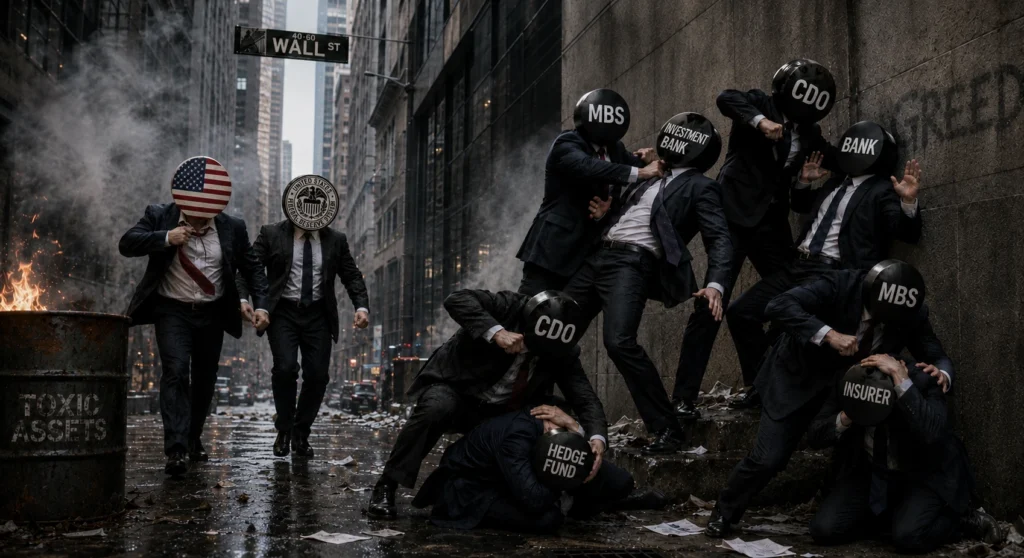
This was not a problem that would end as a simple economic recession. How did one small loan pass through MBS and CDO and become a bomb that shook the entire U.S. financial system? Let’s take a look together.
The Era of Low Interest Rates, the Belief That “Housing Prices Only Go Up,” and Reckless Loan Approvals
Everyone, did you know that in the early 2000s, the U.S. benchmark interest rate was extremely low?
At that time, the United States was maintaining its benchmark interest rate in the 1% range to defend against an economic slowdown caused by the collapse of the dot-com bubble and the aftermath of 9/11.
Naturally, since interest rates were low, loan consultations must have increased, and since the burden of borrowing money was reduced, people probably wanted to buy all kinds of things they had been keeping an eye on here and there, right? In particular, mortgages must have increased as well. Since interest rates were low, buying a house felt less burdensome.
On top of that, back then, the belief that 📌“housing prices will keep going up” was very strong. The confidence that U.S. housing prices would not fall significantly was too strong, and since the collateral was the house, people did not worry much about delinquency.
The Loan Party of Banks and Loan Brokers!
Originally, before giving out a loan, many different checks are done.
They check strict conditions such as 「whether this person is a scammer」, 「whether they are a criminal」, 「how much money they earn」, 「whether they are buried under a mountain of debt」, and 「whether they have the ability to repay for the next 30 years」
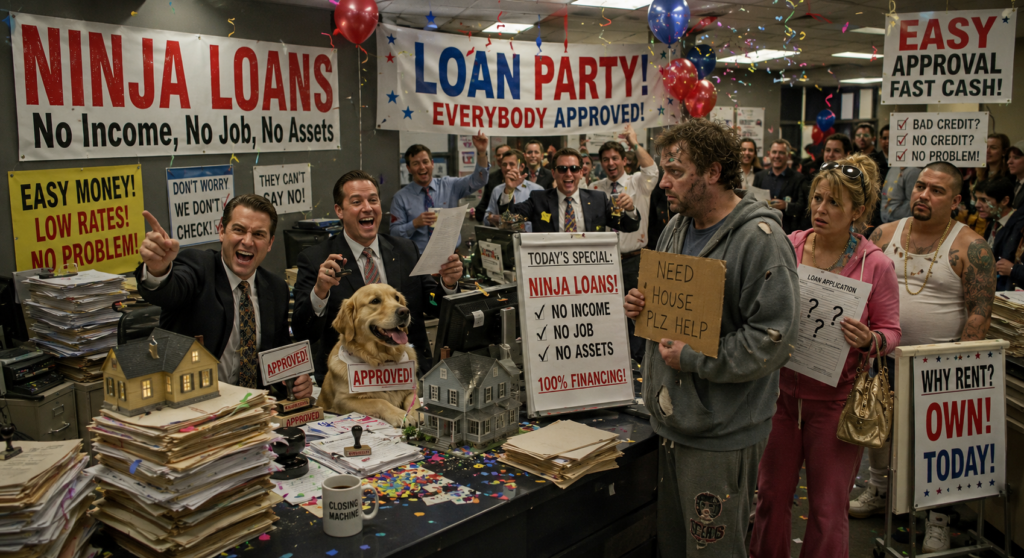
But at that time, “Hey… I’m trying to buy a house, but I need some money. Can you give me a loan?” “Okay, loan approved.”
They did not properly check things like how much debt this person had or how much income they had. It was to the point where people even said loans were given to dogs…
This is the subprime mortgage.
🚨 Prime = a prime customer, meaning a person with good credit. These are people considered capable of repaying.
🚨 Subprime = below prime, meaning a customer with low credit. These are people considered relatively less capable of repaying.
📌So, to put it simply, a subprime mortgage is “a mortgage given to a person with low credit.” (Of course, there were prime customers too. But subprime made up a significant portion.)
Banks Had No Intention of Waiting 30 Years. They Would Rather Sell and Create More Loan Funds
A bank can receive interest from the person who took out a mortgage for 30 years. Along with the principal too. But from here, it becomes important. At this time, banks smelled money.
📌From the bank’s point of view, rather than slowly receiving principal and interest over 30 years, selling this loan claim and quickly recovering cash seemed much more attractive.
People with various credit levels probably took out loans to buy houses, and banks began thinking about selling those loan claims to other financial companies.
From the bank’s point of view, it was totally a thank-you situation.
👉 They received fees because they signed loan contracts, 👉 They sold those loans to other financial companies or investment institutions and recovered cash again, 👉 With the recovered money, they created new loans again, 👉 Received fees again, and built up performance records too….
With this structure, there was no way money would not pile up.
Since these were not loans that banks had to hold while stressing over them, and since they could just sell them to someone else, loan approvals were given out recklessly.
Since, after all, who would not repay a mortgage? And since the interest was higher than Treasury bond yields….. Then what did the financial companies that bought up all those loan claims do?
Whether Rotten Apples or Good Apples, Since They Bought a Lot of Them, Mix Them Together, Package Them Nicely, and Sell Them Expensively
Investment companies that bought loan claims in bulk probably thought like this.
👉 “There are risky loans mixed in, but if we divide them into thousands, the risk will be diversified.” 👉 “Housing prices won’t collapse all across the country at the same time.” 👉 “If we get a AAA rating, investors will buy it.” 👉 “We earn fees, and we pass the risk to investors.” 👉 “This makes a ton of money????”
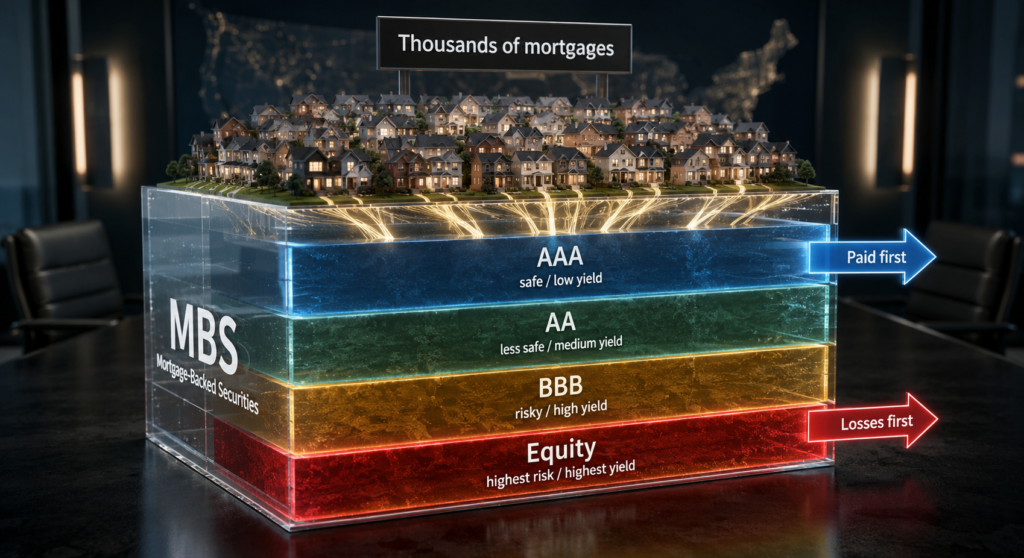
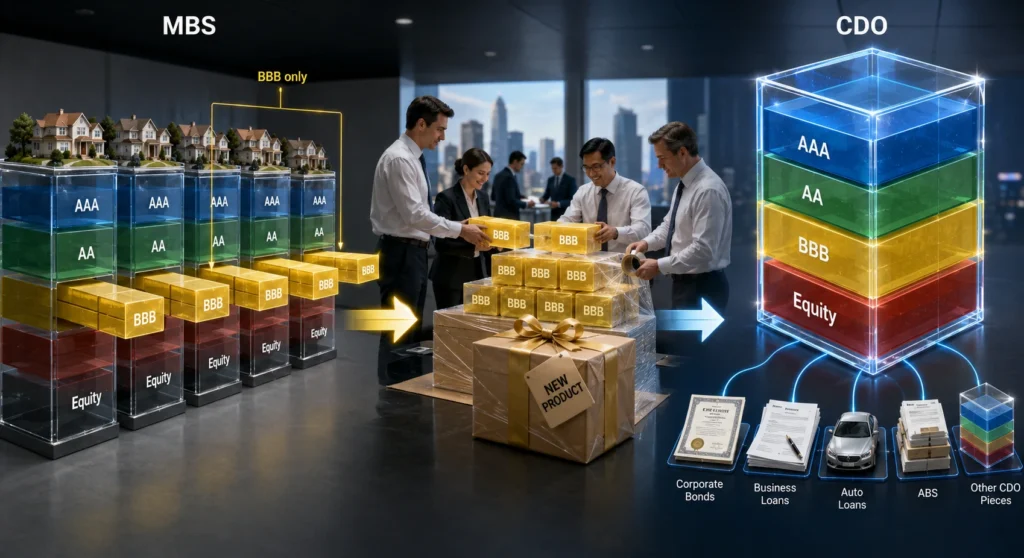
So, whether good or bad, they gathered thousands or tens of thousands of mortgage claims, packaged them nicely, and issued one MBS. Then they divided that issued MBS into several grades. (It is said that thousands of MBSs like this were created.)
With the principal and interest coming in every month from these mortgages, 📌they divided the structure into layers based on who receives money first and who takes losses first.
📍 AAA / safe / low interest 📍 AA / less safe / relatively higher interest 📍 BBB / risky / high interest 📍Equity / high risk / very high interest
This is exactly an MBS.
MBS = Mortgage-Backed Securities
📌And the places that evaluate these ratings are the credit rating agencies. Simply put, they are companies that evaluate the creditworthiness of financial products and companies. (Equity is excluded. Equity is created as a layer that absorbs losses first.)
“We’ll evaluate the credit of the financial product you put out.” “Let’s see how capable the borrowers inside that product are of repaying.”
They are places that roughly evaluate things like this.
And the companies that gave high ratings to MBS and CDO at that time were companies we may or may not commonly know: Moody’s, S&P, Fitch.
🚨 The Reason Credit Rating Agencies Gave Ratings and the Profit and Loss Structure of MBS and CDO 🚨
I believe that if we briefly understand this before going into the main point, it will be easier to understand.
Investment companies pay several credit rating agencies to receive credit ratings for the financial products they issue. There was a belief that if they sold products made up of various regions and various loan bundles, housing prices would not fall nationwide at the same time.
In other words, it was the logic of diversification.
And even if a few borrowers became delinquent, because the people who bought the Equity grade would take the losses first, there was a belief that AAA-grade buyers would not suffer losses. What does this mean?
When you open up an MBS, there are grades like AAA, AA, BBB, and Equity. (There are various grades, but for easy understanding, I will give a short example.)
What is the source of money here?
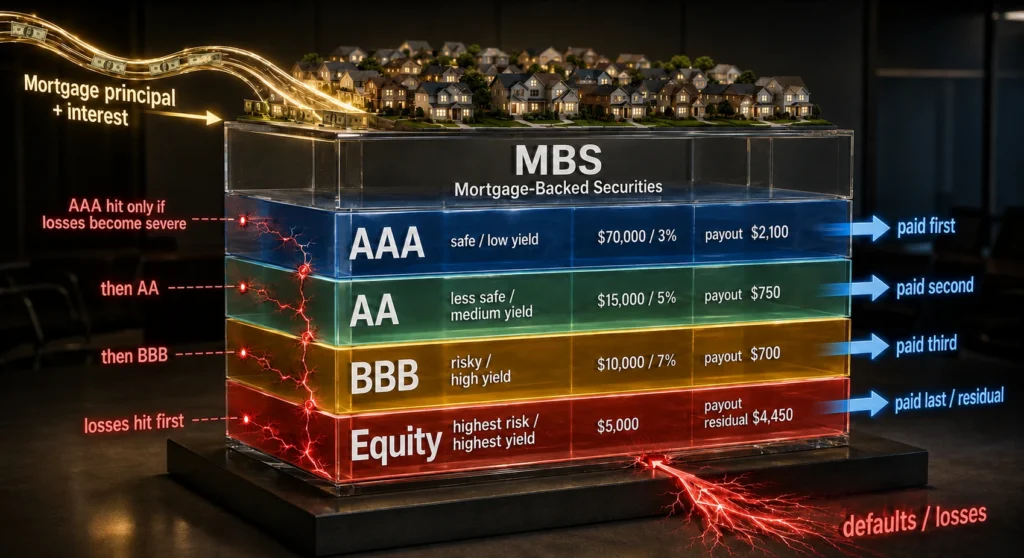
It is the 📌 principal and interest from mortgage loans.
When interest and principal come in, money is deposited first to the buyers of the AAA product. After paying AAA, the remaining money goes to buyers of the AA product. Then the remaining money goes to BBB. Then the remaining money goes to Equity customers.
💡 Let’s look at an example with money.
Let’s assume that in an MBS or CDO product, the cash flow that came in this month was 8,000 dollars in interest.
AAA = investment principal 70,000 dollars / interest 3% AA = investment principal 15,000 dollars / interest 5% BBB = investment principal 10,000 dollars / interest 7% Equity = investment principal 5,000 dollars / all remaining money
AAA interest 3% = 3% of 70,000 dollars principal = 2,100 dollars profit AA interest 5% = 5% of 15,000 dollars principal = 750 dollars profit BBB interest 7% = 7% of 10,000 dollars principal = 700 dollars profit
Equity takes all the 4,450 dollars left after distributing everything that has to be paid to the higher grades from the 8,000 dollars of interest. As expected, ✔️ high risk comes with high return. Conversely, high return always comes with high risk as well.
📌 What if the borrowers say they cannot pay interest? They become delinquent? They cannot pay principal either?
At that moment, the loss structure moves in the opposite direction of the profit structure. Equity takes losses first. They may not receive interest at all, and even principal losses occur.
If the losses exceed the amount that the Equity grade can absorb ➡️ then from that point the BBB grade starts receiving less interest and principal ➡️and if the damage becomes even worse, the AA grade and AAA grade, which were thought to be safe, also suffer damage.
The decisive reason credit rating agencies gave AAA and AA ratings was that, since losses would hit Equity first and then BBB, they believed the possibility of the comparatively very safe AAA grade taking losses was very low. (The buyers of AAA and AA grades were mainly institutional investors, meaning pension funds and insurance companies that operate massive amounts of capital.)
📌 Also, credit rating agencies knew that if they did not give high ratings, investment companies would go not to their own company but to another credit rating agency. So it is said that they gave high ratings even to risky products in order to maintain business relationships.
Returning to the main point, once these products were packaged nicely and even given ratings, if they said, “This pays higher interest than Treasury bonds,” how delicious would it have looked to investors?
It would make them wake up even from sleep.
Since they had bought mortgages cheaply in bulk from banks, now they had to sell them expensively, right? They sold them to other financial companies, institutional investors, financial companies in other countries, and just sold them everywhere.
There was no way this would not make money. Without knowing how risky it was, since people heard it made money, everyone bought MBS. From safe AAA and AA to Equity, they bought various grades of products.
💬 TMI: The investment companies mentioned in this post at that time included representative names such as Lehman Brothers, Bear Stearns, Merrill Lynch, Goldman Sachs, Morgan Stanley, Citigroup, JPMorgan, and Bank of America. 💬The institutional investors included representative names such as AIG, UBS, HSBC, RBS, IKB, SachsenLB, BNP Paribas, Citigroup, Merrill Lynch, and Bank of America.
📌 But among the products, there were some that sold well and some that did not. Among them, the 「BBB」 grade was a headache.
Why was that?
Let’s Make the Awkward Ones Look Nice and Resell Them
What does “awkward ones” mean here?
As mentioned above, financial companies bought mortgage claims in bulk, packaged them nicely into MBS, and sold them by distinguishing various layers and grades such as AAA, AA, BBB, and Equity.
But among them, there was a product that did not sell well. That was the BBB-grade MBS product.
👉 The AAA grade gave higher interest than Treasury yields and was even evaluated as safe, so it was popular. 👉 The AA grade was less safe, but since it still gave relatively high interest, it was the second most popular. 👉 Equity was a high-risk product, but among investors looking for high returns, it had its own popularity.
But BBB?
It was awkward to call it safe, and for its level of safety, the interest was not that high either. It was truly a headache. They had bought mortgages in bulk, but inventory remained, and they must have desperately wanted to clear out that inventory.
📌 So they package this beautifully one more time.
They pick out the BBB grades from MBS products and release them as a new product. Then they will request a rating review from the credit rating agencies again, right? Then the credit rating agencies, using the same diversification logic and business relationship maintenance mentioned above, give high ratings again.
From MBSs made up of thousands or tens of thousands of mortgage claims, only the BBB grades are collected. For example, BBB grade from MBS 1, BBB grade from MBS 2, BBB grade from MBS 3…….
They gather these nicely. And then repackage them again.
AAA / safe / low interest AA / relatively less safe / relatively higher interest BBB / risky / high interest Equity / high risk / takes all remaining profit
Like this, similar to MBS again, they create layers based on the order of receiving money and the order of taking losses.
What was sold after being repackaged like this is exactly a CDO.
CDO = Collateralized Debt Obligation
But the problem was that this did not contain only mortgage loan claims.
Mortgage loans were mainly included, but aside from that, corporate bonds, business loans, car installment payments, ABS, other CDOs, and so on were all mixed in together. (ABS refers to things like car payments and credit card debt bundled together, and other CDOs refer to CDOs that had already been mixed once and then were put into another product again.)
Your head hurts, right? I think even the employees who managed and sold these probably went bald. My head hurts too.
🔥Inside it were subprime mortgages that could explode at any time.
You Too? Me Too! Huh? Foreigners Too?
Another problem here was that MBS and CDO were not sold only inside the United States.
At first, U.S. banks and financial companies bundled mortgages to make MBS, and then chopped those up further to make CDOs. But once these products received AAA ratings and the returns looked decent, the atmosphere became strange.
👉 “Huh? They said it’s safe?” 👉 “The return is decent too?” 👉 “Then I should buy it too!”
📌 Insurance companies bought them, pension funds bought them, hedge funds bought them, investment banks bought them, foreign financial companies and institutional investors from other countries also began buying them.
Even the financial companies that created and sold these products did not completely wash their hands and leave. They also held MBS- and CDO-related products themselves, and bought other companies’ products as well.
Literally, it was a market where you bought it, I bought it, and even the guys who made it were holding it.
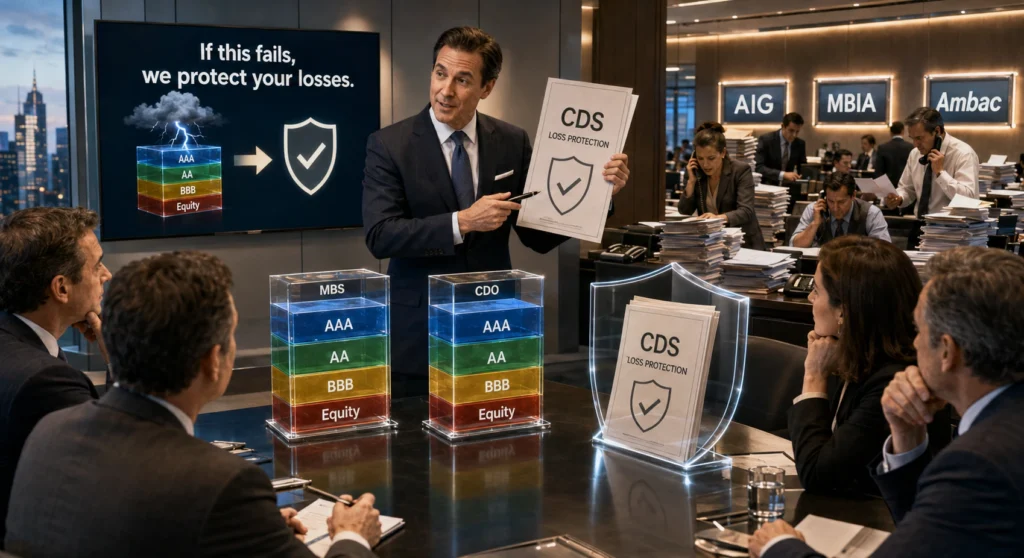
📌📌📌Here, another product enters the scene. They were unbelievably good at smelling money. It was insurance.
👉 “Have you purchased an MBS/CDO product?” 👉 “Are you perhaps worried about principal loss?” 👉 “We will guarantee your losses in case MBS/CDO collapses.” 👉 “How about it? Would you like to sign up?”
They put out a product that guaranteed losses like insurance. That company was the insurance company we know as AIG.
Representatively, AIG sold large amounts of CDS that guaranteed losses on CDOs, and monoline insurers like MBIA and Ambac also attached guarantees to MBS/CDO.
U.S. Housing Prices That Seemed Like They Would Last Forever, But…..
What was bound to explode finally exploded.
Price always inevitably comes with supply and demand. Lending conditions were loose, interest rates were low, and there was even a belief that housing prices would definitely rise. All of this became a reason for people to look for houses a lot.
Housing demand did not seem to stop, and housing prices kept rising without knowing how high the sky was. As a result, they reached prices that could no longer be handled even with huge loans, and delinquencies began to increase even more.
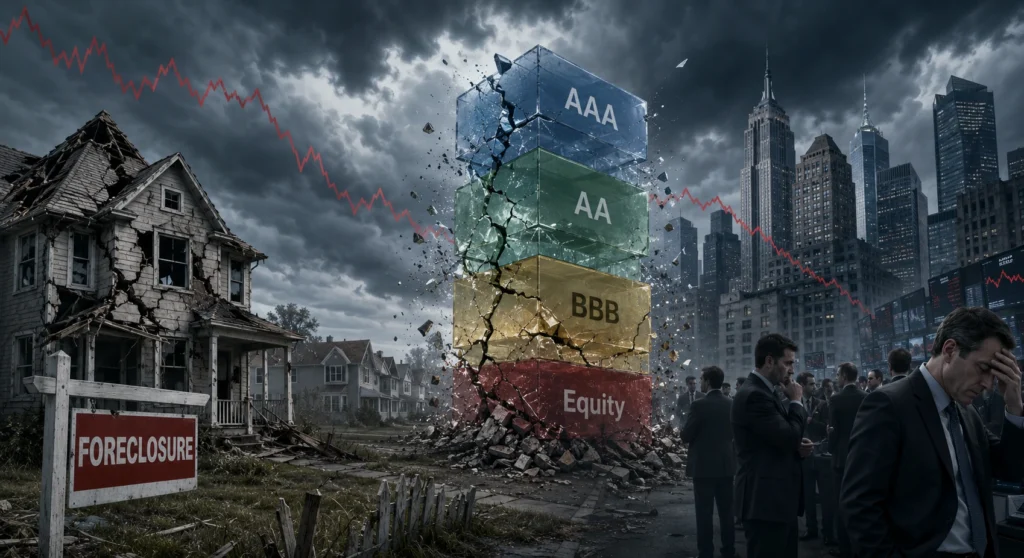
⚠️There were houses for sale, but there were no more people to buy them. ⚠️Adjustable-rate mortgages like 3/27 ARM were also a problem. (3/27 or 2/28 ARM: A mortgage that lures borrowers with a low fixed interest rate for the first 2–3 years, and after that, for the remaining period, the interest can rise sharply depending on market rates.) ⚠️Interest rates gradually rise. ⚠️As delinquencies increase, MBS shakes. ⚠️As MBS shakes, CDOs made up of BBB grades from MBS shake even more. ⚠️As CDOs shake, AIG, which created CDS products as loss insurance for CDOs, faces a flood of collateral demands from customers who bought CDS.
Financial Institutions, Investment Companies, and Everyone Else Began Distrusting One Another
The financial institutions, investment companies, banks, foreign financial companies, and everyone else that had bought MBS and CDO began to collapse.
As mentioned above, losses hit Equity first and then BBB, so AAA was judged to be relatively safe.
But the losses were much bigger than we had thought. The structure was one where profits were earned from loan interest, but delinquencies became severe and principal protection became uncertain. CDOs, in particular, were hit extremely hard.
📉 Subprime lenders began going bankrupt, the major Wall Street investment bank Bear Stearns began shaking badly, Fannie Mae and Freddie Mac, the key institutions responsible for money circulation using U.S. housing funds, became endangered, and Lehman Brothers, which held mortgage-related assets, went bankrupt.
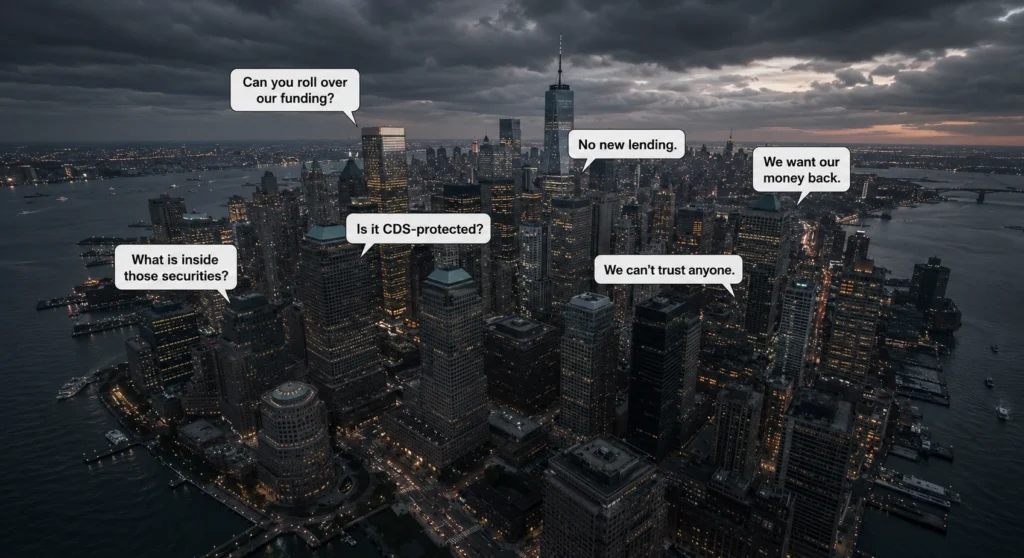
As these large investment companies and quasi-government institutions began shaking, people began asking questions about MBS and CDO.
⚠️ “MBS/CDO, what on earth is inside this?” ⚠️ “Could junk bonds be inside this?” ⚠️ “Then how much of this do banks and investment companies hold?” ⚠️ “Can we trust it??????”
One suspicion gave birth to several suspicions, and those several suspicions soon spread into distrust.
There was also an incident that grew this distrust. That was 📌 AIG and Lehman Brothers.
AIG was a global insurance company, so if it collapsed, it would lose credit from financial institutions around the world. Then banks would take additional losses, and those losses could spread into another crisis, so 📌 the U.S. government and the Federal Reserve intervened and saved it.
📌But there was no government hand for Lehman Brothers.
⚠️ “So the government does not rescue everyone.” ⚠️ “Then what about my money? What about the money I deposited?” ⚠️ “Is the investment company where I put my money okay?”
🚨 These questions added more suspicion, and a bank run among banks, financial companies, and investment companies occurred.
💬 (When ordinary people like us withdraw money from banks, that is called a bank run. But there is also a bank run among financial companies. The act of them suddenly pulling out money from one another is referred to in the subprime mortgage crisis as a shadow bank run.)
But they ended up in a situation where they could not trust one another.
Whether it was Bank A or Bank B, investors or funds, nobody wanted to buy risky products, and nobody wanted to lend money. Ordinary individuals also could not receive loans, but for companies that had to create jobs and make investments, it was even more painful.
If the money line is blocked, companies cannot move either.
The Beginning of the Recession
As financial institutions began to distrust one another, the real problem began.
At first, it may have looked like only the financial companies on Wall Street were in chaos. But the financial market is not a playground where rich people buy stocks and bonds. It is like the 📌heart that sends blood throughout the entire economy.
📌 The point here is that if the heart cannot properly send blood, the fingertips and toes become cold first, and eventually the whole body stiffens. In the same way, if money does not circulate properly in the financial market, banks, companies, households, employment, and consumption begin to cool down one by one.
⚠️ Banks do not lend money to one another. ⚠️ Investors do not buy risky products. ⚠️ Companies want to borrow money but cannot. ⚠️Ordinary people also find it difficult to get loans.
Companies cannot expand factories even if they want to, and store owners cannot hire more employees even if they want to. Even companies that had been holding on begin laying people off as cash dries up.
⚠️ “We are struggling too, so we have no choice.” ⚠️ “This month’s sales are too bad.” ⚠️ “The loan extension is not being approved.” ⚠️ “We are sorry, but we have to begin restructuring.”
Like this, the problem in the financial market spreads to companies, the problem in companies spreads to employment, and the problem in employment spreads back to consumption.
In reality, the U.S. unemployment rate was around 5.0% in December 2007, when the cracks began to show, but by October 2009 it rose to 10.0%. The number of unemployed people more than doubled.
On top of that, job openings also fell sharply, and during the recession, U.S. job openings decreased by about 44%. If there had been 100 job openings, that means they fell to about 56.
Here, the vicious cycle begins again.
👉 People who lose their jobs reduce consumption. 👉 As consumption decreases, company sales fall. 👉 As company sales fall, companies cut people again. 👉 As people lose jobs, they cannot repay mortgages either. 👉 If they cannot repay the loans, houses are foreclosed. 👉 More foreclosed houses come into the market. 👉 When listings pile up, housing prices fall further. 👉 If housing prices fall further, MBS shakes even more. 👉 If MBS shakes, the CDOs made by collecting BBB grades shake even more severely.
They fall into this endless vicious loop where they have to put out the products they bought expensively at cheap prices while swallowing tears..
U.S. housing prices also fell by an average of about 30% to 50%. Housing prices fell, stocks fell, jobs shook, and loans were blocked, so from people’s point of view, all sides were blocked.
At first, it began with the belief “housing prices will keep going up.” Then it grew with the belief “it is safe because it is AAA.” Then it held on with the belief “it is okay because AIG guarantees it.”
But as those beliefs began to break one by one, the only thing left was this.
📌📌 Distrust 📌📌
Eventually, distrust in the financial market spread to the real economy, and the entire U.S. economy was greatly shaken.
Real GDP fell by about 4.3% from peak to trough, and the net worth of U.S. households and nonprofit organizations fell from about 69 trillion dollars to around 55 trillion dollars. A staggering 14 trillion dollars disappeared.
This was not just the level of someone losing a little money in stocks. Housing prices, stocks, pensions, investment assets, and corporate values all collapsed at once, tearing apart Americans’ wallets and psychology at the same time.
This is the beginning of the recession.
The fire that began on Wall Street eventually burned through ordinary people’s wages, jobs, homes, and consumption.
The Sword Pulled Out by the U.S. Government
Now it was time for the U.S. government to step in.
📌 At first, there was also an atmosphere of “market problems should be solved by the market itself.” But once Lehman Brothers went bankrupt, AIG shook, banks stopped lending money to one another, and companies and households began collapsing together, the story completely changed.
This was not just a problem of a few financial companies getting greedy and losing money. The entire U.S. financial system could have stopped.
So the U.S. government and the Federal Reserve eventually pulled out the sword.
1️⃣ The first sword was bailout funding.
🏦 “First, we have to stop large financial institutions from collapsing one after another.” 🏦 “If banks collapse, companies collapse too, and if companies collapse, jobs collapse too.” 🏦 “Then this is not just a financial crisis, but a heart attack of the entire national economy.”
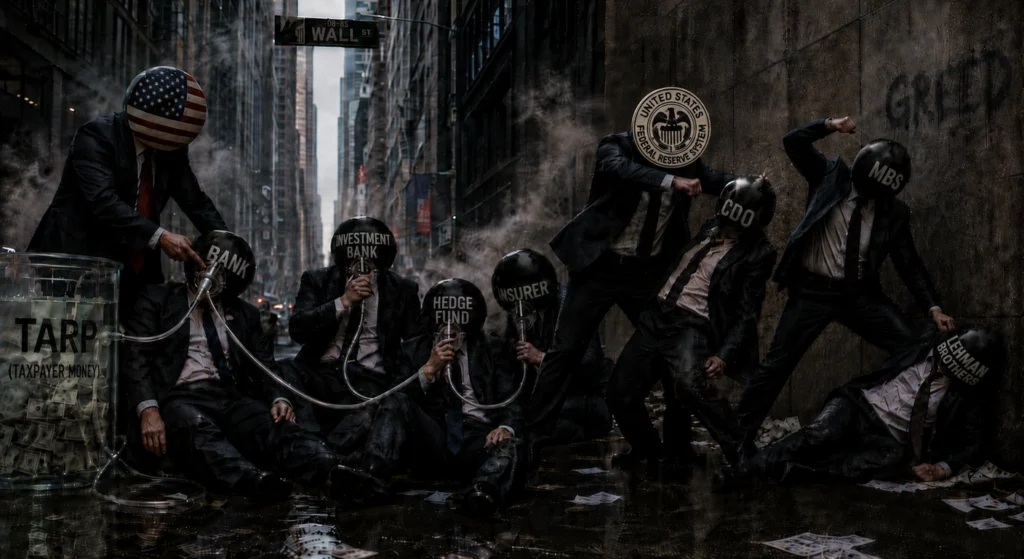
So the U.S. government pulled out a bailout program called 📌TARP.
The initially approved amount was a staggering 📌700 billion dollars.
The number is so huge that it does not feel real. At that time, one of the most famous supercars in the world, the Bugatti Veyron, was about 1.7 million dollars, and with this money, you could buy about 410,000 Veyrons.
(TARP was an emergency bailout program the U.S. government pulled out to save banks during the financial crisis. Originally, the plan was to buy toxic assets like MBS and CDO held by banks, but in reality, it proceeded in a way where capital was injected directly into banks so they would not collapse.)
Simply put, as the financial market reached the point right before cardiac arrest, the U.S. government gave emergency blood transfusions to banks.
That means the government judged, “If we just leave this alone, the whole financial system could collapse.” It was like inserting blood packs to keep a patient alive first because the patient was bleeding too much.
Of course, from the public’s point of view, they had no choice but to be angry.
“Seriously, when they were making money, they had bonus parties for themselves.”
“And now that they are about to collapse, they want to be saved with tax money?”
“We lose our houses and jobs, but they get saved?”
That is right. It was a situation that really made people curse.
📌 But from the government’s point of view, there were not many choices. If big banks collapsed all at once, the damage would not be suffered only by people on Wall Street, but ordinary people would suffer together as well.
2️⃣ The second sword was interest rate cuts.
The Federal Reserve lowered the benchmark interest rate from around 5.25% all the way down to 0~0.25%. It was almost zero interest rate.
Simply put, they tried to make money circulate in the market again by lowering the cost of borrowing as much as possible.
But there was a problem. If interest rates are lowered, will people immediately borrow money? No.
📌 If someone says in front of a burning house, “We will rent this house cheaply!” would anyone immediately go in and live there? No.
When people are scared, even if interest rates are lowered, money does not move well. Banks are scared, so they do not lend. Companies are scared, so they do not invest. Individuals are scared, so they reduce consumption.
It is a situation where even if you say to a very sick patient, “We will make the hospital bill cheap. So please, let’s do surgery!” the patient says, “I don’t trust the doctor, and I don’t trust the words that the hospital bill will be made cheap either!”
So the third sword comes out.
3️⃣ It is the method of directly pushing money into the market.
When the patient is about to die, where is the time to argue about whether to trust or not? First, they force the surgery.
The Federal Reserve supplies money to the market by buying assets like Treasury bonds or MBS. To say this in a difficult way, it is called quantitative easing, or QE.
But there is no need to think of it in a difficult way. It is just that the patient called the economy could not breathe, so they almost forcefully put on a ventilator, inserted IV fluids, and even performed cardiac massage.
The government saved financial institutions, the Federal Reserve opened the clogged money lines, and the market barely began to keep breathing.
📌 Of course, these measures were not all perfect. Some people criticized that “they only saved financial companies,” and some said, “If they had not saved them then, a bigger Great Depression would have come.”
📌 Both are somewhat true.
Morally, it makes you extremely angry. But systemically, they could not just let it collapse either.
Because if those financial institutions collapsed, the companies, insurance companies, pension funds, banks, households, and jobs connected inside them could collapse together too.
This is the scary part of a financial crisis.
One problematic financial company going bankrupt does not end the story. If that problematic guy is connected to too many places, too many people get dragged out together with it.
So the swords pulled out by the U.S. government were these.
🏦 For collapsing financial institutions, they inserted bailout funds, 🏦 Into the blocked money lines, they inserted interest rate cuts, 🏦 Into the frozen market, they pushed in money through quantitative easing, 🏦 And on top of collapsed trust, they added government guarantees and intervention.
To put it in one sentence, it was this.
“First, let’s keep the dying financial system alive.”
But here, important questions remain.
Why did this happen? Who should be held responsible? And can the market really be trusted to be safe on its own?
The subprime mortgage crisis showed us one thing clearly.
📍Money moves on trust.
And the moment that trust collapses, no matter how complex and beautifully packaged a financial product may be, it can ultimately become a bomb box whose contents nobody truly understands.